In honor of the 50th anniversary of the 1967 International and Universal Exposition or Expo 67 in Quebec, Canada Post, and renowned architect Moshe Safdie have revealed a celebratory stamp depicting Safdie’s iconic Habitat 67, which was unveiled as the Canadian Pavilion for the world fair.
The housing complex, commissioned by the Canadian government and the city of Montreal, now holds the status as a National Heritage Site and its commemorative stamp is the first of ten to be issued by Canada Post in celebration of the country’s 150th anniversary. Each stamp highlights a key moment in Canada’s history since its centennial in 1967.
https://www.archdaily.com/870317/canada-post-commemorates-canadas-150th-anniversary-with-habitat-67-stampOsman Bari
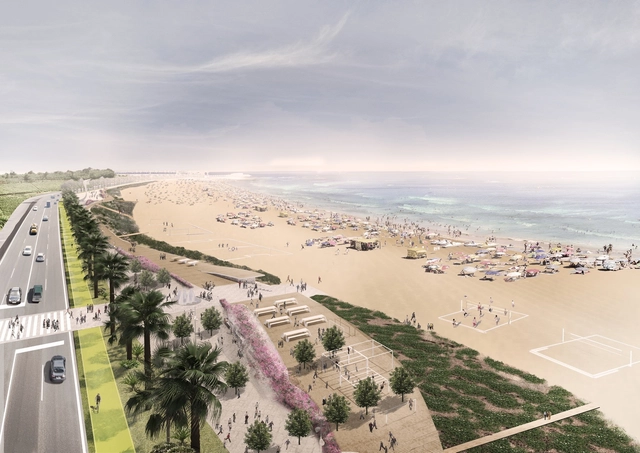
Quebec-based practice Lemay has won the global bid to redesign Morocco’sCasablanca Coast, which will include the new seaside promenade of the Hassan II Mosque and the Ain Diab corniche.
With modernity, sustainability, and innovation in mind, the urban and landscape design will promote mobility along the length of the corniche (a coastal, cliffside road) and aims to reinforce the appeal of the coast.
Launched in December, the project will feature an urban park and corniche along the El Hank embankment that will include rest areas, walkways, outdoor sports, and more. As an extension of the Hassan II Mosque, the promenade is expected to become a new Moroccan landmark.
Established in June 2010, 100Landschaftsarchitektur shared with us the current status of Jardin de la Connaissance which is still up and thriving. With the knowledge truly disappearing into the forest, the book structures have decayed in the natural setting, but have also provided various micro-environments for a range of local creatures. Interacting with the forest, seedlings and insects have activated the walls, carpets and benches while mushrooms – those cultivated and those who have come by themselves – have made the garden their home. More images and architects’ description after the break.
The ContemPLAY pavilion project is a student-led initiative by the Directed Research Studio (DRS) of the McGill School of Architecture, in coordination with the Facility for Architectural Research in Media and Mediation (FARMM), investigating new methods of practice. The project presented a unique opportunity for the students to learn through hands-on experience in an academic context. The pavilion occupies an 8.8m x 6.7m footprint with a total height of 3.7m in front of the Macdonald-Harrington building on the McGill University campus in Montreal, Quebec. More images and architects’ description after the break.
“A Thousand Traps to Escape” is a temporary installation designed by 13 students from Laval University under Olivier Bourgeois in the Magdalen Islands in Quebec, Canada. The project builds on the collaboration of themes of architecture, art, landscape and installation in the creation of space based on simple materials, the landscape and “the basic rules of construction”. The “local material” chosen for this construction is the ubiquitous lobster trap made of wood and fishnet. Its formal simplicity allowed for an basic stacking technique that produced relatively complex visual results of transparencies and opacities.
Read on for more information on the development of this project.
The purpose of this architecture contest is to “equip the city of Trois-Rivières with an open-air amphitheater capable of seating 10,000.” Trois-Rivières is a small Canadian city (population 130,407) once known as the pulp and paper industry capital of the world. Located halfway between Montreal and Quebec City, Trois-Rivières was looking to build its own venue for hosting high-volume summer festivals and internationally renowned bands, and housing its symphony orchestra during the summer. “In the early 2000s, the city of Trois-Rivières began work on a re-qualification project. The site in question (a former paper mill) is situated along the St. Lawrence River, adjacent to the harbourfront park, the city centre, the St. Lawrence River and St. Quentin Island (for outdoor activities). Such a location calls for an extraordinary construction,” explains Philippe Drolet, architect, in an excerpt from the contest catalogue. For the first phase of the contest, Sid Lee Architecture and Régis Côté et Associés banked on the project’s historical roots and awed the jury with a vision that reflects the site’s industrial past. Their competition entry was awarded as a finalist.
https://www.archdaily.com/153311/competition-finalist-for-the-tripode-amphitheatre-de-tois-rivieres-sid-lee-architecture-and-regis-cote-et-associesChristopher Henry
The Canadian Centre for Architecture (CCA) is hosting an exhibition of Palladio’s drawings, giving new insight into the use of drawings as a tool to record, develop and disseminate his ideas. Curated by Guido Beltramini, in collaboration with Charles Hind, Palladio at Work will be on view in the museum’s Octogonal Gallery from March 3 to May 22, 2011.
More on the exihibition and on Andrea Palladio after the break.
The International Garden Festival at Les Jardins de Métis/Reford Gardens presents temporary gardens at the cutting edge of garden design, landscape, architecture, design and environmental art. This year’s theme for design was “Secret Gardens.” First launched in 2000, the International Garden Festival is host to innovative ideas and has presented over 80 gardens by more than 200 designers from fifteen countries and has attracted more than 800,000 visitors. This showcase of a wide range of projects has featured budding designers from a range of different fields. Out of a total 194 proposals submitted by over 500 architects, landscape architects, designers and artists from three countries, the jury selected the following three designs.
After the break, images from 2011′s three selections of “Secret Gardens” from The International Garden Festival.
Canadian design team Open Form has shared with us their recent competition entry for the new Trois-Rivières Amphitheatre. Additional images and a description from the architects after the break.
This competition, open to practitioners, faculty, students and intern architects, provides an opportunity to reflect upon a universal problematic: how to build the city of tomorrow in the complex urban fabric of the past.
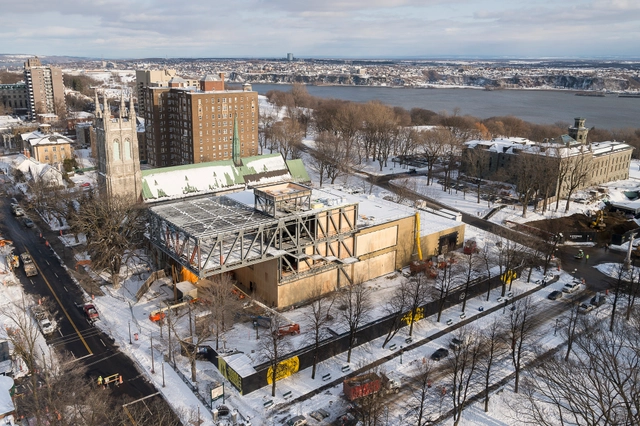
wHY architecture shared with us their proposal for the Musée National des Beaux-Arts du Quebec (MNBAQ) international competition, which was won by OMA. See more images and architect’s description after the break.


.jpg?1493587707&format=webp&width=640&height=580)