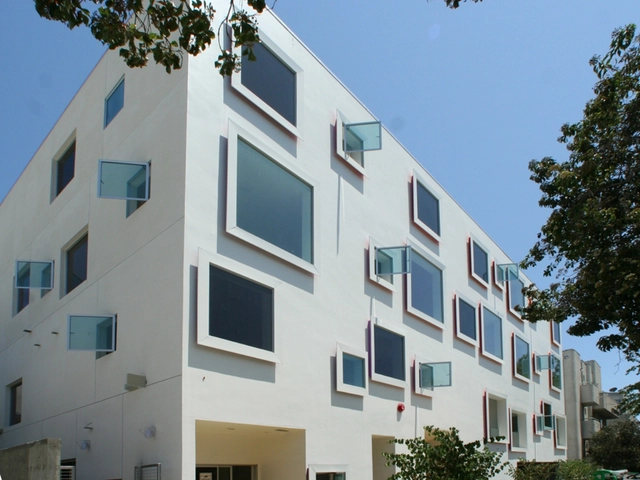
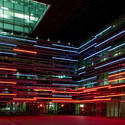
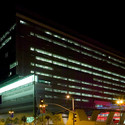
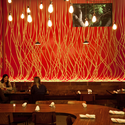
Catherine Opie has photographed people and architecture in and around Los Angeles, California for over twenty-five years. She has successfully captured the interplay between architecture and urban life by photographing the subcultures and castaways of Los Angeles, from the undersides of freeways to lonely Beverly Hills mansions. These works create a portrait of Los Angeles as a singular built environment.
Ever wonder why the skyline of Los Angeles is peppered with flat top skyscrapers? Or for that matter, why does such a global cosmopolitan city have so relatively few skyscrapers dotting its cityscape, the majority residing in downtown LA?
The answer lies in a section of the Los Angeles Municipal Code introduced in 1974 – Sec. 57.118.12 – “Emergency Helicopter Landing Facility.” The code stipulates that “Each building shall have a rooftop emergency helicopter landing facility in a location approved by the Chief.” The text also dictates that the helipads measure 50′x50′ in addition to a 25′ safety buffer. The resulting skyline thus far has been dominated by flat roof skyscrapers that would only make it through the planning process if in strict accordance with this code. However, a newly introduced proposal called the Hollywood Community Plan would allow skyscrapers to be constructed along the subway served “Hollywood Corridor.” In lieu of embarking on a plan that would surely result in more box type towers, an amendment has been introduced into the plan that would exempt skyscrapers within the corridor from having to conform to Sec. 57.118.12 helipad requirements. More After the break.
Craig Hartman, FAIA, the Design Partner in SOM’s San Francisco office, stated, “We want to be part of the dialogue in LA – a tremendously important cultural and talent hub and a diverse design-centric city. With Michael, Paul and Jose leading our studio,” Hartman continued, “we will be part of the conversation and be able to collaborate meaningfully with colleagues and institutions that we’ve known for years.
Los Angeles-based CO Architects and New York City-based FXFOWLE have announced the formation of a joint venture firm known as CO/FXFOWLE. Formed in late December, the two firms will embark in a “genuine collaboration” with all their project services. While each firm will still maintain their individual identity and operations, they will pursue new projects together, allowing them to expand their geographic and expertise reach.
The Recording Academy® has announced that architect Frank Gehry will create the official artwork for the 54th Annual GRAMMY Awards. Traditional GRAMMY iconography will merge with Gehry’s distinct architectural style, creating the official artwork for the world’s premier music event, gracing the cover of the GRAMMY Awards program book, telecast tickets and promotional poster.
Woodbury School of Architecture and the Woodbury Hollywood Gallery (WUHO) are pleased to announce the opening of The Infrastructural Monument by Anna Neimark. The opening is on Thursday, December 8, 7 p.m. and runs until December 18th. Anna Neimark’s installation, constructed out of fifty-four three-foot cubes of EPS white foam, re-imagines a piece of infrastructure as a monument of a complex history when a canal from Moscow to St. Petersburg (formerly Leningrad) was built during the second Five Year Plan, under Josef Stalin. More information on the installation after the break.
As the SCI-Arc students finalize their thesis projects each September, they join the faculty in an annual ritual of constructing a temporary pavilion that will host that year’s graduation ceremony. Produced by Them Too Productions, this video documents the development and fabrication of Netscape, the 2011 SCI-Arc Graduation Pavilion by Oyler Wu Collaborative and the students of SCI-Arc. View ArchDaily’s detailed coverage of the 2011 pavilion HERE.
SCI-Arc‘s introduction of the Robot House (spring 2011) – a multifunctional robotics lab that enables the exploration of advanced fabrication techniques, manipulation of high tech materials, and numerous methods for simulation – has brought about a new and intriguing component to the school. Designed by faculty members Peter Testa and Devyn Weiser, its primary goal is the advancement of next generation platforms for the experimentation and future speculation of architecture.
On view until Marcg 25th and the Los Angeles County Museum of Art (LACMA), the installation for California Design, 1930–1965: “Living in a Modern Way” Exhibition is created by the Hodgetts + Fung Design and Architecture Studio, which is also responsible for a number of Los Angeles landmarks, including the renovated Hollywood Bowl and Egyptian Theater. The design for the exhibition is inspired by California’s unique style, with lithe, sensuous lines carried throughout the installation, including the display cases and a helical construction that soars through the center of the space. Hodgetts + Fung also collaborated with curators Wendy Kaplan and Bobbye Tigerman to bring the re-creation of the Eames living room to life. More information on the design and exhibition after the break.
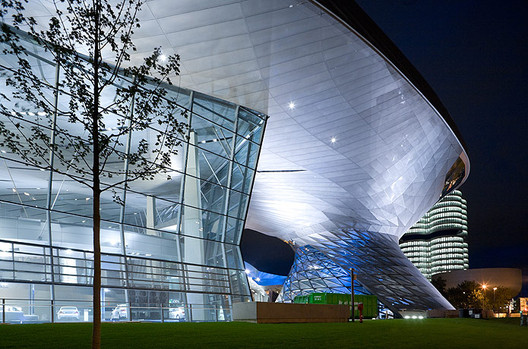
This summer Coop Himmelb(l)au recieved two awards for two different buildings in Europe. The Dedalo Minosse International Prize was awarded for the firm’s design of BMW Welt in Munich on June 24, 2011 in Vicenza, Italy. According to the president of the Italian Association ALA, Bruno Gabbiani, who presented the award, the prize boosts “the quality of architecture looking at final result, analysing and focusing on project and constructive plan process and giving special attention to people who determine the success of the work: the architect and the client”. The awarded works, with Coop Himmelb(l)au among them, will be presented at the CISA, Cento Studi di Architecttura Palladio in Vicenza until September 18, 2011. Read more on this project here: BMW Welt / Coop Himmelb(l)au
Architect Jennifer Bonner‘s installation at the Woodbury Hollywood Gallery.
“Bonner filled the gallery with water in order to provoke a discussion of crisis, flood, drought, and watershed geographies. This piece is not only timely, but critical. The question of flooded environments is not an abstraction but a reality. In an arid climate such as Los Angeles, the wet, hot, and humid installation heightens awareness of other environments and potential future scenarios.” -Mimi Zieger


1995.jpg?1362071594&format=webp&width=640&height=580)