Award-winning architects Renzo Piano and Zoltan Pali will design the Academy Museum of Motion Pictures, the Academy of Motion Picture Arts and Science announced today. “Renzo’s track record of creating iconic cultural landmarks combined with Zoltan’s success in transforming historically-significant buildings is a perfect marriage for a museum that celebrates the history and the future of the movies,” said Dawn Hudson, Academy CEO.
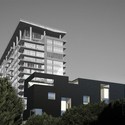
Designed by Abramson Teiger Architects, the TCH boutique hotel, located in downtown Los Angeles, weaves the nature of the temporal society with the evolving art world. Reflecting the architects’ philosophy of a visually dynamic architecture which evokes a sense of peace, sanctuary, and productivity, the art gallery becomes a backdrop to viewed experiences while the hotel becomes a backdrop to the guests. They are both fortresses of collections: a collection of art and a collection of people. All spaces within the 47 rooms activate as a gallery resulting in a building that activates as an art piece. More images and architects’ description after the break.
Christopher Hawthorne’s article “Atlantic on the Move“, published in the Los Angeles Times, covers the transitions taking place along LA’s boulevards and one in particular: the 5600 block of Atlantic Avenue. Hawthorne reveals the changes taking place that are “reversing decades of neglect” among LA’s roadways. Among those that have promoted a cultural association with Los Angeles: traffic, congestion and miles of roadways. The article covers the small steps that take place over time via minor interventions that combine to change the face of the boulevards to more pedestrian and bike-friendly spaces for alternative modes of transportation.
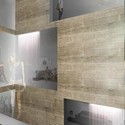
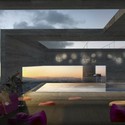
XTEN Architecture is planning a new, 65,000-square-foot hotel in downtown Los Angeles, California. The monolithic concrete structure will be carved by a system of slots and slices that bring light, air and views deep into the building. Equipped with a performance-based lobby, two subterranean bars, restaurant and a rooftop terrace featuring an infinity edge pool, this mid-rise hotel will surely attract some attention.
Constructed from non-architectural artifacts, Yevrus 1, Negative Impression is a disposable architecture of literal references that calls into question the contemporary architectural vogue for digital complexity and abstraction. The cast impressions of 1973 Volkswagen Beetles and speedboats unite to form a strong structural whole that serves as a lookout tower in the SCI-Arc Gallery. More information after the break.
Metro officials have released six conceptual visions that suggest how the historic Los Angeles Union Station could be transformed by 2050. Preliminary “Vision Boards” were released in a public forum at Union Station last week, and although they are not part of the formal evaluation process, they have ignited an immense amount of public interest in the competition.
In an article posted on The Source, Los Angeles Mayor and Metro Board Chair Antonio Villaraigosa described that this competition is “about preparing for the future.” As plans for the California High-Speed Rail System evolve, it is imperative that Union Station is redeveloped to meet the standards of a 21st century transportation hub.
Continue after the break to view each Vision Board provided by the six well-known practices shortlisted for the competition.
The American Institute of Architects, Los Angeles Chapter recently announced their 10th Annual 2×8 Student Exhibition which features a display of 16 of the major architectural school programs in California. Although based in LA, they have extended their invitations to the region and are opening the door to more schools. Taking place at the A+D Museum, each of the participating academic programs selects two projects that exemplify its core vision. The students’ design work will be judged by a noteworthy panel of architects and designers. The panel will then announce the winners at the exhibition opening and convene in a forum to discuss the award-winning projects. The exhibition will be on view from June 5 till June 30. For more information, please visit here. More images of past exhibitions can be viewed after the break.
Founder and principal of Studio Gang Architects, Jeanne Gang, FAIA, LEED AP, will be delivering a lecture at LACMA on May 8th at 7:30pm. Reveal, the first volume on Studio Gang’s projects and processes, was released in 2011 from Princeton Architectural Press. Recent projects include a proposal reimagining the suburb of Cicero, Illinois, as a part of MoMA’sexhibition Foreclosed: Rehousing the American Dream; Reverse Effect, a book intended to explore and spark a radically greener future for the Chicago River and Great Lakes; Aqua Tower, an Emporis Skyscraper of the Year; and Nature Boardwalk at Lincoln Park Zoo, an educational project demonstrating how nature and city can coexist. The event is presented by LACMA and organized by Francesca Garcia-Marques, with an introduction by Christopher Hawthorne, Los Angeles Times architecture critic. For more details and information on the event, please visit here.
Breaking Ground: Chinese American Architects in Los Angeles (1945-1980) at the Chinese American Museum (CAM) is an exhibition that focuses on four Chinese American architects that have transformed parts of Los Angeles with iconic buildings and distinct design styles. The work will be on display until June 3rd 2012 and feature architects such as Eugene Choy,Gilbert Leong, Helen Liu Fong andGin Wong.
Breaking Ground is part of Pacific Standard Time, a collaboration created by Getty in which sixty cultural institutions will tell the story of the birth of LA art scene over the course of six months beginning October 2011. Breaking Ground at CAM LA tells the story of the skyline and the changing built environment through the perspective the four prominent Chinese American Architects.
I once saw a video of David Hockney discussing a Chinese landscape scroll. A provocative little art-geek film (or so it seemed at the time) entitled, ”A Day on the Grand Canal With the Emperor of China (or Surface Is Illusion but So Is Depth)”.
On the surface, the film’s subject is a 17th-century Chinese scroll painting. The depths, however, are personal and make the film more about the artist himself, a target for his projection. So, if surface is illusion but so is depth, then what we have is an interesting problem.
In this sense, he wasn’t trying to lay down any absolute truth or theory about Chinese landscape painting, or even himself. But merely his understanding at that moment in time—a moving target exploring another moving target. What would Hockney say about the scroll now?
When I first noticed Mobyblogging about architecture, this film, long-buried in my art history memory, was one of the first reference points that came to mind. Like Hockney with the scroll, Moby is seemingly unrolling Los Angeles and winding his way through it’s weird little buildings and spatial complexities. The hills–and one does not always associate hills with Los Angeles–are uncannily similar to the hills in the Chinese scroll.
Below is the Hollywood Reservoir. I’m two hours early for this interview because, as usual, I’ve guessed the traffic incorrectly. You see, I’m not really from LA. Have never considered myself from here. I’ve lived here most of my life, but I’m not from LA. Being from or not from here usually goes unspoken. It’s typically assumed you are not from here…and never will be.
I park at a trailhead. I’m in dress shoes. Black dress shoes. Black shirt. But I have a scarf and a jacket to fight the wind. Rain coming. The sky is a neapolitan of grays, blues, and whites, laid out horizontally with little light filaments touching down. The canyon is absolutely quiet even though I can see some bulldozers crawling up and down the side of a precarious ravine in the distance. They remind me of the sandcrawlers from Dune. This seems just the type of place where famous LA murders would have taken place. The fact that Ray Manzarek lives in this neighborhood somehow makes it seem more eerie.
I imagine Moby watching from his tower window, watching me turn away from the house and down the dusty trail in my black dress shoes. I’m obviously early. He might think I’m intentionally heading out for a hike. Like I worked this into my itinerary because I knew there was a trail here. Actually, I had no idea. I have never been in this neighborhood and rarely come to this side of town. Just like I have no idea what I’m going to ask him. At this point, I’ve lost almost all interest in architecture, buildings, and the reasons he’s blogging about these things.
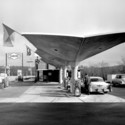
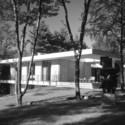
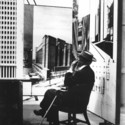
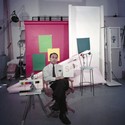
Pedro E. Guerrero: Photographs of Modern Life at Woodbury University Hollywood Gallery (WUHO) is on view through April 25. The show is the first extensive exhibition on the West Coast of Guerrero’s career as an architectural photographer. Curated by Anthony Fontenot and Emily Bills, JSI director, Pedro E. Guerrero: Photographs of Modern Life will highlight the diversity of Guerrero’s subjects taken over seven decades. During that time, he captured the architecture of Marcel Breuer, Philip Johnson, Edward Durell Stone and Eero Saarinen. His wide ranging work included portraits of architects as well as commercial work for House & Garden, Vogue, the New York Times Magazine and Architectural Record. He is perhaps best known for his close relationship with Frank Lloyd Wright. The exhibition will feature Guerrero’s illuminating portraits of Wright, including twelve photographs of the architect’s hands demonstrating the difference between organic and conventional architecture at the Plaza Hotel in New York. Continue reading for more.
Exhibited from April 6 – Mary 13, the Southern California Institute of Architecture (SCI-Arc) is pleased to present “Towards Comfo-Veg,” a large scale, site-specific installation designed for the SCI-Arc Gallery by architect and artist Peter Cook and partner Gavin Robotham of London-based CRAB Studio. Building on CRAB’s internationally recognized experimental work, Towards Comfo-Veg introduces an almost completely light-tight, multimedia experiential space welcoming visitors through a single point of entry and leading towards hints of an invented and dreamlike world. More information after the break.
DO|SU Studio Architecture shared with us their architectural research installation, titled ‘Bloom,’ displayed at the Materials and Application Gallery in Los Angeles. The project acts as a sun tracking instrument indexing time and temperature, with a shape alluding to a woman’s Victorian-era under garment, ‘Bloom’ to stitch together material experimentation, structural innovation, and computational form and pattern making into an environmentally responsive form. The project is especially designed for peak performance on spring equinox, March 20, 2012. More images and architects’ description after the break.