Last spring, the Los Angeles Bureau of Street Services tested a new, creative approach to combat the rising temperatures in the city center. The pilot project covered one neighborhood street in each of the LA's 15 council districts with CoolSeal, a more reflective asphalt-based coating developed by California-based company GuardTop. After seeing a difference of 11-13 degrees Fahrenheit on the coated streets, Los Angeles and other cities plan on implementing more reflective roofs and pavements to reduce the side effects of "heat islands."
More on the CoolSeal coating and the fight against heat island effect after the break.
Studio Gang has released details of their first project in Los Angeles, a 26-story mixed-usetower designed in collaboration with local development partner Creative Space and European lifestyle brand MOB. The scheme places an emphasis on community spaces, with a curved form creating dynamic public plazas at street level, forming a link between Chinatown, the recently-opened LA State Historic Park, Union Station, and El Pueblo.
Located on 643 North Spring Street, the scheme will provide 300 apartments ranging from studios to three-bedroom units, and a 149-room hotel operated by MOB. Emphasizing the importance of community space and interaction, the residents and hotel guests will share a rooftop amenity deck with landscaped terraces on the second and third floor, as well as a gym, coworking spaces, rentable offices, pop-up stores, a rooftop swimming pool and bar, and space for outdoor cooking.
https://www.archdaily.com/893019/studio-gangs-curved-mixed-use-tower-to-be-their-first-project-in-los-angelesNiall Patrick Walsh
OMA New York has released initial details of its design for the Audrey Irmas Pavilion, a new addition to the Wilshire Boulevard Temple in Los Angeles, California. The OMA scheme, currently seeking planning approval, seeks to “forge new connections within the existing campus and create a new urban presence to engage Los Angeles.”
Having won a competition for the pavilion's design in 2015, the OMA scheme represents the firm’s first commission from a religious institution and their first cultural building in California. Designed in collaboration with Gruen Associates, the Audrey Irmas Pavilion will form the newest addition to the Wilshire Boulevard Temple, the oldest Jewish congregation in Los Angeles. The scheme will serve as a multi-purpose gathering space in what Rabbi Steve Leder regards as “the city’s most diverse neighborhood.”
https://www.archdaily.com/891674/oma-reveals-pavilion-design-for-wilshire-boulevard-temple-in-los-angelesNiall Patrick Walsh
Recently, long-standing architecture critic for the LA Times Christopher Hawthorne announced that he was stepping down to take up the position of chief design officer for the City of Los Angeles in Mayor Eric Garcetti’s administration. According to Hawthorne, the role will involve raising “the quality of public architecture and urban design across the city — and the level of civic conversation about those subjects.” This dramatic shift from the question: what is the role of the critic and architecture criticism in shaping civic architecture?
The Lucas Museum of Narrative Art, designed by MAD Architects, has broken ground in Los Angeles, California. Founded by “Star Wars” creator George Lucas, and standing at the gateway to the city’s Exposition Park, the scheme is envisioned as a “futuristic spaceship” landing on the site’s natural environment.
The building’s interior has been designed as an expansive, open cave, flooded with natural light from skylights above. At least $400 million worth of art will be housed in the museum, including over 10,000 paintings, illustrations and movie memorabilia. The first floor and roof will be designated as public areas for visitors to exercise, relax, and “directly experience nature in the urban environment."
https://www.archdaily.com/890808/new-images-of-mads-spaceship-lucas-museum-released-as-construction-breaks-ground-in-los-angelesNiall Patrick Walsh
In recent years, many ambitious proposals have been brought forward to revitalize and improve the area around the Los Angeles River. The Lower Los Angeles River Revitalization Plan (LLARP), proposed by Perkins + Will Architects in conjunction with various community groups and public institutions, aims to connect residents to the river and improve the environment surrounding it.
There ought to be a word for this kind of film—halfway between a sequel and a reboot—but there isn't, so we just have to call it Blade Runner 2049. The film is perhaps more subtle in the way it refers to Ridley Scott's 1982 dystopian cult classic than some recent sci-fi restorations—Star Wars: The Force Awakens, I'm looking at you—but it isn't above a bit of blatant parallelism. For example, it's easy to see reflections of Blade Runner characters in 2049: private dick Rick Deckard is now the stoic, world-weary K; femme fatale Rachael is Joi, a hologram companion who straddles the line between mortal and machine; wacky Roy Batty is the single-minded, murderous Luv; not to mention a bevy of replicants passing for humans and cops with hidden agendas. In fact, one of the few prominent characters not recast is the city of Los Angeles, whose architecture is strikingly absent compared to the first film. The resulting movie feels curiously devoid of a civic soul, which is perhaps the point.
https://www.archdaily.com/890005/grit-vs-globalism-what-the-city-of-blade-runner-2049-reveals-about-recent-trends-in-urban-developmentColin Newton
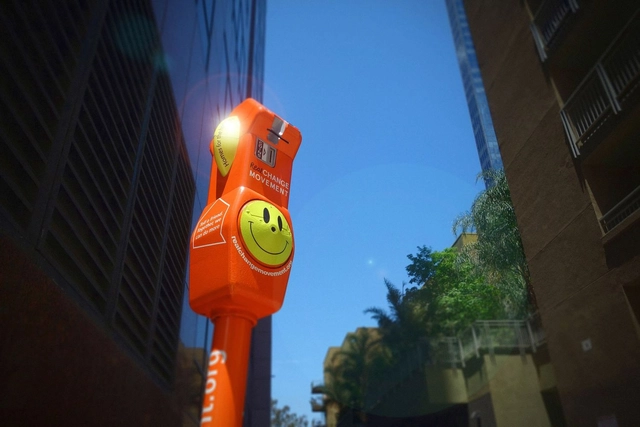
The Downtown Los Angeles meters will resemble those installed in Pasadena. Image via Curbed LA
Homelessness is a pressing issue faced by many cities across the globe. But, could the logistics of parking potentially assist in alleviating this epidemic by supporting community-based initiatives?
In Los Angeles County, where an estimated 58,000 people are homeless, city and county officials recently released six meters designed in collaboration between community advocacy organization the Flintridge Centre and the office of City Council member Jose Huizar to collect charitable contributions as opposed to parking fairs.
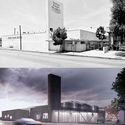
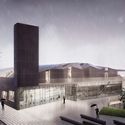
An adaptive reuse project by P-A-T-T-E-R-N-S is currently under construction in North Hollywood, California. The project transforms an existing warehouse into a dynamic medical campus with Urgent Care, Elderly Daycare, Surgical Centre, Physical Therapy, Imaging Centre, Medical offices, café and a small shop.
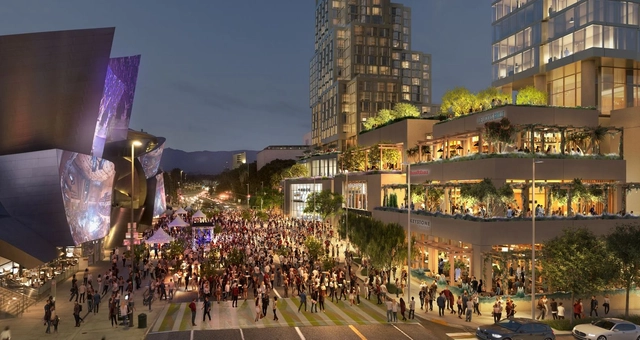
New renderings have been revealed of Gehry Partners’ Grand Avenue Project as construction is finally set to begin this fall. Located across from Gehry’s Walt Disney Concert Hall in downtown Los Angeles, the development now known as The Grand will offer up retail, entertainment and residences within two blocky, terracing towers.
Originally conceived as as 22-story hotel and residential tower, the project has now been shortened to 12 stories (130 feet) to meet restrictions imposed by the city’s Downtown Community Plan, which calls for “aggressively slow growth” and a “lower scale downtown” of mainly 4-5 story tall buildings.
“As soon as we were able to get into the space we wrote the entire menu in basically a day. It was being in the building itself that had this creative charge about it,” said chef Jordan Kahn.
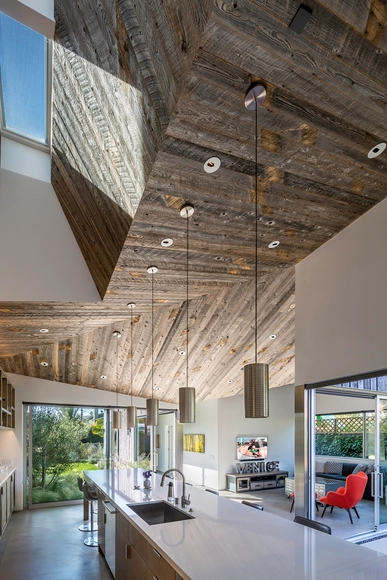
At LA chef Jordan Kahn’s new fine dining adventure, it was the architecture which informed the menu.
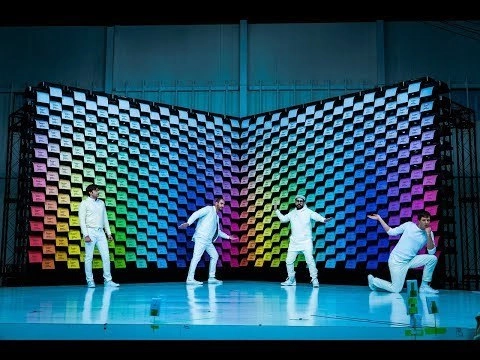
The old adage "writing about music is like dancing about architecture" (it's stupid etc.), loses some of its impact when architecture becomes the backdrop for both music, and dancing. Ever since video killed the radio star, famous houses, quirky spaces, and history's great buildings have provided beautiful, unique and dramatic settings for music videos of all types. So which of 2017s music videos have capitalized on the wonderful world of architecture?



_Studio_Gang.jpg?1524241991)



.jpg?1521561138&format=webp&width=640&height=580)