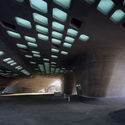
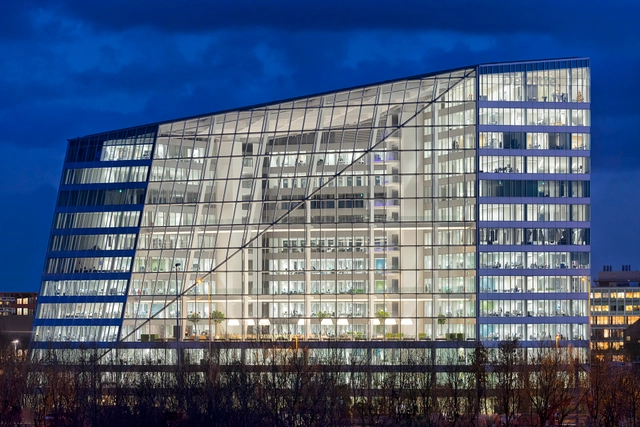
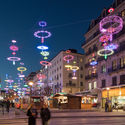
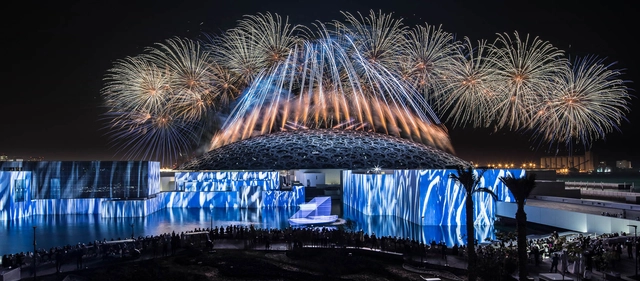
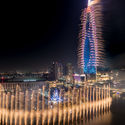
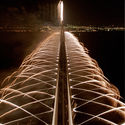
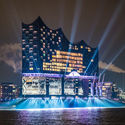
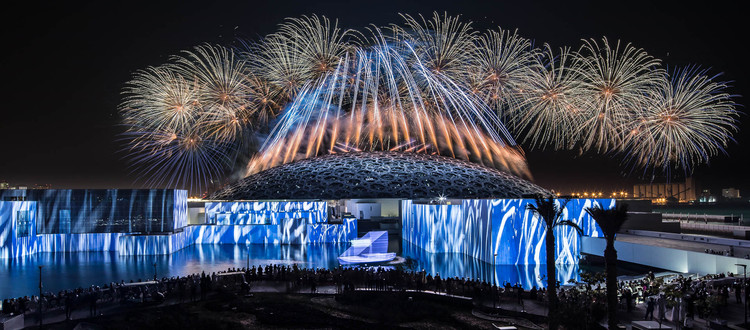
After finishing a building, the client is faced with an important question: How do they celebrate the new architecture? This moment offers an essential opportunity to inform the public about the existence and mission of the building. Therefore, the designs of opening ceremonies are often loaded with symbolic imagery to construct a new identity. Fireworks and light shows are an especially common part of the powerful repertoire used to magnify the aura of architecture. This luminous storytelling can underline the client’s uniqueness and superiority on both a local level and an international stage. I spoke with two leading designers to get their insights on how opening ceremonies have changed in recent years: Christophe Berthonneau, Creative Director at Groupe F, who introduced the Louvre Abu Dhabi, and Fred Thompson, Creative Director at Laservision Mega Media, who worked on the opening of the Marina Bay Sands in Singapore.
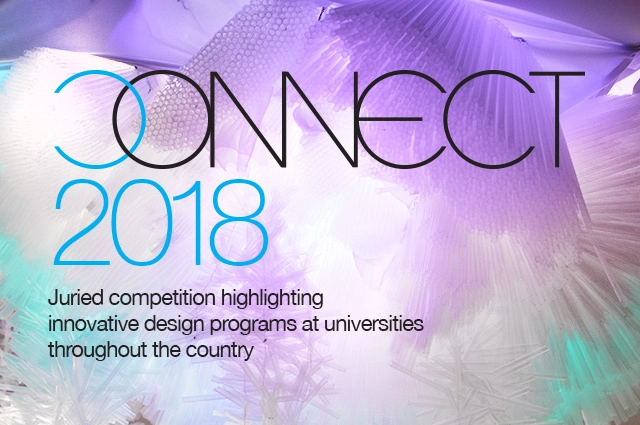
Now in its sixth year, CONNECT highlights innovative design programs at universities throughout the country. Students, under the supervision of university faculty, have the opportunity to design environments that incorporate seating and lighting installations, with the intention of offering an intimate area on the show floor where attendees can sit, relax and "connect." Exhibits will be located throughout the show floor, providing SOFA CHICAGO's international audience an opportunity to experience the innovation and creativity of future designers.
Update:The deadlines for this opportunity have been extended
Call For tutors : Extended till January 28
Call for participants : Ends on February 28
MEDS workshop “Meetings of Design Students” is an international workshop that takes part each summer in a different country, focusing on various issues, themes, topics and settings that will help any designer expand their expertise. It is a chance to get in touch with diverse approaches to design, different building techniques, traditions and skills. MEDS workshop is both practical and educational because it focuses not only on creative theoretical designs, but actually compels participants to execute these designs during the 2-week span of the workshop. You can apply to MEDS as a tutor or as a participant.
“This place is really Instagrammable, you’ll see what I mean.”
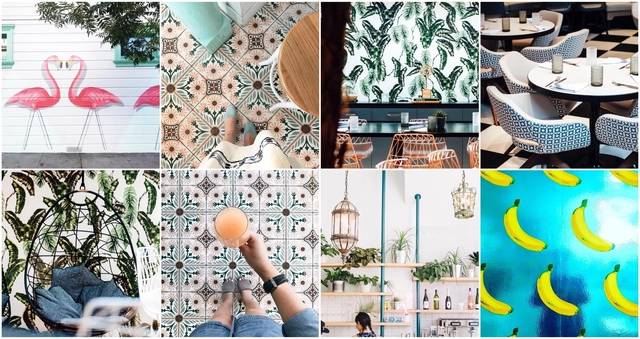
Walking into a tiled entryway and catching a glimpse of the cocoon-shaped swings, I saw fast. Planta, located on a busy street in Downtown Toronto is an Instagram magnet. And they know it. Opened last fall, Planta’s geotagged posts grow daily, with several of the restaurants’ key spaces photographed again and again. With jungle-inspired wallpaper, graphic tiling and a solid 14k following on their own account, the plant-based eatery means business.
Instagram’s parent-company Facebook announced it made $9.1 billion in earnings this quarter on advertising, retaining its longstanding rule over digital advertising alongside with Google’s Alphabet ($26 billion). With Instagram absorbing competitor Snapchat’s story features and increasing the number of sponsored posts it shows this year (yeah, we noticed), it’s not a stretch to say that the social media giant sits at the center of food and beverage trends. But what happens to interior spaces when restaurants set out to be “Instagrammable”?
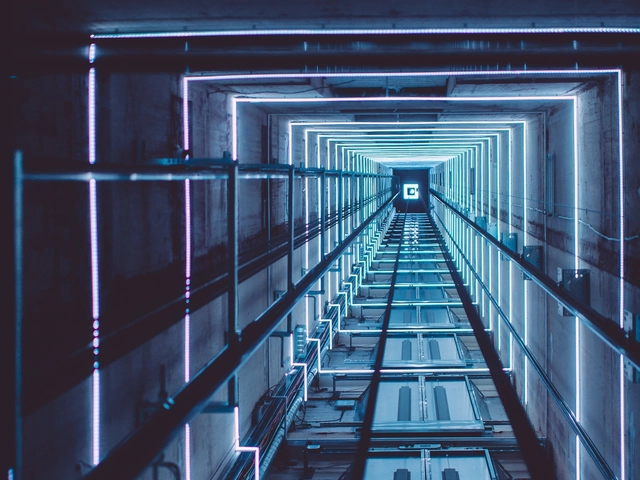
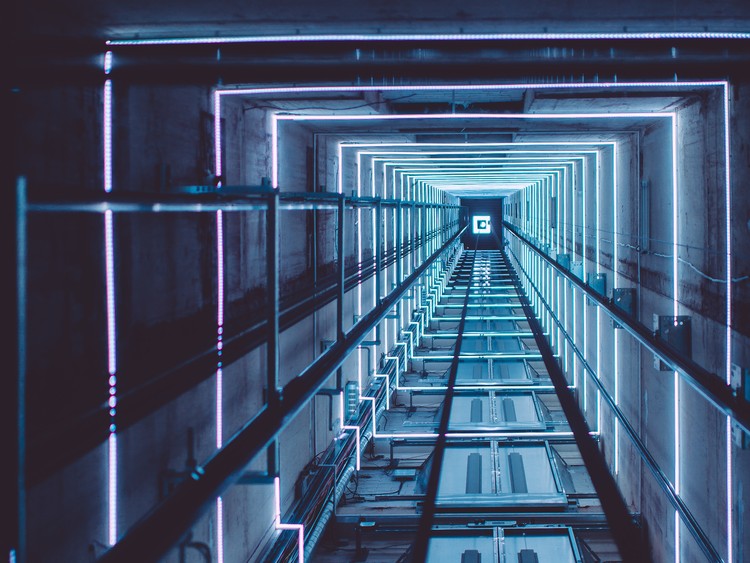
Elevator rides may offer an uplifting experience in the literal sense, but while they are indispensable in modern buildings, users face extremely compact spaces which are designed to fit effectively into buildings. Awkward looks at the floor or past other people’s faces reveal our discomfort with the elevator’s crowded anonymity. Couldn’t a more spatial experience lead to a more exciting journey? Flat screens and projections are starting to be included in elevators, but these are just the beginning of a revolution in the atmospheres created during vertical transportation.
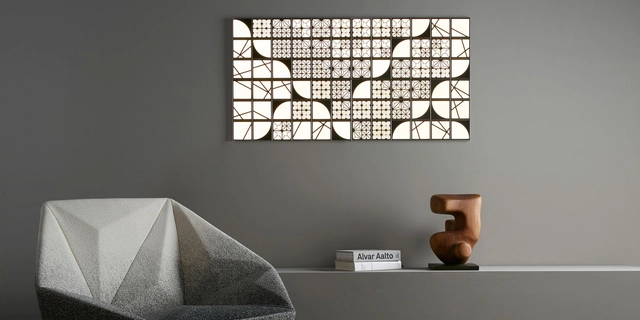
Japanese designer Michiru Tanaka has released a new product partnering with lighting manufacturer Kaneka to create a stainless steel tile that doubles as both an OLED and a mirror. A graduate of Tokyo’s Musashino Art University, Tanaka pursued a career in architectural lighting and her projects range from commercial installations, lighting at museums as well as product design. Coined “Kumiko,” the tiles come from a fusion of inspirations, ranging from traditional Japanese architecture and woodworking techniques to Manhattan’s gridded cityscape.
While many cities strive for a spectacular appearance at night, Zurich follows a modest strategy for nocturnal illumination. Numerous urban centers in the world are oversaturated in the evening, with individual buildings calling for attention through bright light, harsh contrasts, or colorful façade lighting. In contrast, the Zurich master plan for lighting has focused on an overall image of sensitive light levels with white light. But this nocturnal presence far from simple design, and is instead based on detailed urban studies and precise, customized projections, where technology is discretely hidden in favor of authentic culture.
The Built Environment Trust along with the Mayor of London are seeking ideas that could help cities work better at night. Built environment professionals and the public are encouraged to show policy makers and developers how we might think differently by entering Night Time is the Right Time ideas competition. £2,000 in prize money is on offer and the best entries will be featured in a major exhibition. Amy Lamé, the new Night Czar for London is amongst the high profile judging panel.
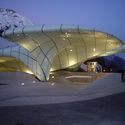
Zaha Hadid's projects are remarkable not only for her innovative way of handling tangible materials but also for her imagination regarding the medium of light. Her theories of fragmentation and fluidity are now well-known design techniques which enabled her form-finding. However, her advances in using light to render her architecture have often been neglected—even though they became an essential element in revealing and interpreting her architecture. The three-decade transition from minimal light lines at her early Vitra Fire Station to the world's tallest atrium at the Leeza SOHO skyscraper, which collects an abundance of daylight, shows the remarkable development of Zaha Hadid’s luminous legacy.
Techniques, technologies, construction, controls: master it all during the free LIGHT IN ACTION, a fast-paced, one-day lighting education, hosted by Edison Price Lighting.
Flagship stores excite both fashion shoppers and designers alike due to their role as visionary laboratories for the latest trends and stimulating retail experiences. Architects have developed various ways to dress haute couture stores, from distinctive icons in the day to seductive night-time images. The images accompanying this article, created by the Portuguese architect and illustrator André Chiote, help to explore the graphic potential of famous brands like Dior, Prada and Tod's. The illustrations clearly reveal the various techniques of playing with diaphanous layers, intimate views inside or the contrast of light and shadow.
How will our buildings change when your mobile device can receive huge amounts of data flowing from the luminaires above you? Not only has LED brought us a highly efficient light source, but a promising instrument for visible light communication (VLC) as well. Therefore light will not only be a medium to support vision, but it will also be an essential means of data communication. With the low energy consumption of LED one can even set up luminaires without mains cables for the power and just install Ethernet cables. Welcome to the world of digital lighting.
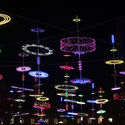
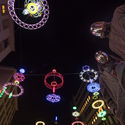
Brut Deluxe has created a colorful light installation, made up of 48 chandelier-like pieces that dangle above Geneva’s Rue du Mont Blanc for the 2015 Geneva LUX light festival. The project continues on Brut Deluxe’s extensive work with ephemeral installations and their study of spatial qualities through light.
Miguel de Guzmán and Rocío Romero, from the photography studio Imagen Subliminal, have shared with us their images and video of the installation.
Community Lighting for the Urban Environment has set itself the goal of encouraging and challenging young designers such as students (University & Colleges) and emerging Professionals (<5 years in their profession) to develop innovative lighting concepts for interior and exterior spaces, stimulate challenging ideas and recognize the individuals creating those ideas.
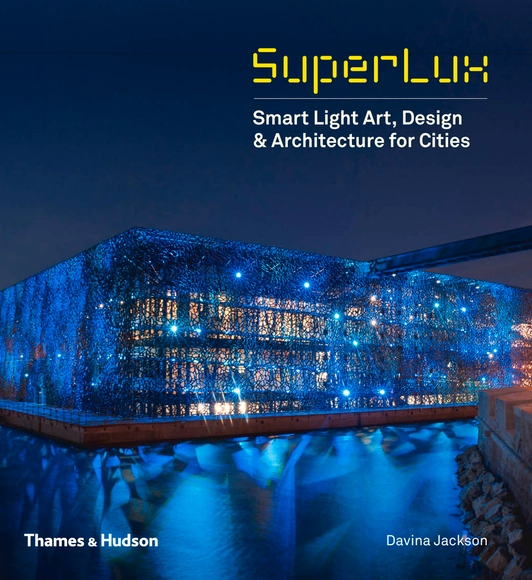
There is arguably no aspect of architecture in which science is more influential than in the realm of lighting; from the florescent bulbs of the late 19th century to the LEDs that only became truly viable in the past decade or two, advances in the science of creating light have been quickly followed by architectural experimentation. In this excerpt from her book "Superlux: Smart Light Art, Design & Architecture for Cities," Davina Jackson recounts the tremendous advances made by lighting in the 20th and early 21st centuries, and looks forward to the next frontier - that of "smart lighting."
Today’s smartest lighting innovation has no need for machine-generated power. Simply fill a clear plastic bottle with water (plus bleach) and silicon-seal it through a hole in the roof of any rudimentary shelter. Behold: daylight floods the dark interior.
PET bottles for conducting radiance, solar-powered LED lamps for night visibility and satellite-enabled smartphones to exchange instant knowledge globally: these are the 21st century’s keys to illuminating billions of people living rough in settlements. Like the original campsites of London, New York, São Paulo and Sydney, some of these slums will become great global centers.
https://www.archdaily.com/776340/how-the-science-of-light-will-affect-the-future-of-architectureDavina Jackson
With its hundreds of churches, Rome has a developed a rich history of domes. Inspired by this heritage, Jakob Straub has photographed the city's most remarkable rotundas from the ancient Pantheon up to Pier Luigi Nervi's modern sports arena. His neutral photo perspective, taken looking upwards from the center of the rotunda, opens a new view for the underlying concepts where the architecture yearns for the firmament. For Elías Torres, these “zenithal-lit” spaces constitute an important method for daylight architecture, where the exterior is also transformed into a fascinating distant reality.
Torres has analysed numerous strategies for lighting architecture effectively with daylight from above. In his book “Zenithal Light,” illustrated with an abundance of striking photos, he came to the conclusion that “Amongst the representations of the sky in the interior of architecture, the one that depicts the sun shining from above with a circular form has been the favoured one for many cultures.”
Light Pavilion, World Nightscapes. Photo Credit: Lighting Planners Associates
In celebration of the International Year of Light in 2015 and the practice's 25th anniversary, Lighting Planners Associates (LPA) is putting up an ambitious show Nightscape 2050, with the exhibition travelling from Berlin to Singapore and then to Hong Kong and Tokyo, from August 2015 to June 2016. Nightscape 2050 is intended to be one of its kind for Light and Lighting, in which visions of the future of lighting and the way LPA imagines to use this light are shared with the visitors.






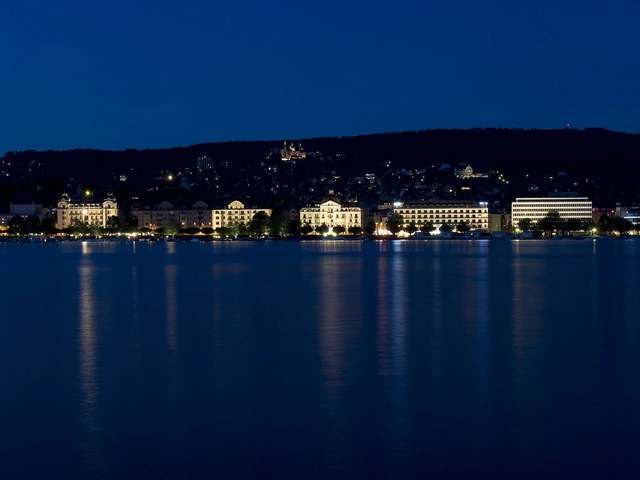
.jpg?1496789104 "Waterfront illumination of Stadthausquai with Fraumünster Church and St. Peter Church, Zürich. Photo by Benno Tobler. Image © Stadt Zürich")


.jpg?1490812427 "MAXXI Museum, 2009, Rome / Italy. Image © Iwan Baan")