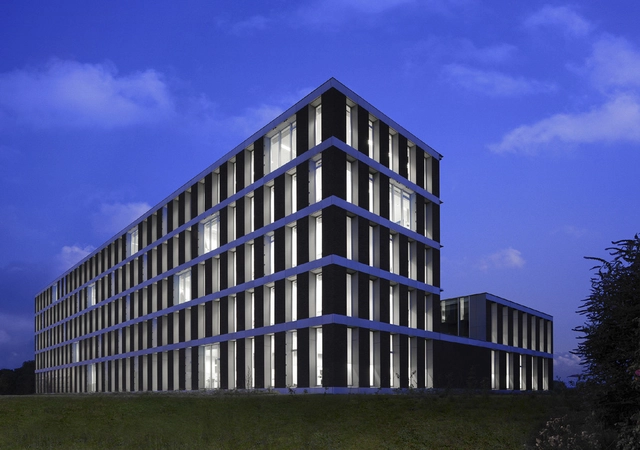
Not so long ago, we featured Cyril-Emmanuel Issanchou’sMaison Eco-rce, a timber residence, and today, we share his EC*-Cocoon, a low energy house. Designed for the competition BETWIN, the low energy houses are prefabricated modules that are installed upon a set of walls and plinths made from locally gathered stones.
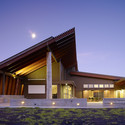
Architects: Flansburgh Architects Location: Kamuela, Hawaii Partner in Charge: David A. Croteau, AIA Client: Hawaii Preparatory Academy Contractor: Quality Builders Inc. Project Management: Pa’ahana Enterprises LLC Civil Engineering: Belt Collins Hawaii Ltd. Structural Engineering: Walter Vorfeld & Associates Mechanical Engineering: Hakalau Engineering LLC Electrical Engineering: Wallace T. Oki, PE Inc. Surveyor: Pattison Land Surveying Inc. Sustainability Consultants: Buro Happold Consulting Engineers Completion Date: 2010 Construction Area: 6,100 square feet Construction Value: $650/sf Photographs: Matthew Millman
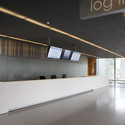
Conceived as a high school science building dedicated to the study of alternative energy, the new Energy Lab at Hawaii Preparatory Academy functions as a zero-net-energy, fully sustainable building. The project’s fundamental goal is that of educating the next generation of students in the understanding of environmentally conscious, sustainable living systems. The project targets LEED Platinum and Living Building Challenge certification. Recently completed in January 2010, the Energy Lab today strives as a living laboratory, furthering its educational goals as a functioning example of sustainability.
This interview first appeared in Assembly, a new magazine that ArchDaily contributor Sarah Wesseler is working on.
According to the United Nations, 1 billion people currently live in slums. Over the next two decades, this figure is expected to double. In recent years, slums (also known, more neutrally, as informal settlements) have increasingly attracted positive attention from academics and design professionals impressed by their efficient deployment of scarce resources, community-based orientation, and entrepreneurial vitality. Architect Rem Koolhaas celebrated the slums of Nigeria in his 2008 book Lagos: How It Works, while Teddy Cruz has become well known for his work with shantytowns on the U.S.-Mexico border. And no less a traditionalist than design enthusiast Prince Charles, prone to harsh public attacks on contemporary architecture, has championed Dharavi, the Mumbai neighborhood portrayed in Slumdog Millionaire, praising its “underlying, intuitive ‘grammar of design’” in a 2009 speech.
Detractors claim that these and similar attempts to examine the slums through the lens of design romanticize poverty and ignore the sociopolitical forces responsible for their creation and proliferation. However, although some projects involving informal design are doubtless better conceived than others, in general there can be no real question that it is appropriate for architects and planners to concern themselves with a phenomenon fundamentally tied to design-related issues such as land use, infrastructure, and materials. And given the failure of so many top-down modernist schemes for housing the poor over the past century, it is logical for the profession to turn its attention to a housing model which continues to mushroom organically around the globe: the shantytown.
An ongoing research project being carried out by 26’10 South Architects, a young South African firm headed by husband-and-wife architects Thorsten Deckler and Anne Graupner, provides an interesting look into this type of work. The couple have spent the past year and a half studying the spatial dynamics of Diepsloot, a Johannesburg suburb created in 1994 to house the poor. Today, approximately three-quarters of Diepsloot’s residents live in slums.
Check out this master plan video by Vandkunsten for designing sustainable cities. Not only do we love the animation techniques, by the layers of information are presented in a clear manner. Upon viewing the video, the zoning of public space, circulation routes, and green spaces are made evident while great glimpses of zoomed-in perspectives tie the ideas together. The video depicts three different master plan ideas: reusing a shipyard in Sweden, redefining a recreational space in Denmark in an attempt to better integrate the area with the surroundings, and the renewal of a suburban city center in Denmark. Enjoy!
Built on Taylors’ Island, Kieran Timberlake‘sLoblolly House is nestled into a grove of loblolly pines and responds in an “environmentally ethical” way to its surroundings. Lifted on skewed wooden pillars in order to rest lightly on the site, the residence seems to float amidst the trees and aims to put the focus on the natural environment, such as the sun, the trees and the Chesapeake Bay. The video shares some of the thought process, assembly and construction process as well as the finished project. We find the project extremely thoughtful and hope you enjoy the video!
A month and a half ago we presented you Roadmap 2050, a proposal to set in motion an invisible revolution in the energy sector which would stabilize the Earths climate.
We are always excited to see what the Solar Decathlon entries bring to the table. It is an extremely intense competition, rooted in the belief that highly efficient homes can be sustainable without sacrificing aesthetics or comfort. Throughout the months spent preparing their final houses, students from some of the best universities in the world strive to fuse technological innovation, sustainability and design into a functional entity.
The competition challenges students to think beyond the systems and strategies that are currently in use, thus, each proposal attempts to find innovative ways to approach the issues of renewable energy and energy efficiency. The University of Florida’s Project RE:FOCUS combines its Floridian vernacular language with a ‘back-to-basics’ approach to sustainable living. As such, the 800 sqf house rethinks traditional practices and “hopes to communicate the need to RE:FOCUS how, and in what, we live.”
More about the project and more images, including some great construction shots, after the break.
At an exhibit in Gothenburg, architects Fredrik Kjellgren + Joakim Kaminsky from Kjellgren Kaminsky Architecture have designed a sustainable city as a ”glimpse of a possible sustainable future” for Sweden. The project, entitled Super Sustainable City, takes the analytical findings of a previous green initiaive,”Gothenburg 2050″ and presents a new “architectonic vision.”
Yesterday, architect William McDonough and chemist Dr. Michael Braungart launched their Green Products Innovation Institute, Inc., an addition to their Cradle to Cradle Movement® (C2C). This new non-profit organization is focused on being a valuable resource for all consumers, and ultimately, will help people achieve a higher level of environmentally safe and healthy products. The driving force behind the movement is that through the innovation of “redesigning products and ingredients to become nutrients, and enabling old products to become the raw material for new goods and services” a cycle of reusing elements will eliminate waste.
The Emilio Ambasz Prize for Green Architecture were awarded in Israel. Among all the categories, there’s an International Prize for buildings outside Israel. You can check the International Prize winners after the break, and see all the winners right here.
For Forrest Fulton Architecture‘s competition proposal, the Alabama-based firm designed a 900,000 sqf biomorphic spatial surface that connects the adjacent city and the landscape. The architecture focuses on creating an urbanistic landscape that morphs the common urban element of Yerevan, the superblock, to the site, a truncated hill along the natural amphitheater of the Yerevan. This new model of development supports a “holistic, ultra-green lifestyle” with overlapping natural and urban phenomenon.
More images and more about the project after the break.
Earth Day today, just in time to annunce the top ten examples of sustainable architecture and green design by the AIA and its Committee on the Environment (COTE). Check them all after the break.
GLR Arquitectos‘ residence in Nuevo Leon, Mexico sits on higher topography than its neighboring houses. This “privileged situation” provides the home with greater height, and as a result, better vistas toward the National Park of Chipinque. The home is comprised of simple, pure geometric volumes that intend to evoke an image of lightness within a language of heavy and massive volumes.
AMO is a design and research studio inside OMA, a think tank operating on the boundaries of architecture: media, politics, sociology, sustainability, technology, fashion, curating, publishing and graphic design. Some of their works include the barcode flag for the EU and a study for Wired magazine.
And while OMA covers sustainable strategies on a building or master plan scale, AMO is approaching it on en European scale as one of the five consultants conducting technical, economic and policy analyses for Roadmap 2050, an initiative by the European Climate Foundation which looks to chart a policy roadmap for the next 5-10 years based on the European leaders’ commitment to an 80-95% reduction in CO2 emissions by 2050. You can download a brief of Roadmap 2050 in PDF.
The goal is to achieve a 2% energy efficiency saving per year in order to meet this goal, with power and vehicle transportation being the most important areas.
Through the complete integration and synchronization of the EU’s energy infrastructure, Europe can take maximum advantage of its geographical diversity. The report’s findings show that by 2050, the simultaneous presence of various renewable energy sources within the EU can create a complementary system of energy provision ensuring energy security for future generations.
AMO’s work focuses on the production of a graphic narrative which conceptualizes and visualizes the geographic, political, and cultural implications of the integrated, decarbonized European power sector.
On their study you can find an interesting approach to a diverse european energy grid, including energy trade and the use of new non-traditional sources.
The image of “Eneropa” appears as a new continent based on its energy production: Biomassburg, Geothermalia, Solaria, the Tidal States… are part of this new territory. Other branding concepts are introduced on the study, creating a tangible image of this ambitious plan, which reminds the powerful (yet simple) idea behind the barcode flag.
Based in Germany, Studio Aisslinger‘s new housing prototype is modular, sustainable and transportable. The low energy house, named ‘Fincube’, is comprised of thin horizontal “ledges” of locally grown wood that wrap the slightly bulging form. This second facade layer provides privacy for the inhabitants and fuses the man-made structure with its natural surroundings. The home provides 47 sqm of living space with a minimal CO2 footprint, and can also be easily dismantled and rebuilt on a different site. The supporting structure is made of local larch and the interior is a combination of larch and stone-pine. Organized in a helical structure, the entrance area blends into a generous open kitchen with an adjacent living space, and around the corner rests the bedroom.
Organized by MoMA and PS 1 Contemporary Art Center, the Rising Currents exhibit cannot be missed by architects, ecologists, or green enthusiasts…let alone any New Yorker. The exhibit is a cohesive showcase of five projects which tackle the lingering truth that within a few years, the waterfront of the New York harbor will drastically change. Dealing with large scale issues of climate change, the architects delve into a specific scale that we can recognize and relate to. The projects are not meant to be viewed as a master plan, but rather each individual zone serves as a test site for the team to experiment. The projects demonstrate the architects’ abilities to look passed the idea of climate change as a problem, and move on to see the opportunities it presents. Barry Bergdoll, the Philip Johnson Chief Curator of Architecture and Design at MoMA, explained, “Your mission is to come up with images that are so compelling they can’t be forgotten and so realistic that they can’t be dismissed.”