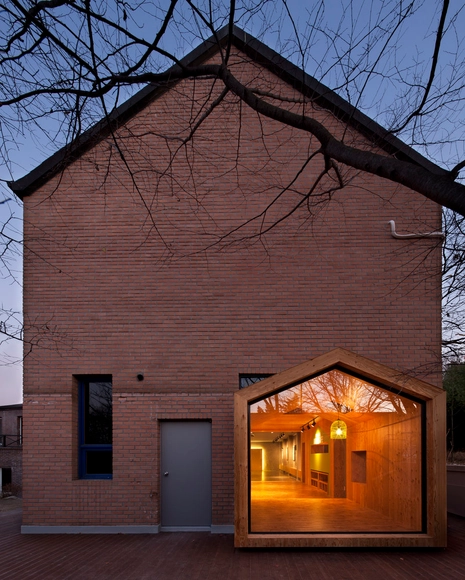
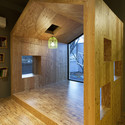
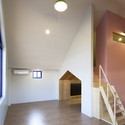
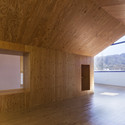
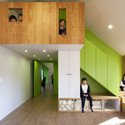
With the city of Be’er Sheba standing out in the areas of education, architecture and environment, this proposal for the day care center, which won an honorable mention, is an opportunity for innovative thinking in social services and integration with the community. Designed by Uri Cohen Architects their plan suggests selective exposure to city life for the users, while keeping their privacy and giving the city areas for activities. More images and architects’ description after the break.
The Odate Jukai Dome in the Akita Prefecture of Japan was completed by Toyo Ito in June 1997. The project is another example of the architect's impressive canon, making use of cutting edge technology and bringing architecture closer to people. Seemingly floating a few meters above the ground, the dome leaves space for the people to flow in comfortably, while the use of wood is itself a way of bringing nature into architecture while adopting the latest technological advancements.
The city of Yatsushiro is known in Japan as a home for exemplary architecture - the legacy at least in part of Artpolis, a plan by the government of the Kumamoto Prefecture to seek out a range of talented architects to design cultural buildings in the cities of the region. Though the Artpolis scheme has been running for the past 22 years, perhaps its most successful building was completed back in 1991, with the construction of Toyo Ito's Yatsushiro Municipal Museum.
Designed by UGO Architecture, their 'Culture Island' project is a model of a public library meant for small towns up to 15,000 inhabitants. The starting point for creating their concept was the research carried out in 2010 by the Office for Readership Research of the National Library and the Public Opinion Research Centre TNS OBOP. The research shows that 56% of Poles did not read a single book during the year. Thus, they started to think about how to make the citizens and the authorities of the municipality (the latter will finance the project) interested in the idea of model public libraries in spite of the poor readership. More images and architects' description after the break.
Setting new standards of sustainability through the design of the Passive House "Bruck", Peter Ruge Architekten’s project is a model apartment complex, consisting of 36 one room staff flats, 6 two room executive suites and 4 three-bedroom model apartments currently being built in southern China. With a 95% energy savings over that of a conventional Chinese residential building, the project is the first housing of its kind to be realized in the countries damp, warm, southern climate. Construction just began last month and is expected to be completed within the upcoming months. More images and architects’ description after the break.
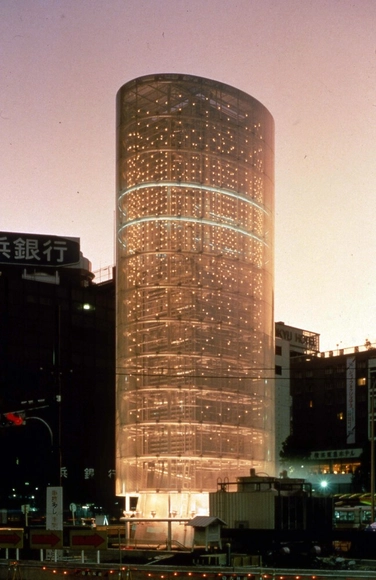
The Tower of Winds is a project largely indicative of Toyo Ito's approach to architecture, particularly his belief in the importance of technology and its vital role in the future of architecture. The project not only embraces technology and involves it in a dialogue with the city, but also establishes a direct symbolic relationship between nature and the installation.
gmp Architekten just won the first prize in the competition to design the 1.2 million square-meter Tianjin Exhibition Center. Now the third city where an exhibition center of international importance will be built after Shanghai and Guangzhou, their design concept proposes two almost identical construction phases. They both consist of a central entrance hall roofed over by filigree canopies, 8 exhibition halls on both sides and a main central thoroughfare that connects the entrance halls with the exhibition halls. More images and architects' description after the break.
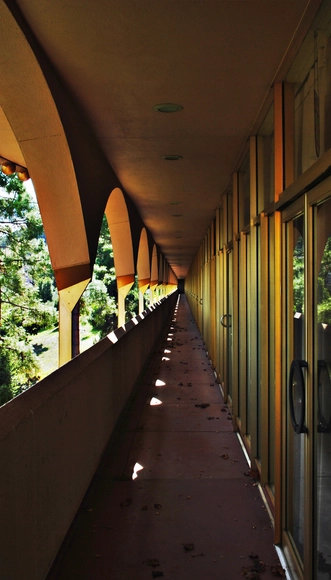
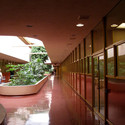
The Marin County Civic Center was Frank Lloyd Wright's last commission and largest public project, including several civic functions that would serve Marin County and San Francisco, which after the opening of the Golden Gate Bridge became closer than ever. Wright was selected for the project in 1957, winning a vote out of hope he would be able to best represent a democratic government open to the people through the Civic Center.
Slated to open in 2015, the Patricia and Phillip Frost Museum of Science is on its way to become the world's most innovative and sustainable science museum with the structural foundation now complete and the vertical construction currently in progress. Designed by Grimshaw Architects, the 250,000 square-foot complex will harness energy from water, sun, wind and even museum visitors to power exhibits and conserve resources. More images and architects' description after the break.
Atelier CMJNshared with us their proposal for the Great Fen Visiting Center which aims at reconnecting humans with nature. In terms of sustainable development, or in the broader term ecology, is the reconnection of humans with their environment by restoring links between the users and the fen. By maximizing one’s chances to connect to this raw and simply beautiful environment, the project intends to not just restore a piece of anthropogenic nature, but reconnect mankind with its deepest self, nature. More images and architects’ description after the break.
Coop Himmelb(l)au has come up with an incredibly unique design for the new Grand Theatre and International Culture & Art Center for Changsha, China. The site is located on the northeastern side of the newly created Changsha Meixi Lake in the Daheexi District, with the design engaging both land and water with a flowing and undulating white form of enormous scale. The architects hope to create a new cultural center that interacts with the existing natural landscape, not only visually, but scientifically by running on alternative energy sources and efficient passive energy systems to reduce environmental impact.
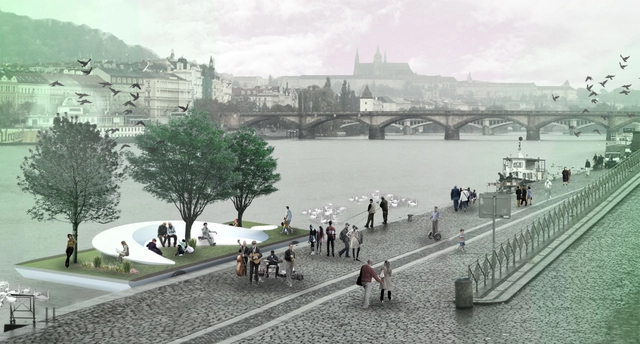
Courtesy of Juras Lasovsky, Zuzana Masna, and Koen Hezemans
Designed by the collaboration of Juras Lasovsky, Zuzana Masna, and Koen Hezemans, their project "Prague Activators" suggests the idea of pontoons floating on the river. The pontoons "activate" the Vltava riverbank as well as various parts of the city of Prague. The proposal was originally awarded at the Skanska Bridging Prague Competition and was later elaborated into the current project Prague Activators. The project aims to motivate people not only to pursue activities on the riverside, but also to inspire them to care for the public space and alter it. More images and architects’ description after the break.