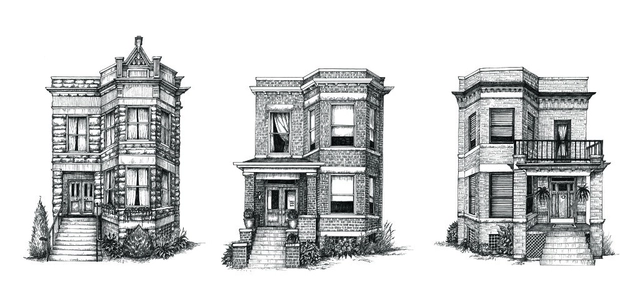
For the past two years, artist Phil Thompson of Cape Horn Illustration has been creating pen and ink drawings of Chicago's homes and residential buildings.
Inspired by the patterns and themes of the streets and neighborhoods and a love for art and architecture, Thompson began drawing two-flat styled homes, which are "long and narrow to fit on standard city lots, able to accommodate two-generation immigrant families, and have distinctive large bay windows, elements of Arts and Crafts style, exteriors heavy on masonry, and terracotta, but wood-framed interiors with built-ins," Thompson told us. "I love them."
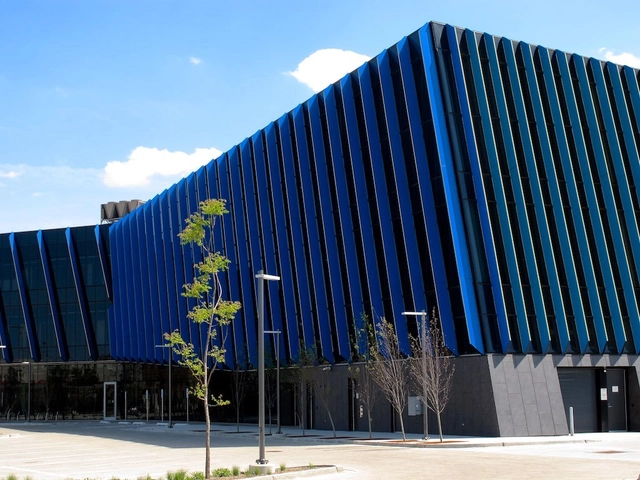
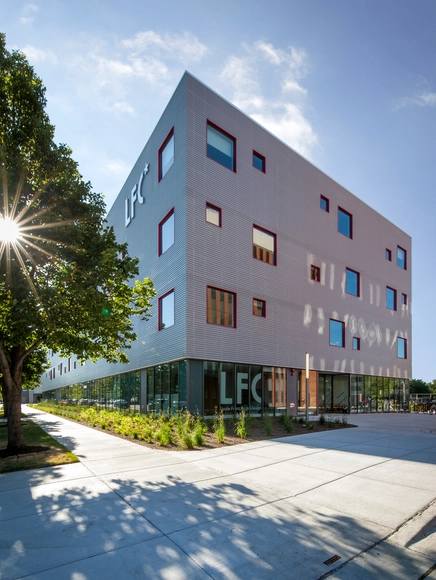
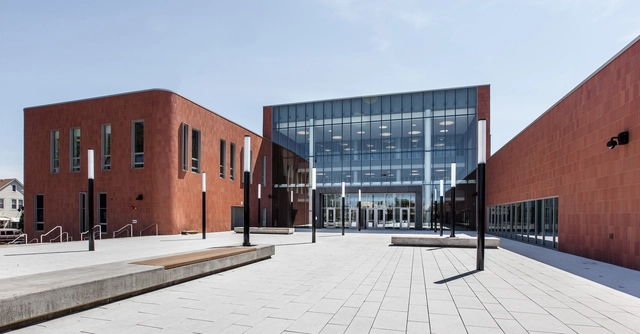
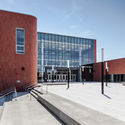
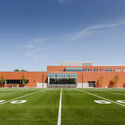
How much editing is acceptable in architectural photographs? And what if those edited photographs are the basis of judging a design competition? Chicago Tribune architecture critic Blair Kaminexplored these questions in a recent column after an altered photo led to a Design Excellence Award from the Chicago chapter of the AIA. The building in question, the El Centro campus of Northeastern Illinois University designed by Juan Moreno, was one of five recipients of the chapter's honor award, the highest level of recognition. But one of photos submitted to the award jury had been digitally altered by the photographer to remove a prominent row of large air handling units on the roof that marred one of the best views of the building.
Until recently, the only options for providing clients and the public with visualizations of what a prospective building would look like were almost exclusively hand drawn renderings, or scale models built by hand. Both of these practices are still in use today, but now there is a much wider range of options with 3D modeling software providing the bulk of renderings, the growing presence of 3D printing, and even video fly-throughs with special effects that rival the latest Hollywood action movie. This 16mm film created by architecture firm Skidmore, Owings & Merrill (SOM) in 1984, and digitized by illustrator Peter Little, reminded us of what the early days of digital 3D modeling looked like.
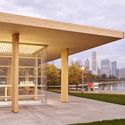
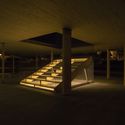
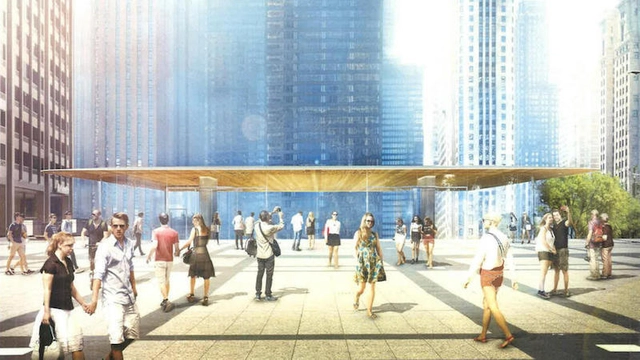
Apple's new Foster + Partners-designed flagship store in Chicago is said to have been inspired by Frank Lloyd Wright's Prairie Style Homes outside the city. Unveiled first by the Chicago Tribune, the store will feature a 14-foot entry pavilion that will usher visitors from Michigan Avenue down into the sales floor backdropped with views of the Chicago River. A "grand flight of stairs" will offer pedestrians an alternative route to the riverside walkway that flanks the bank.
In his book We Have Never Been Modern, philosopher Bruno Latour concludes that an inability to make humanity and nature inherently separate is one of Modernism’s most misguided tropes. Thus, contemporary designers that hope to riff on or have continuity with modernism must understand that architecture, even at its most aestheticized, is not hermetically sealed off from the outside world - and that therefore modernism is not a plateau of design, but another base camp on the road to further refinement.
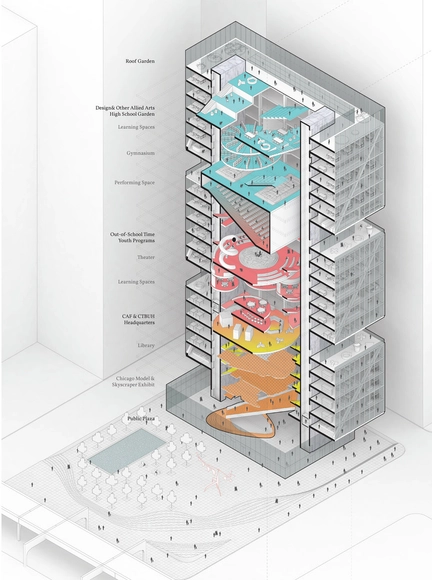
In Chicago, the city where Modernism reached both its metaphoric and physical peak, Atelier 2B, a team of Yewon Ji, Nicolas Lee, Ryan Otterson, recently shared the top-five prize of the Chicago Architecture Foundation's ChiDesign Competition (part of the Chicago Architecture Biennial) for their project Soft in the Middle: The Collaborative Core. Indebted to the legacy of Mies and the International Style, Atelier 2B proposed a Modernist-tower-redux that (externally at least) is composed of three stacked rectangular volumes bisected with terraces, set back from the street by a large public plaza. The project brief called for “a new center for architecture, design and education,” in a competition judged by critics including Stanley Tigerman, David Adjaye, Ned Cramer, Monica Ponce de Leon, and Billie Tsien.
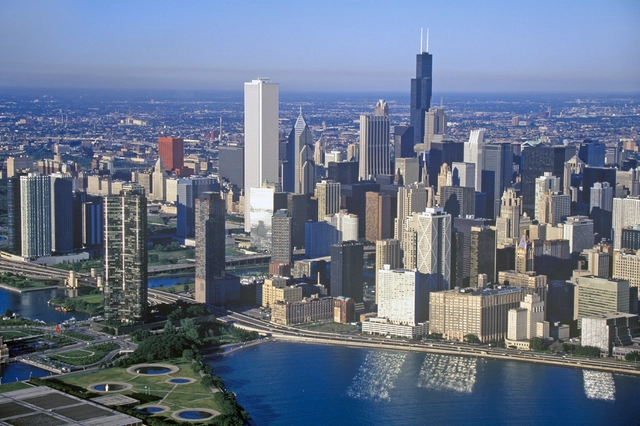
Chicago has long been known for distinctive architecture, and this year’s inaugural Chicago Architecture Biennial has only furthered that reputation. Although it is nearly impossible to narrow down the countless iconic structures, in celebration of the Biennial, we have compiled five Chicago buildings that highlight the many phases of the city’s architectural history.
Exterior Rendered View. Image Courtesy of mcdowellespinosa
The Chicago Architecture Foundation (CAF) has announced the three winners of its ChiDesign ideas competition to design the Chicago Centre for Architecture, Design and Education (CADE). The competition was in conjunction with the first ever Chicago Architecture Biennial, following the spirit of Robert McCormick’s international competition for the Chicago Tribune Tower in 1922 which opened discourse on the importance of design to the public. Similar to McCormick’s competition, but tackling a more modern, mixed-use typology, the Chicago CADE is envisioned as a facility to house the Chicago Architecture Foundation; the Council on Tall Buildings and Urban Habitat; a design and allied arts high school; and learning spaces for an extra-curricular youth program. Read about one of the winners, "Layered Intelligence" after the break, and see another winner, "Unveiled" here.
The Chicago City Council has voted to approve zoning for George Lucas' controversial, MAD-designed Lucas Museum of Narrative Art. Planned for a lakefront site on Chicago's Museum Campus park, near the Shedd Aquarium and Field Museum, the "mountainous" design faced opposition from environmentalists who claim the building is a "confiscation of public land." Despite this, and according to reports on NBC News, the Star Wars director won the Council's approval by promising more parking and tailgating space to Chicago Bears fans.
“The Lucas Museum of Narrative Art will be an incredible addition to Chicago’s Museum Campus,” said Mayor Emanuel in an official statement. “The Lucas Museum will join the 56 other museums in Chicago to provide new cultural and educational benefits for generations to come. And the new parkland will add more open greenspace that will be enjoyed by residents across the city.”
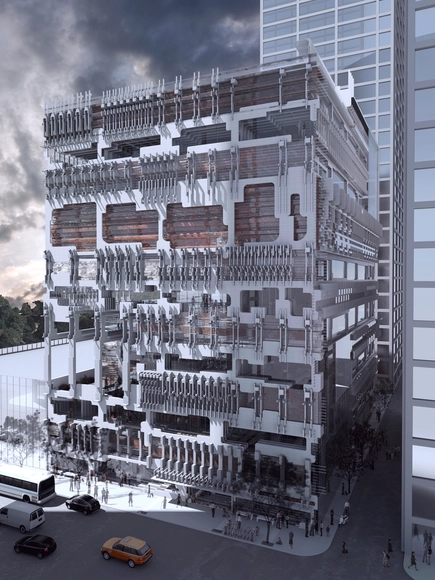
Building on these precedents, Hawthorne predicted that after years of baroque parametricism, in 2015 architects would use last year’s meditations on history as a practical foundation for new projects and proposals. An example of this can be found in the work of Michael Ryan Charters and Ranjit John Korah, a duo who recently shared the top-five prize for the CAF led ChiDesign Competition (part of the Chicago Architecture Biennial) for their project Unveiled. In a brief that called for “a new center for architecture, design and education,” and with lauded jurors including Stanley Tigerman, David Adjaye, Ned Cramer, Monica Ponce de Leon, and Billie Tsien, Charters and Korah proposed what could casually be summarized as a terracotta framework over a multi-story crystalline form of wooden vaults, but is actually something much more complex.
In a culture dominated by smartphones and Instagram, with estimates that over one trillion photographs will be taken this year alone, it might seem impossible for photographs to make and shape issues in the ways they once did. Despite this, images still steer debates with shocking resiliency and, with luck, become iconic in their own right. As architecture is synonymous with placemaking and cultural memory, it is only logical that images of the built environment can have lasting effects on the issues of architecture and urbanism. It's never been easier for photographs to gain exposure than they can today, and with social media and civilian journalism, debates have never started more quickly.
Last week, the Chicago Architecture Biennial opened to over 31,000 visitors and much fanfare, and for good reason - it is the largest architecture event on the continent since the 1893 World's Columbian Exposition, featuring over one hundred exhibitors from over thirty countries. With a theme as ambiguous as "The State of the Art of Architecture," and with the hope of making the biennial, according to directors Joseph Grima and Sarah Herda, "a space for debate, dialog and the production of new ideas," the event was sure to generate equally wide-ranging opinions. Read on to find out what the critics had to say about the Biennial.
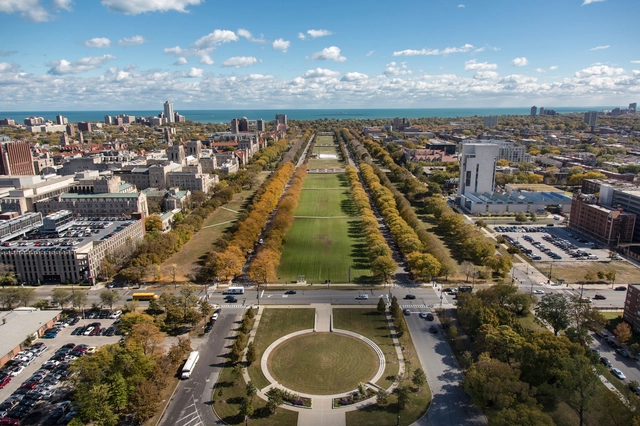
The University of Chicago has selected Diller Scofidio + Renfro (DS+R) to design their David M. Rubenstein Forum, a new facility to host conferences, workshops, lectures, ceremonies and other gatherings. Planned for the University’s Campus South, on the southeast corner of Woodlawn Avenue and 60th Street, the Forum will provide a mix of informal and formal meeting spaces that encourage an "open exchange of ideas."
“As our first building in Chicago, the Rubenstein Forum presents a unique challenge: to imagine a contemporary place of discourse for all of the university’s constituent departments and institutes as well as invited scholars and dignitaries from around the world,” said DS+R founding partner Elizabeth Diller.