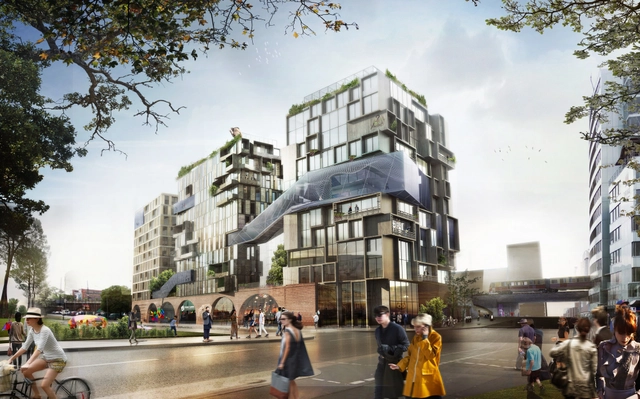
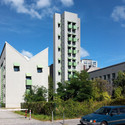
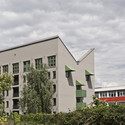
GRAFT and Kleihues+Kleihues has teamed up with Genossenschaft für urbane Kreativität (Cooperative for urban Creativity) to realize a complex of five towers centered around working and living in Berlin, Germany. Titled “Eckwerk,” the new complex is set to rise within the confines of an existing viaduct, whose shape and materiality served as the project’s main source of inspiration.
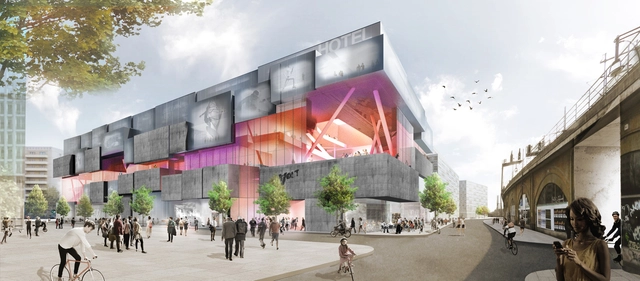
J. Mayer H. has won an invited competition to design “Volt Berlin,” a new “shopping and urban experience” center near Berlin’s Alexanderplatz. The winning scheme offers a variety of experiential offerings, including multi-brand shopping, an indoor skydiving and event space, and a 7,500 square meter hotel, all within a single cubed complex whose organization is based off an uneven grid.
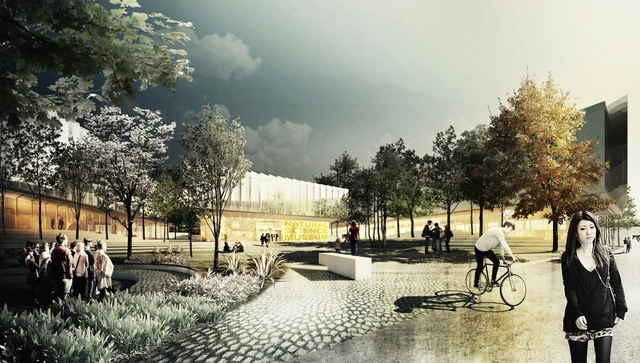
The winners of the international competition to design Berlin's new Natural Science Museum have been announced. The brief, which called for a large scale iconic building in the heart of the German capital, offered the opportunity for architects and students to design in a city founded in the 13th century.
Understanding that natural science museums are often simply seen as places for public spectacle, the organization behind the competition wanted to ensure that the "importance of the museum's specimen collections for documenting historical and present-day patterns of biological diversity cannot be overstated."
See the winning entry, along with the runners up, after the break.
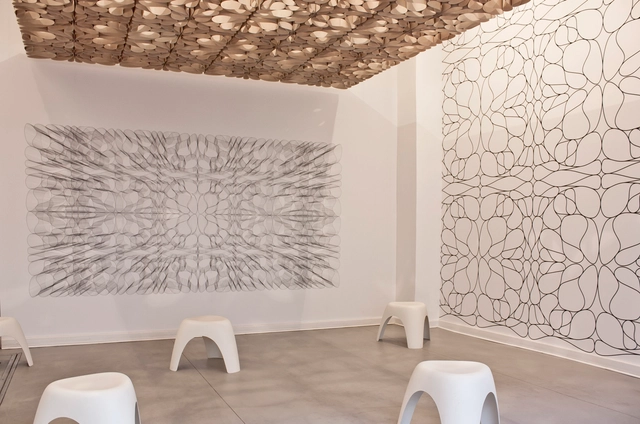
Only 5 more days on the exhibition 2D:3D, an installation by Barkow Leibinger at the BDA Berlin Gallery. Covering the wall surfaces of the small gallery space with “tapete” or wallpaper the façade of the storefront gallery frames what Leon Battista Alberti described as a fenestra aperta. In this configuration the space of the gallery is a projection/ extension of the streetscape in the bourgeois residential historical Mommsenstrasse neighborhood.
Playing with the concept directive 2D 3D, the wall paper on one side of the gallery is a two dimensional pattern: an organic looping structure which repeats and mirrors itself that is both ornamental and geometrically structural in its architectural implication. On axis with the street front façade at the back of the gallery is a wallpaper “portrait” of this system in black and white but now projected as a one-point perspective optically extending the perspective of the gallery itself.
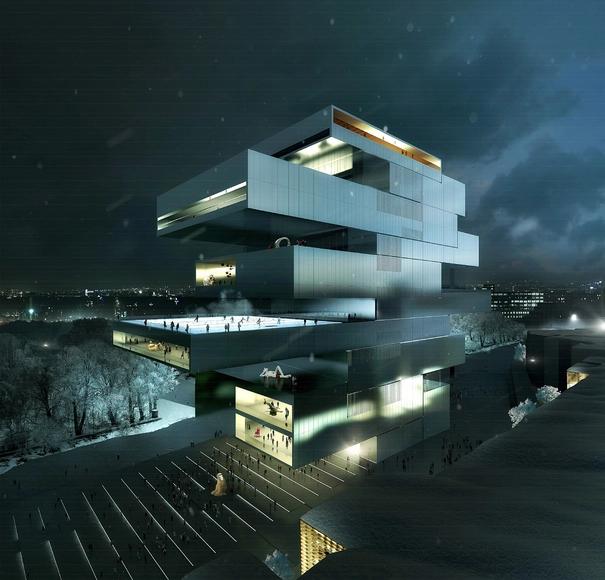
A new series of international architecture competitions are characterizing a clear change in the current urban planning strategy of Moscow. The initiator of these developments is the incumbent chief architect of the Russian capital, Sergey Kuznetsov. Together with his team, he has breathed new life into Moscow’s urban development since taking office in mid 2012. The exhibition New Moscow – Новая Москва presents two international competitions – from the fields of landscape planning (1st prize Diller Scofidio + Renfro, New York) and cultural building (1st prize Heneghan Peng, Dublin) – and through these demonstrates the great gains for the city’s urban planning that are being drawn from this open, global approach.
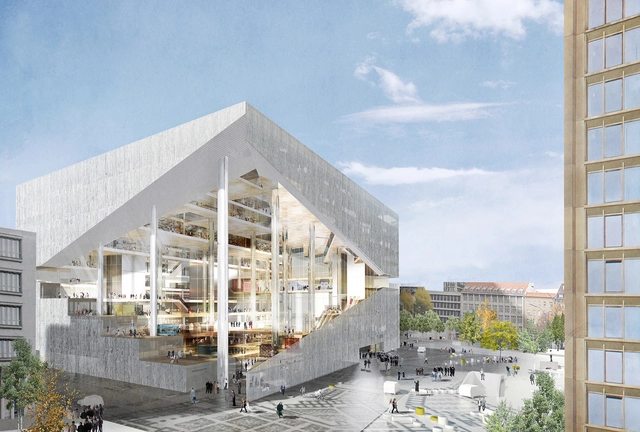
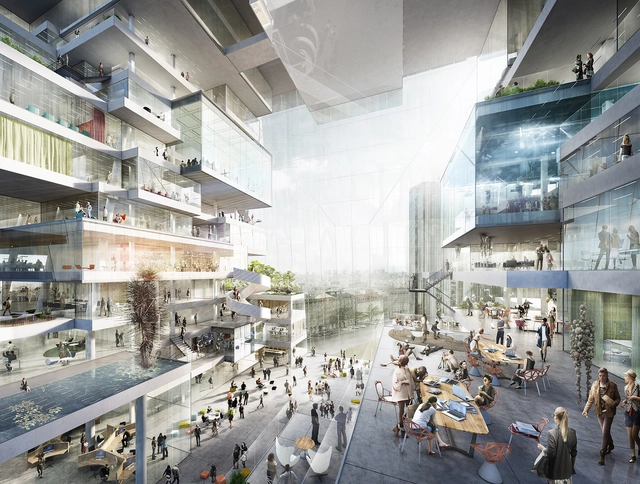
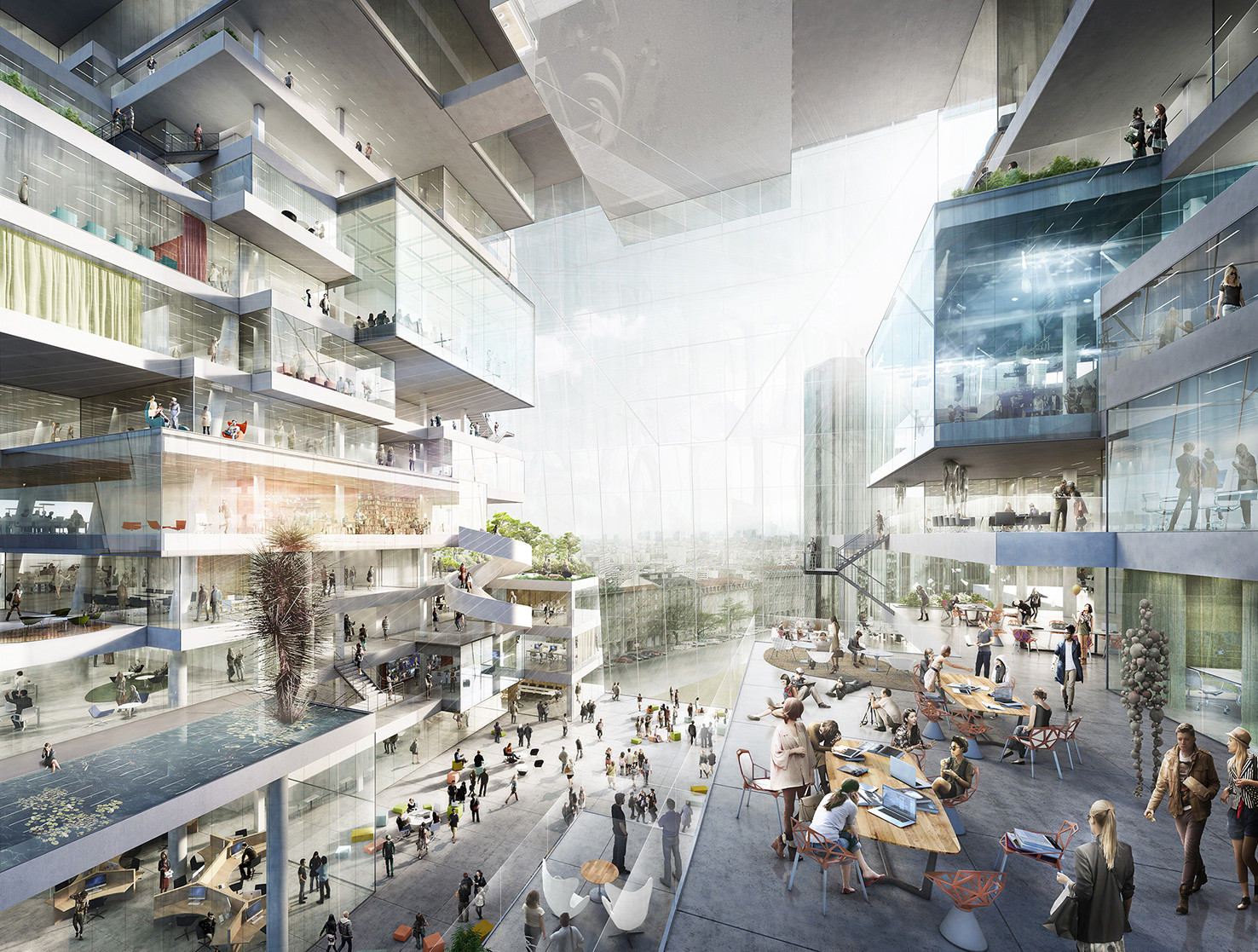
The task of the competition was to create additional space for the media company, particularly its digital offers, and thus design a workplace fit for the future of online media. Koolhaas' design, which features a large 30-meter high atrium or "open valley" with interconnected terraces and public workspaces for both individual, collaborative, and mobile work, won favor with the jury for its forward-thinking concept. As Dr. Mathias Döpfner, Chief Executive Officer of Axel Springer SE, commented: “[Koolhaas] presented the conceptually and esthetically most radical model. The fundamental innovation of working environments will support the cultural transformation towards a digital publishing house."
For his part, Koolhaas had this to say: “It is a wonderful occasion to build in Berlin again, on this historical site of all places, for a client who has mobilized architecture to help perform a radical change…a workplace in all its dimensions.”
See more of OMA's winning proposal, after the break...
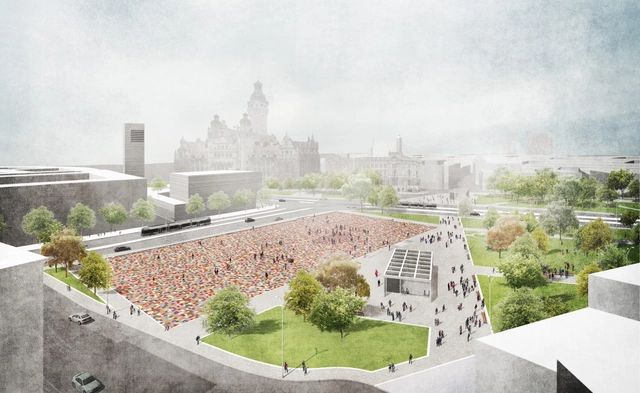
To commemorate the 25th anniversary of the fall of the Berlin Wall this autumn, Germany planned two memorials, one in Berlin and one in Leipzig. However, as Der Spiegel reports, not only are they almost certainly not going to be complete in time for the anniversary, they have both proven highly controversial with the local people. Will these designs turn out to be monuments to German reunification, or just monumental failures? Read the article on Der Spiegel to find out more.
Berlin'sBarkow Leibinger has won an invited competition to design a new hotel tower and conference centre as part of Berlin's largest hotel complex, the Estrel. Establishing a new gateway to the center of Berlin from Schönefeld International Airport, the tower will stand at 175 meters (578 feet) making it the tallest high-rise in Berlin to date. Located on the Sonnenalle at the intersection of the Ship Canal, S-Bahn and Autobahn, the site acts as a threshold between the heterogeneous industrial and residential periphery of the city and the historical neighborhoods of Neukölln.
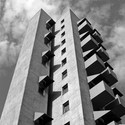
Robert Slinger, a founding partner of Berlin-based practice Kapok, narrates the story of a building "too radical to implement and too relevant to ignore." Having lived in John Hejduk'sKreuzberg Towerfor eight years, Slinger "came to understand how Hejduk’s architecture both flexibly accommodates and yet asserts a presence which resists any attempts to co-opt it. Whilst impressed by its powerful exterior presence, its austerity and frontal directness left a strangely cold impression upon me."
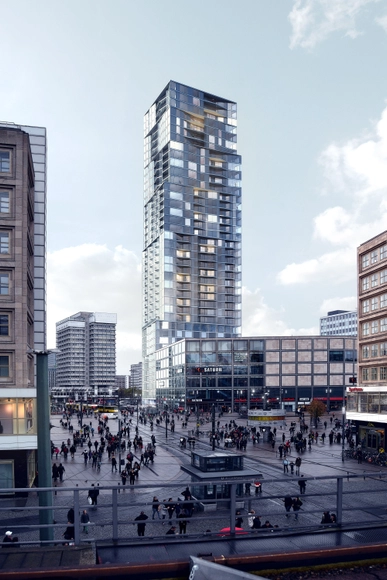
In a competition that ultimately crowned Frank Gehry as winner, Berlin’s Barkow Leibinger placed third with their 150-meter “faceted stacked building” proposal clad in glass. Aimed to be Berlin’s tallest building, the apartment and hotel tower is planned to be the city’s first high-rise residential development since the 1970s.
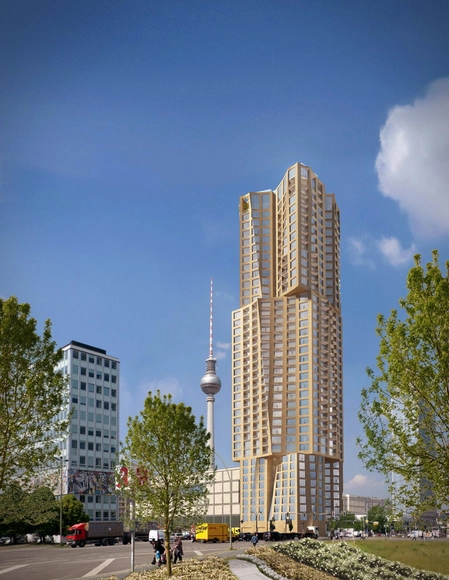
Gehry Partners has been selected over David Chipperfield, Adjaye Associates and seven other practices in an invited competition for a 300-unit residential tower in Berlin. The winning proposal, deemed “the most compelling” by jury for its rotating stacks of sculptural, stone-clad cubes that rise up to 150 meters, is expected to be Berlin’s tallest skyscraper and Germany’s tallest residential tower.
“Gehry’s design is strong in visual expression and introduces an unusually eccentric, new pattern for this location. Nevertheless, the façade radiates agreeable tranquility. In addition, the design blends well with the neighborhood and conveys all aspects of metropolitan living,” commented Regula Lüscher, Senate Building Director.
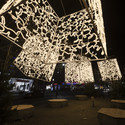
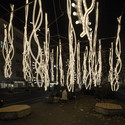
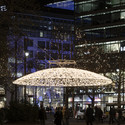
Spanish architecture photographer Miguel de Guzmán has released a new video, just in time for Christmas. The video covers three light installations in Berlin designed by Brut Deluxe: the first, a huge light dome, the second consisting of five big three-dimensional light cubes, and the third, an artificial landscape built of 50 light shrubs. All of the installations are designed to create atmospheric spaces that can be entered and experienced. Check out more of his videos here, and some great pictures of the installations after the break...
Proposal from Büro-OS. Image Courtesy of Axel Springer SE
UPDATE: OMA has provided more information and images of their proposal, see them after the break.
BIG, Büro Ole Scheeren, and OMA have been announced as the three finalists in the competition to design the new Media Campus for AXEL SPRINGER SE in Berlin, Germany, beating out Kuehn Malvezzi and SANAA. The final ranking will be released in January.
The new campus will be located on the historic site of the former Berlin Wall, what was once a no-man’s land. All three proposals address this contentious history as well as the demands of a 21st century workplace. President of the jury, Prof. Dr. Friedrich von Borries, proclaimed that: "All three projects show how fascinating architecture can be today. No matter which of the three proposals will be realised: The competition is already an enrichment of Berlin's building culture." See all three proposals, after the break...
Studio Daniel Libeskind has released images of his latest project: a 10,000 square meter residential building planned for the center of Berlin. Occupying a half-acre corner site in the neighborhood of Chausseestrasse, “Chausseestrasse 43” will be encased by a metallic-coated ceramic facade shaped to maximize exposure to natural light.

















PX2__01.jpg?1386695269&format=webp&width=640&height=580)