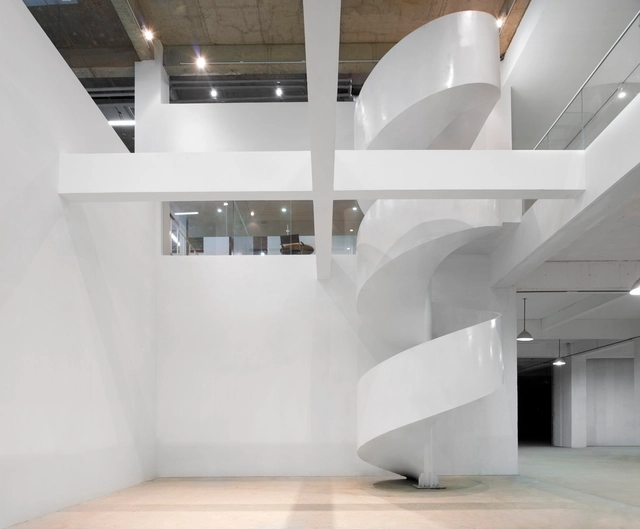
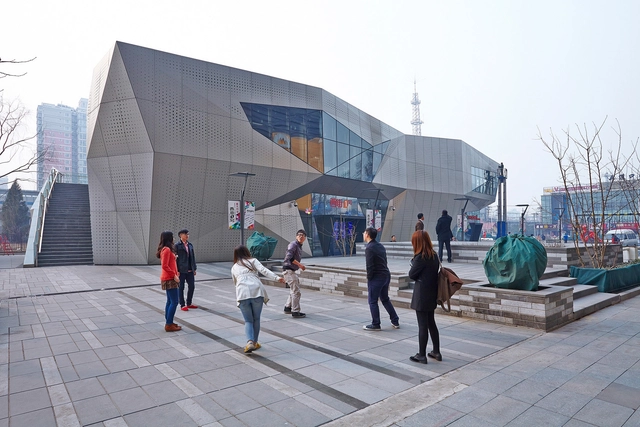
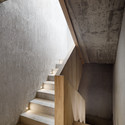
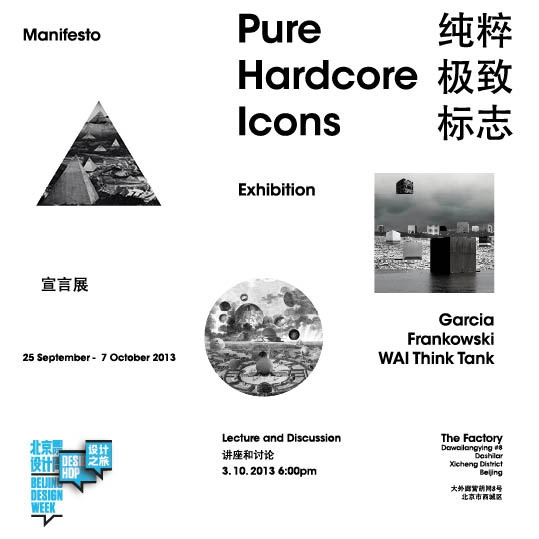
Text description provided by the architects. The Cube, a sixteen meter tall painted steel and rope installation designed for the 2013 Beijing Biennale by the Oyler Wu Collaborative, challenges the volumetric perception of its own archetypal geometry. The aspiration of the installation is to achieve the transcendence of the first dimension - the line - by simulating warping two-dimensional planes, which penetrate and populate the object framework, to create the perception of inhabitable three-dimensional space.
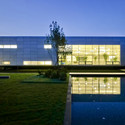
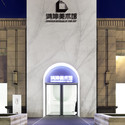
Entrance Facade (night). Image Courtesy of Latitude Studio
Latitude Studio, based in Barcelona and Beijing, have unveiled designs for a showroom exhibition centre in China's capital city. Integral to the design is how visitors circulate and interact with the spaces centred around the "future shopping mall". Including an auditorium, model spaces and views onto an area which is expected to see enormous retail development, the building's central atrium and "thematic sightseeing walk" offer a unique journey for the visitor.
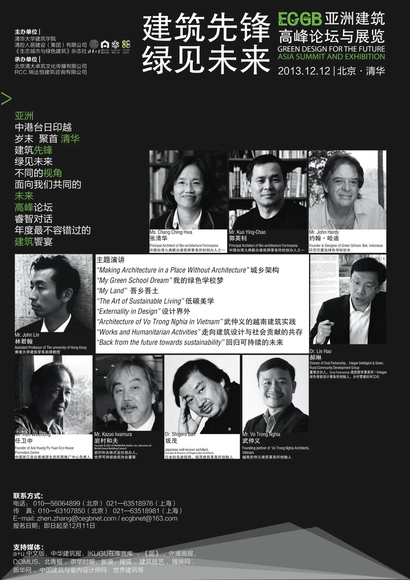
Tsinghua-ECGB Asia Architecture Summit & Exhibition will be held December 12-13, 2013 at Tsinghua University in Beijing City. Jointly sponsored by School of Architecture, Tsinghua University, Tsinghua Holdings Human Settlements Construction (Group) Co., Ltd, Editorial Office of Eco-city and Green Building (ECGB) magazine, the Summit will bring together eight award winning Asian architects to share their design thinking and key projects on creative sustainability. Keynote speakers include Vo Trong Nghia, Principal Architect of Vo Trong Nghia Architects and Shigeru Ban, Founder of Shigeru Ban Architects.
"When you find a piece of stone which is three or four hundreds years old, then you understand the notion of time as more than what we can experience as human beings. At that moment the old thing might be beautiful, it might be ugly. It doesn't matter, but it gives you a sense of profound time, and then you understand your history and ancestors that lived in a different world, different from the one we are in now."-Yung Ho Chang
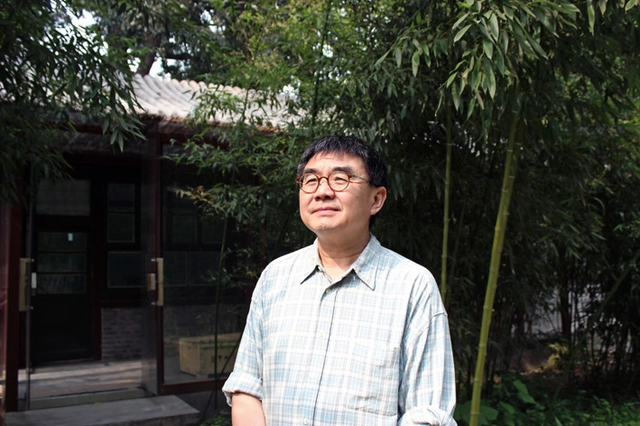
Located in Beijing’s Yuanming Yuan Park, next to the ruins of the mixed-style Baroque Palace, Yung Ho Chang's office is in an ancient wooden dwelling, surrounded by vegetable gardens grown by the architects of the studio.
In this conversation, Yung Ho, who established China’s first independent architectural office, Atelier FCJZ in 1993, laying the foundation of contemporary practice in China, talks about his story, describing a Beijing which has disappeared as well as the contemporary Beijing and its "New Beijing Sky." He talks about architecture using references from movies, literature, art and artists, describing his approach to architecture in accordance with his philosophy of life.
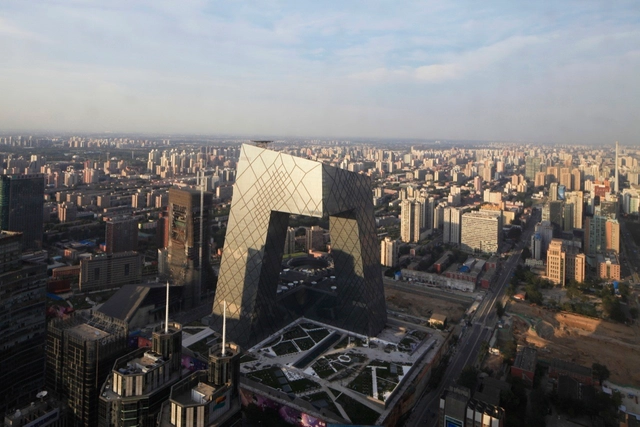
CCTV/OMA Partners-in-charge: Rem Koolhaas and Ole Scheeren, designers, David Gianotten, photographed by Iwan Baan
OMA’s CCTV Headquarters in Beijing, ArchDaily’s 2012 “Building of the Year,” was deemed “Best Tall Building Worldwide” by the Council on Tall Buildings and Urban Habitat (CTBUH). Selected from a shortlist of four deserving skyscrapers, CCTV was awarded “best” due to its “unusual take on skyscraper typology.”
The jury stated: “Instead of competing in the race for ultimate height and style through a traditional two-dimensional tower soaring skyward, CCTV’s loop poses a truly three-dimensional experience, culminating in a 75-meter cantilever."
In the latest of NOWNESS' spectacular videos, Ole Scheeren - a former partner at OMA and now principal of Büro Ole Scheeren in Beijing - reflects on the past decade he has spent in China overseeing construction of the CCTV Headquarters. He muses over the delicate balancing act that Western architects maintain when they work in China, simultaneously bringing change to the city and allowing the city to change who they are and how they see the world. In this context, where change is "something that you are immediately and instantly confronted with" he believes that the CCTV Building is "both confrontational and complicit".
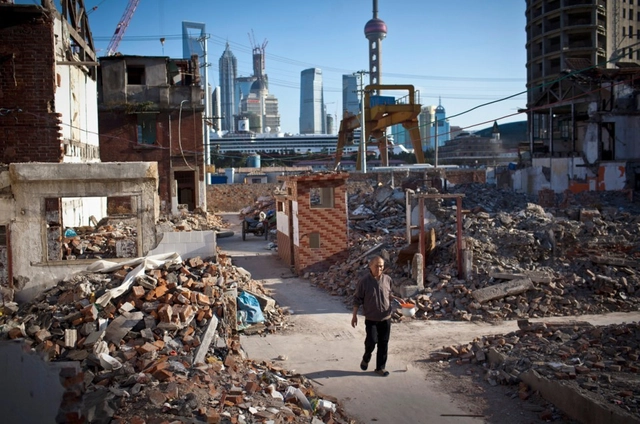
Chinese city-dwellers are waking to find eight stories of construction debris outside of their homes. Over two billion tons of waste, outside Beijing and other major cities, is a result of a booming construction industry. "There's no systematic way to deal with [the garbage]," says Wilson W.S. Lu, architecture professor at the University of Hong Kong, "The illegal dumping is everywhere." Recycling efforts have just begun, but local activists believe it will require a radical paradigm shift in the way Chinese residents reclaim material. Read the full New York Times article, "China's Mountains of Construction Rubble."
https://www.archdaily.com/443367/mountains-of-construction-debris-accumulate-outside-chinese-citiesJose Luis Gabriel Cruz
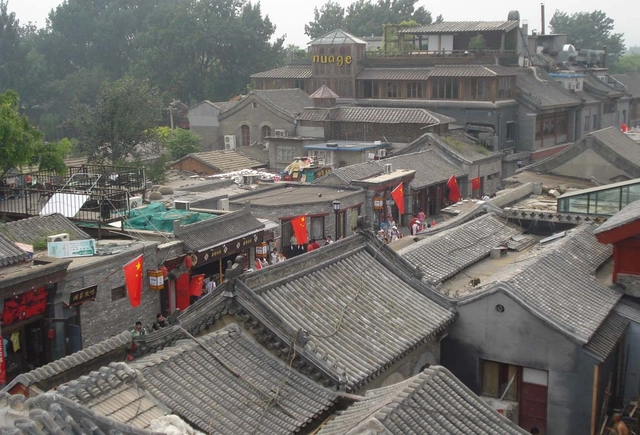
The Guardian's Oliver Wainwright documents the current trend of micro-scale installations spurring new life into the historic hutongs of Beijing and gaining support from the local communities, eager to reject the economic pressures of destroying/rebuilding. The local government’s endorsement, however, comes as a surprise - especially considering its fervent impetus to raze these areas just a few years ago. Read the full article here: Designers Use 'Urban Acupuncture' to Revive Beijing's Historic Hutongs.
https://www.archdaily.com/435775/reviving-beijing-s-hutongs-with-micro-installationsJose Luis Gabriel Cruz
As a continuation to his “Shan-Shui City” concept, which envisions a “city of mountains and water,” Ma Yansong of MAD Architects has proposed an interpretation of China’s ancient natural philosophy in the contemporary city: the Chaoyang Park project. Situated in the world’s second largest city park and surrounded by a typical Chinese business district, the Chaoyang Park project seeks to infuse the “vigorous Shan-Shui culture” with a new urban typology that unites architecture and nature as a single entity.








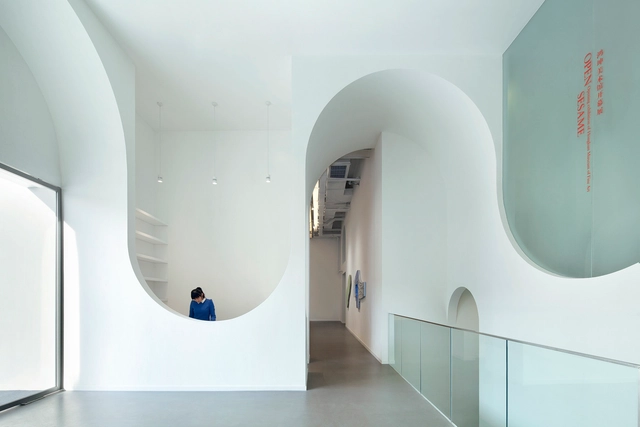

.jpg?1389137893&format=webp&width=640&height=580)
.jpg?1389137745 "© GU Yunduan")
.jpg?1389137647 "© GU Yunduan")
.jpg?1389137490 "© GU Yunduan")
.jpg?1389137256 "© GU Yunduan")
.jpg?1389137893)