The week of Burning Man 2017 is halfway through, and glimpses of the event are starting to make their rounds through the social mediasphere. Under the theme of “Radical Ritual,” this year features as many impressive structures and sculptures as ever, including a central temple holding the wooden man built to commemorate the Golden Spike, the ceremonial final spike driven to join the rails of the United States’ first transcontinental railroad.
Check out our favorite structures from the event, below.
2017 Perrier Artist of the Year Eric Rieger, also known as HOTTEA, has completed a massive installation of colorful string at the largest indoor mall in North America, the Mall of America in Bloomington, Minnesota.
Consisting of 13,000 individual strands of yarn in 103 colors, the installation completely transforms the mall’s Atrium, enveloping visitors in a storm of buzzing color as soon as they pass through the north entrance. In total, a total of 721 pounds of yarn were used, covering the footprint of 55 by 45-foot skylight above.
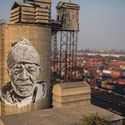
Last month, ArchDaily had an opportunity to speak with Akshat Nauriyal, Content Director at Delhi-based non-profit St+Art India Foundation which aims to do exactly what its name suggests—to embed art in streets. The organization’s recent work in the Indian metropolises of Delhi, Mumbai, Hyderabad, and Bengaluru, has resulted in a popular reclamation of the cities’ civic spaces and a simultaneous transformation of their urban fabric. Primarily working within residential neighborhoods—they are touted with the creation of the country’s first public art district in Lodhi Colony, Delhi—the foundation has also collaborated with metro-rail corporations to enliven transit-spaces. While St+Art India’s experiments are evidently rooted in social activism and urban design, they mark a significant moment in the historic timeline of the application of street art in cities: the initiative involves what it believes to be a first-of-its-kind engagement between street artists and the government.
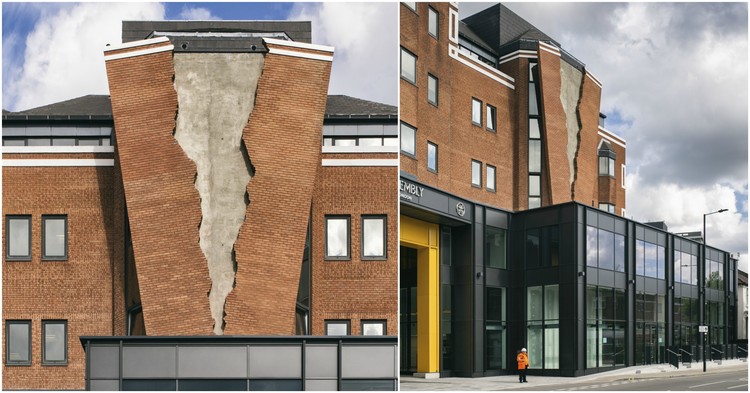
The work of artist Alex Chinneck is grounded in architecture. From melting buildings to a slumping facade to a structure ripped in half and hovering, Chinneck’s work plays with the expectation of materials and tectonics, resulting in captivating mind-bending illusions. His latest work (and first permanent sculpture), Six Pins and Half a Dozen Needles, continues this exploration, taking the form of a large brick wall ripped down the center.
Whether architecture is a form of art or not has often been a controversial topic of conversation within the architecture world. If one goes by the general definition of the word "art," architecture could potentially fit within the umbrella term: "the expression or application of human creative skill and imagination, typically in a visual form such as painting or sculpture, producing works to be appreciated primarily for their beauty or emotional power." As anyone involved in the architectural discipline probably knows, there is an abundance of varying definitions of the word "architecture," so whether its primary purpose is to achieve beauty or to organize space is evidently up for discussion.
Ask Jay A. Pritzker, founder of the Pritzker Prize, and he may say that "architecture is intended to transcend the simple need for shelter and security by becoming an expression of artistry." Ask The Guardian's Jonathan Jones and he may tell you that "architecture is the art we all encounter most often, most intimately, yet precisely because it is functional and necessary to life, it's hard to be clear about where the 'art' in a building begins." But this ambiguity is part of what makes the field of architecture challenging and exciting. To celebrate this complicated aspect of architecture, below we have collected a list of just some of the works that could be seen as art, architecture or both, depending on who’s looking, to provide some context to those blurry boundaries.
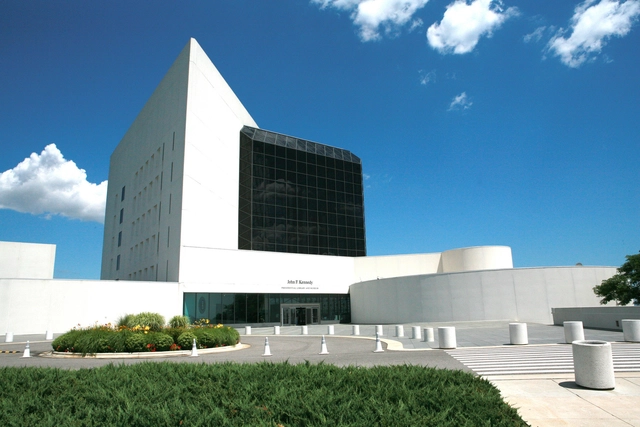
Today, April 26th 2017, marks I.M. Pei’s 100th birthday. The occasion offers a wonderful opportunity to take a retrospective look at one of the most significant and productive architects of the past 100 years, with many organizations hosting events, celebrations, and symposiums to talk about Master Pei and his notable projects. However at these events, just as throughout I.M. Pei’s career, there is unlikely to be much intellectual conversation about Pei’s architectural legacy. The main discussion around I.M. Pei is still focused on his design talent and intriguing narratives about the charisma he used to convince clients to continue through tough projects.
Though I.M. Pei himself has never talked at length about his design theory or the intellectual basis of his projects, these simple narratives leave certain questions unanswered: Where does I.M. Pei’s inspiration for architectural form come from? How did his architectural design affect his peer group of architects and artists, and contribute intellectually to the contemporary art world?
https://www.archdaily.com/870059/im-peis-inspiration-a-comparison-of-masterful-architecture-with-minimalist-artTianci Han
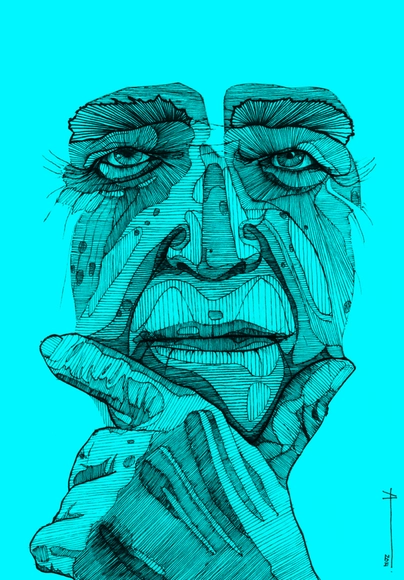
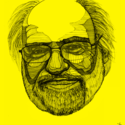
Chilean architect and illustrator Francisca Álvarez Ainzúa created "Architecture of the Portrait": a series of illustrations of renowned architects drawn with the precision and accuracy of a fineliner. In order to choose the protagonists of her geometrical analyses, the architect states a preference for strong character and the presence of imperfections, which imparts a certain richness to the representation.
The architectural construction of the face is done using lines to create a hatch effect. Next, she adds color that pays tribute to the traditional default CAD shades: yellow, cyan and magenta.
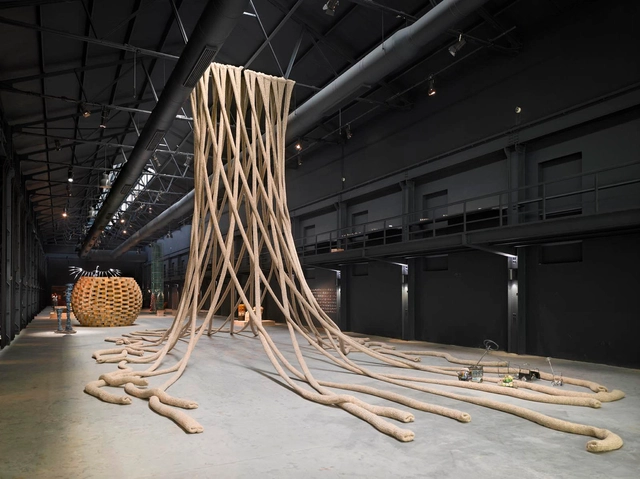
Jordanian artist Raya Kassisieh, with the support of American firm NADAAA, has repurposed her exhibit from the Amman Design Week in Jordan to create blankets for Syrian refugees and Jordanian families. The Entrelac exhibit, created by Kassisieh and NADAAA, consists of 300kg of hand-knit, un-dyed wool which was later cut and stitched to create blankets for those fleeing the Syrian Civil War, now approaching its sixth year.
The production of creative work often requires a very particular type of space—a temple, if you will, to the work being done. Architects and artists are open about how their living and working areas affect their practice, and musicians, of course, are no different. Perhaps this is why places and spaces are often featured on album covers. The art on an album cover is partially advertising, but it is also often a visual symbol of an entire period in the life of a musician. An album's cover artwork may depict the view a band saw coming into the studio every day, the building the album was recorded in, the city the musician grew up in, or myriad other more abstract connections. We will leave it to you to make sense of the connection between the 7 architectural landmarks featured on the following albums and the music their images envelop, but the stories behind the constructions themselves may help you make a more educated guess.
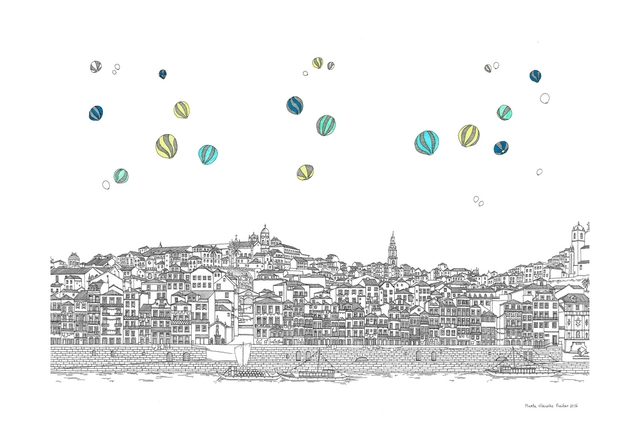
In the first installment of her series, “Cities and Memory - the Architecture and the City," architect Marta Vilarinho de Freitas created a set of intricately rendered architectural fantasy worlds that straddled the line between realism and abstraction.
Now Vilarinho de Freitas has returned with an additional 7 illustrations, this time experimenting with planimetrics and new cityscape scenes.
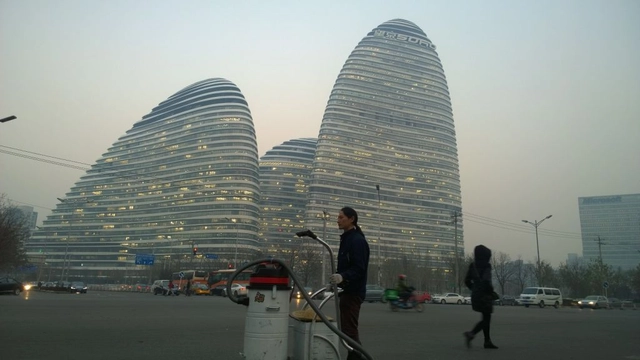
Day 98. Image via Quartz / Supplied by Nut Brother
From the Bird’s Nest to the CCTV headquarters, for the past 100 days Chinese performance artist "Nut Brother" has been wandering the streets of Beijing collecting smog with an industrial vacuum so that he can eventually turn it into bricks. He has now began to form his bricks by mixing a combination of the collected "dust and smog" with clay. As he told Quartz, the project is meant to be a symbol. Read the whole story here.
OMA's first ever building for a religious institution will be constructed with a little help from one of the United States' greatest 20th century artists. In an auction at Sotheby's in New York yesterday, Cy Twombly's 1968 "Untitled (New York City)" - one of the artist's notable "Blackboard Paintings" - sold for $70.5 million, $30 million of which will be donated to LA's Wilshire Boulevard Temple by the painting's owner, Audrey Irmas, to fund the temple's OMA-designed extension.
As reported by the LA Times, the synagogue's new "Audrey Irmas Pavilion" has been designed to be "clearly in dialogue" with the 1929 Byzantine revival temple, and will be used in the celebration of weddings and bar mitzvahs, as well as for meetings, conferences, and gala events by other nonprofit groups. Though the design has not yet been unveiled, the pavilion is currently slated for a 2019 opening.
Let your inner designer out and explore the playful side of architecture at this hands-on program for adults. Join other kids at heart and build amazing structures with BSA Space’s LEGO® collection, while enjoying beer, wine, snacks, and conversation. This month’s session is inspired by Canstruction’s 2015 theme: get inspired by Boston!
This coming October, the international month of architecture, BABEL is launching a new project: Macau Architecture Promenade. MAP opening is schedule for 10/10 at 6.30 at the Creative Albergue and it will last until 1/11.
Image: Stannard-Greensboro Methodist Church, Stannard-Greensboro Bend Methodist Church, Stannard, Vermont, 1888. Photographed 1972, Steve Rosenthal, cropped.
Presenting 40 images by Boston photographer and trained architect, Steve Rosenthal, this exhibition showcases rural New England churches of the eighteenth and nineteenth centuries. From the early meetinghouse through the changing patterns of Greek and Gothic revivals, Rosenthal’s black and white depictions will trace the evolution of church styles in New England and capture what remains of these architecture gems around the region. The exhibition is organized by Historic New England.
2015 marks the 20th Anniversary of Canstruction Boston. The 2015 theme is "Celebrate 20 years in Boston!" Canstruction Boston is a charity event and exhibition in which teams of Boston-area architects, engineers, contractors, designers and students compete to display colossal sculptures made out of canned goods. After the sculptures are dismantled, all the canned goods will be donated to the Merrimack Valley Food Bank in Lowell, Massachusetts.
It has been a week since the conclusion of this year's Burning Man festival in Black Rock City, Nevada, and images of its most imaginative structures are still surfacing. Even Bjarke Ingels has published a few of his favorite findings from the week-long event. Read on to see of the best structures and installations found at Burning Man 2015.
On the 25th and 26th September The Gallery on the Corner in Battersea is opening its doors for the first solo exhibition of the Architectural Artist Minty Sainsbury.
Studying Architecture at Cambridge has not only influenced her choice of subject matter but has also taught her to draw with an eye for detail and a spatial understanding of composition.
Part of the exhibition will be a series of street views in which the building in focus is drawn in rich detail and the contextual surroundings are left as silhouettes. By concealing the focal building behind the faceless structures, Sainsbury references a visual experience that you would experience yourself walking in the city streets.




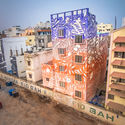
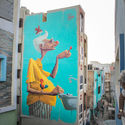
__Anpu_Varkey___photo_by_Akshat_Nauriyal.jpg?1501258835 "Gandhi Mural by Hendrik Beikirch and Anpu Varkey, Delhi. Image © Akshat Nauriyal")











.jpg?1483734839 "© Marta Vilarinho de Freitas")
.jpg?1483734922 "© Marta Vilarinho de Freitas")