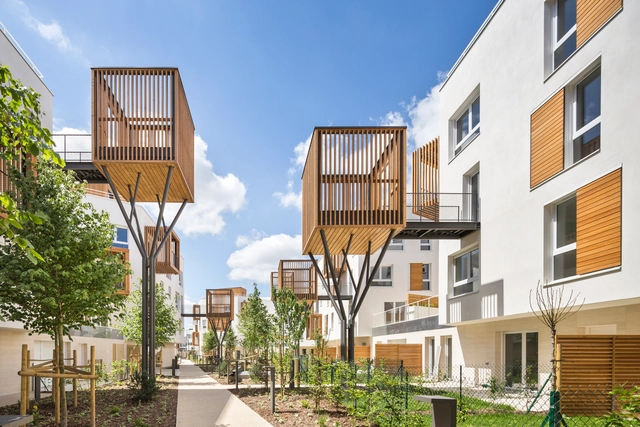
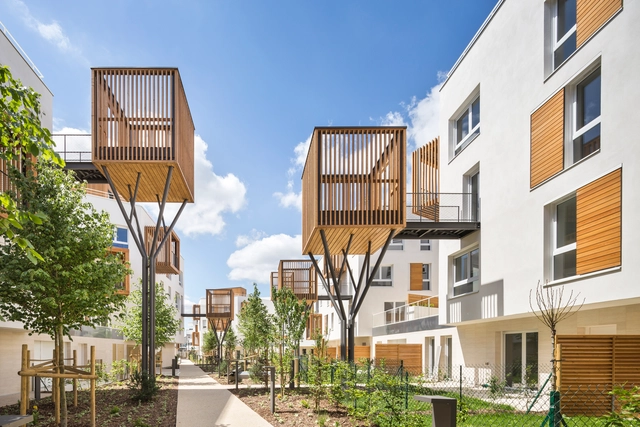
“We need a new spatial contract." This is the call of Hashim Sarkis, curator of the Venice Biennale 2021, as an invitation for architects to imagine new spaces in which we can live together. Between a move towards urban flight and global housing crises, the growth of more low-rise, dense developments may provide an answer in the countryside. Turning away from single family homes in rural areas and suburbs, modern housing projects are exploring new models of shared living in nature.
Few things irritate us more than exposure to excessive noise or inability to hear what we need to hear. Whether it's a nearby construction site, highway traffic, air conditioning, or a neighbor learning saxophone, research shows that noise can contribute to cardiovascular disease, high blood pressure, headaches, hormonal changes, sleep disturbance, reduced physical and mental performance, and the reduction of well-being. On the other hand, in an acoustically "comfortable" environment, in addition to listening to what we want, we focus better and feel calmer.
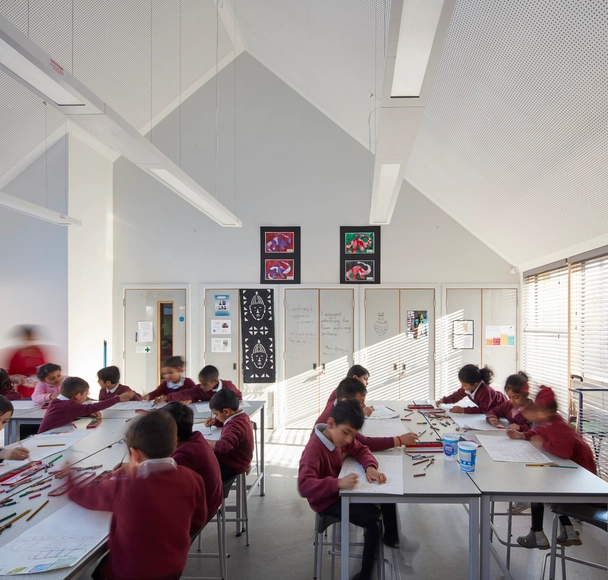
The concern about creating acoustically comfortable environments is often relegated to cinemas, concert halls and recording studios. But it is particularly important in learning environments, such as classrooms, as it directly influences the teaching-learning relationship. Acoustic discomfort can harm the process of knowledge acquisition, interfering with attention and worsening student-teacher communication.
Designers have created civic institutions, governmental centers, public plazas, and many other spaces as testaments to individual and shared values. As spaces for gathering and exchange are necessary elements to urban life, architecture can also act as a vehicle to encourage understanding. Advocating knowledge while empowering the public, libraries celebrate ideas, curiosity and empathy.
In a 2016 survey of 400 employees in the U.S., Saint-Gobain found that office building occupants commonly complained about poor lighting, temperature, noise, and air quality, leading the company to deduce a need for improved lighting and thermal comfort in buildings while also maintaining low energy consumption and freedom of design for architects and clients. Their solution was SageGlass, an innovative glass created first in 1989 and developed over the course of the past three decades. The glass, which features dynamic glazing protecting from solar heat and glare, simultaneously optimizes natural light intake. A sustainable and aesthetic solution, SageGlass’ adaptability to external conditions dispels the need for shutters or blinds.
https://www.archdaily.com/957605/more-daylight-but-less-glare-and-heat-how-does-automatically-tintable-glass-workLilly Cao
2020 has fundamentally changed our spatial routines and the current health crisis brought about a significant amount of speculation regarding how our daily lives will unfold onward. With the year coming to an end, we look at how the pandemic accelerated some architecture trends that were already underway, and how it brought into question other well-established ideas.
On behalf of the entire ArchDaily team, we would like to thank you for your continued support and for making 2020 our best year so far! We are now reaching more architects around the world and inspiring them in the creation of better built environments. With more than 5500 different projects published during the year, our curators are excited to share this collection of the 100 most visited projects of 2020. This selection represents the best content created and shared by the ArchDaily community over the past 11 months.
In the Genesis flood narrative, Noah built an ark after a call from God, who decided to flood and destroy all life on Earth due to the misbehavior of humanity. Only Noah's family and a couple representatives of each species of animals could enter the huge vessel and save themselves. In the bible, the ark is described in the exact measurements of 300 cubits in length by 50 cubits in width by 30 cubits in height. This was a unit used at the time based on the length of the forearm, measured from the tip of the middle finger to the elbow. A Dutchman who has devoted himself to building a replica of Noah's Ark, without success in finding a correspondingly accurate value in the metric system, used his own body measurements as a module. Modulation in architecture means adapting the project to a defined measurement based usually on a specific dimension or material. Whether it is a meter, a brick, a tile, or a container, it serves to guide the design process and make it more efficient and sustainable.
Between 1950 and 2011, the world's urban population increased fivefold. In 2007, for the first time, the number of people living in cities surpassed the number of people living in the country. In 2019, the urban population had already reached 55% of the total population, and by 2050, it is estimated that just over two thirds of the population will live in urban areas. However, this growth is not constant in all parts of the world: according to the UN World Urbanization Prospects 2018 Report, the global urban population is expected to grow by 2.5 billion inhabitants between 2018 and 2050, with almost 90% of this increase concentrated in Asia and Africa. As populations in these areas increase, so will the demand for energy, food, and water, making resources more scarce. This scarcity will be compounded by the negative impact of urbanization on the climate and the environment.


















_Del_Rio_Bani.jpg?1608748851&format=webp&width=230&height=230&crop=true)












.jpg?1577928861&format=webp&width=640&height=580)
.jpg?1577929392&format=webp&width=230&height=230&crop=true)
.jpg?1577929132&format=webp&width=230&height=230&crop=true)
.jpg?1577929346&format=webp&width=230&height=230&crop=true)
.jpg?1577929429&format=webp&width=230&height=230&crop=true)
.jpg?1577928861)
.jpg?1576697201&format=webp&width=230&height=230&crop=true)
.jpg?1576698804&format=webp&width=230&height=230&crop=true)
.jpg?1576698912&format=webp&width=230&height=230&crop=true)
.jpg?1576697314&format=webp&width=230&height=230&crop=true)
