This article was originally published on September 8,2014. To read the stories behind other celebrated architecture projects, visit our AD Classics section.
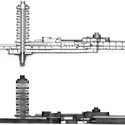
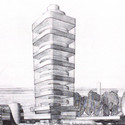
The next time you catch the scent of a Glade air freshener or evade pesky mosquitoes thanks to Off!, think of Frank Lloyd Wright. His 1950 building for the SC Johnson Research Tower at their headquarters in Racine, Wisconsin, was home to the invention of many of their landmark products.
Following his election a few months ago, the current president-elect of Mexico, Andrés Manuel López Obrador, announced that a referendum would be held to determine whether or not the government should proceed with the Foster + Partners and FR-EE's proposed 13 billion dollar project for the International Airport of the Mexico City.
Making good on his campaign promise, a public vote on the project's fate was held from 25-28 October, asking citizens to answer the following question: Given the saturation of the International Airport of Mexico City, which option do you think will be best for the country? The two options given to voters were:
"Recondition the current airport in Mexico City, Toluca and build two runways at the Santa Lucia Air Base"
"Continue with the construction of the new airport in Texcoco and cease operations of the current International Airport of Mexico City."
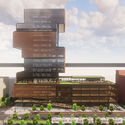
Data Sciences Center. Image Courtesy of KPMB Architects
KPMB Architects have released a design to construct a 17-floor tower for Boston University's new Data Sciences Center. Located on the university’s main Charles River campus, the project will become the tallest building at the university. The vertical design was made to bring together the mathematics, computer science and statistics departments under one roof. Overlooking the Boston skyline and the Charles River, the stacked design will become a new landmark for Boston University.
Sasaki has unveiled images of their proposed Chengdu Panda Reserve in China, intended to aid wildlife preservation efforts of the Chinese cultural icon. The masterplan for the reserve represents the launch of “China’s increasing communication, collaboration, and awareness of its pioneering strategies to protect the species and its native habitat.”
With only 1,800 left in the wild, the giant panda is one of the most vulnerable species on earth, and are native to only one region in the world: an area of western China near Chengdu. As one of the fastest-growing cities in the world, Chengdu’s rapid urbanization will yield to a 69-square-kilometer reserve, providing a framework for the protection of endangered species worldwide.
The story of the Hastings Pier is an improbable one. Located in Hastings - a stone's throw away from the battlefield that defined English history - the pier was first opened to the promenading public in 1872. For decades the structure, an exuberant array of Victorian-era decoration, entertained seaside crowds but by the new millennium had fallen out of disrepair. In 2008 the pier was closed - a closure that became seemingly irreversible when, two years later, it burnt down.
To rank architects, or to even pretend that any list or selection would be exhaustive and/or apply to the individual tastes of every architecture lover, seems, on the surface, a pointless task. However, as we move away from looking for inspiration from merely the great masters or the handful of contemporary firms studied in academic programs, it is important to shine a light on the works that we, as ArchDaily editors, have found particularly valuable. Of the thousands of architects whose projects have been selected to be published on our site, we occasionally notice firms whose work stands out. Whether we’re drawn to their innovative approach to practice, the role they play in contributing to their local communities, or their generosity, we are eager to display their work as an example, so that others may be inspired to challenge the status quo.
https://www.archdaily.com/904738/a-selection-of-the-worlds-best-architectsAD Editorial Team



















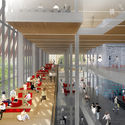









.jpg?1540405202&format=webp&width=640&height=580)
.jpg?1540405410 "Hastings Pier / dRMM. Image © Laurian Ghinitiou")
.jpg?1540404858 "Hastings Pier / dRMM. Image © Laurian Ghinitiou")
.jpg?1540405254 "Hastings Pier / dRMM. Image © Laurian Ghinitiou")
.jpg?1540583713 "Hastings Pier / dRMM. Image © Laurian Ghinitiou")
.jpg?1540405202)