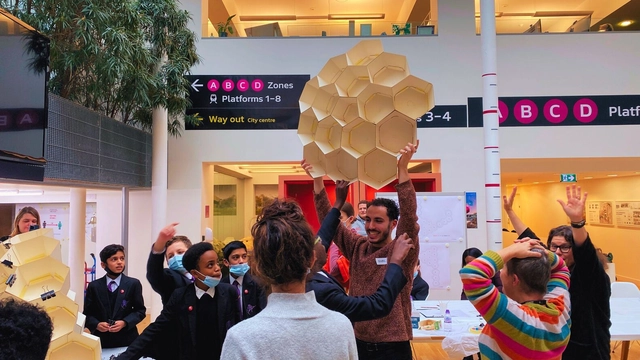
The Grimshaw Foundation is a charitable organization aiming to bring access to creative learning tools to a diverse range of young people. The organization was established by Sir Nicholas Grimshaw, in partnership with the partners of international architecture practice Grimshaw. The central purpose is to bring together a globally linked educational community of artists, architects, and designers to support and empower young people. It hopes to reach them at the stage of navigating their career options and help them discover the varied options and opportunities that the creative industry can offer. The Foundation officially launched on 6 July 2022 at the Royal Academy of Arts in London.
The current architectural production faces several paradigms and one of them is aesthetic. In a scenario of constant uncertainty, buildings with projections, holograms, or completely automatic ones that science fiction has shown so much, seem more and more distant from reality. Nowadays, the search for greater identification with the built space has been amplified instead of idealizing the new for the new. Therefore, looking at the past has presented different perspectives and it is in this scope that perhaps we can imagine a new futuristic aesthetic.
An ancient Indian folktale narrates the story of a demigod, Hiranyakashipu, who was granted a boon of indestructibility. He wished for his death to never be brought about by any weapon, human or animal, not at day or night, and neither inside nor outside his residence. To cease his wrathful ways, Lord Vishnu took the form of a half-human-half-animal to slay the demigod at twilight at the threshold of his house.
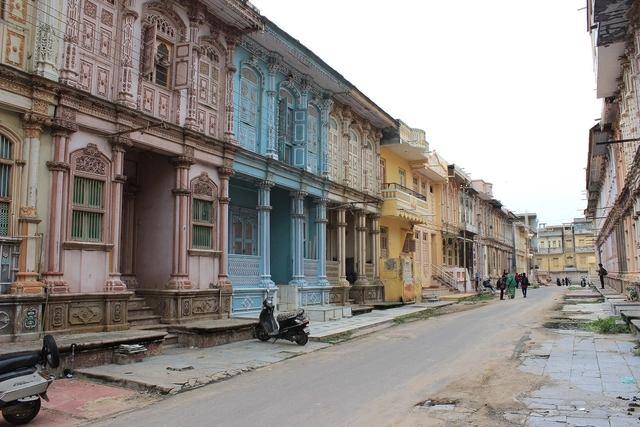
Threshold architectural spaces have always held deep cultural meaning to the people of India. In-between spaces are found in the midst of daily activities as courtyards, stairways, and verandas. The entrance to the house is revered by Indians of all social backgrounds. Throughout the country’s varied landscape, transitional entry spaces are flanked by distinctive front verandas that merge the street with the house.
Despite its dazzling collection of masterpieces, London’s National Gallery has been cursed with a series of ill-advised architectural schemes over its two-century existence. Only once have its leaders made a truly inspired and visionary choice: in the mid-1980s, the gallery held a competition, won by Venturi, Rauch and Scott Brown (VRSB) of Philadelphia, to build a special collections building.
The addition was constructed from 1988 to 1991, using funds donated by the Sainsbury family as a gift to the nation and was immediately hailed as one of the finest buildings of its type erected in the 20th century. It has remained popular with Londoners and has served well as an expansion of William Wilkins’s undistinguished classical building ever since. Experts on the work of Robert Venturi, John Rauch, and Denise Scott Brown consider it one of their masterpieces. Apparently, the National Gallery has a different opinion.
https://www.archdaily.com/985449/in-london-a-venturi-scott-brown-masterpiece-is-threatenedMark Alan Hewitt
No city is like New York. As an amalgam of different cultures, it is one of the most diverse in the world. New York is also facing social and environmental challenges that range from the need for new housing and transportation demands, to rising sea levels and storm surges. As the global pandemic further underlined the importance of design in shaping public life, city officials and planners are looking at a range of approaches and models for urban development and renewed growth.
The Permanent Mission of Zimbabwe to the United Nations in New York, in collaboration with the Ministry of Local Government and Public Works of Zimbabwe, has launched a call for submissions for the selection of consultancy firms to provide architectural consultancy services to the Permanent Mission of Zimbabwe for the supervision of demolition, design and construction of the Chancery in Manhattan, New York, as well as the design and supervision of construction of the Official Residence in the City of Rye, New York. The Government of Zimbabwe owns properties in New York City and the City of Rye and is therefore inviting local firms in New York with proven record to participate in the tender.