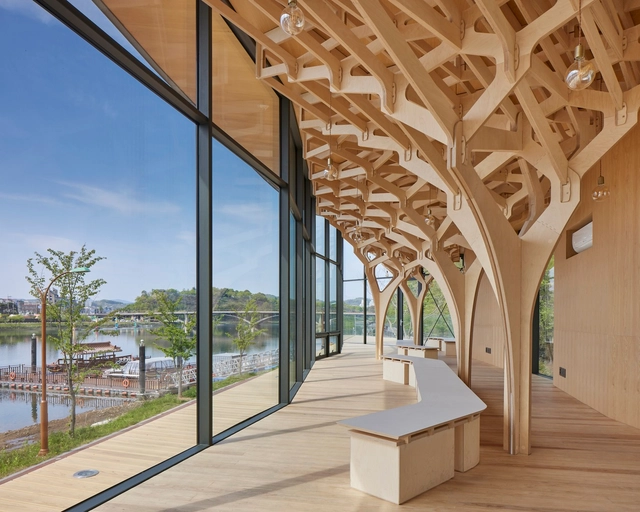
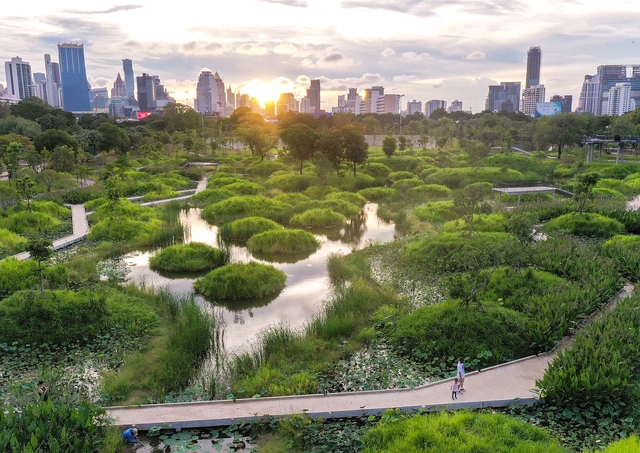
By imagining an alternative reality and rediscovering his cultural background, architect Jae Kyung Kim of JK-AR established his identity as an architect when creating his practice, selected as one of ArchDaily’s New Practices 2023. After studying and working in South Korea and the US, he’d noticed an absence of traditional Asian architecture, which had peaked his interest. He began to thoroughly look at a possibility where the traditional timber buildings of East Asia had still been relevant and continued to evolve.
Modernity and globalization have significantly reduced geographical distances, transformed social interactions, and accelerated the flow of information across nations, which has, in a sense, made the world more accessible to people everywhere. However, it's important to note that when we say "everyone," we refer to a vast and diverse population. Modernity and globalization had an impact on noticeable inequalities in both social and technological realms, as more advanced and privileged nations have established benchmarks and norms for leisure, culture, and consumption. As a result, certain cultures have established a dominant influence, promoting the notion that there is a "correct" way to live and build cities. This unchecked pursuit of development comes at a significant cost to the Earth's ecosystems and biomes.
From the famous Kitchen Debate between Nikita Khrushchev and Richard Nixon to the popularity of Henry Ford within the USSR, the hundreds of factories designed by Detroit engineer Albert Kahn for Soviet Russia, and skyscrapers erected in Moscow, the Cold War had a peculiar side to it, that is the Russian fascination with American culture and technology.
This summer the federal government released an astonishing statistic: 87% of American homes are now equipped with air conditioning. Since the world is getting undeniably warmer, I suppose this isn’t all that surprising, but keep in mind that robust number of mechanically cooled homes include residences in some fairly temperate climates. So my question is a simple one: When did air conditioning in the U.S. became a requirement, rather than an add-on?
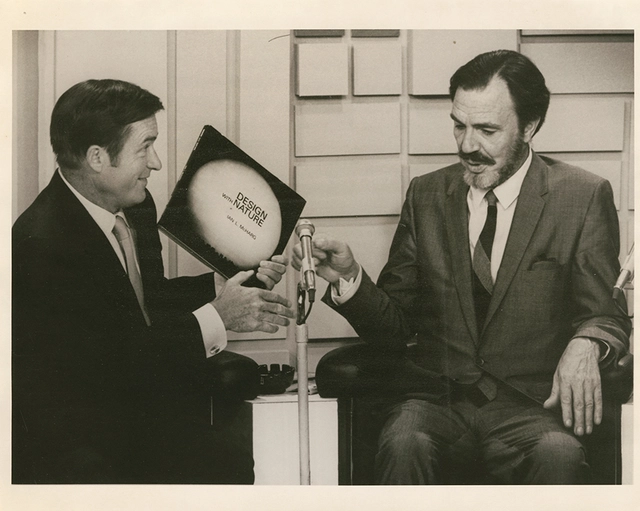
McHarg promoting his book in 1969. Image Courtesy of the Architectural Archives, University of Pennsylvania
Fifty years have passed since the publication of influential landscape architect Ian McHarg’s book, Design With Nature in 1969. Throughout the United States, an environmental movement was taking place, into the center of which McHarg’s book was thrust. The 1970s and ‘80s were a time of much landmark legislation surrounding ecological concerns, and McHarg argued that landscape architecture alone was able to integrate all the disparate fields involved.
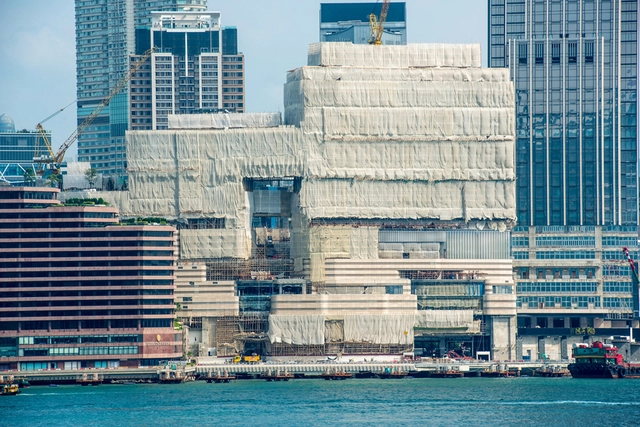
CTF Museum under construction within the existing KPF development. Image Courtesy of SO-IL
As a firm which has already won major awards, worked on culturally significant projects on a large scale, and generally achieved substantial success and recognition in just over 10 years, SO-IL seem to straddle a line between being an “emerging” and an “established” practice. Florian Idenburg and Jing Liu founded SO-IL (Solid Objectives-Idenburg Liu) in 2008 and have since gained a reputation for modern, clean-lined designs, but often with a unique material twist.
Innovation and technology are often presented as inextricably linked ideas. Yet, when it comes to solving today’s urban problems, technology does not always represent the best way forward.
Innovation instead should come from a thorough understanding of the city’s functions and processes, including its municipal government and other local organizations. Technology can help, yes, but cannot be used as a panacea.
The public will soon have the opportunity to experience the vulnerability and awe of briefly inhabiting an animal domain at the “Reverse Zoo,” LABIOMISTA. Translating to “mixture of life,” the 60-acre project is spearheaded by Belgian artist Koen Vanmechelen and is set to open in 2019.
Four Towers In One (Competition). Image Courtesy of Morphosis
Despite what you may think, Thom Mayne isn't the "bad boy" of architecture - at least, not according to Thom Mayne. He sees himself more as a skilled negotiator than a starchitect (a phrase he hates) - after all, he reasons, how else would he have completed so many buildings? In this interview, originally published on Metropolis Magazine's Point of View blog as "Q&A: Thom Mayne," Andrew Caruso and Mayne discuss Morphosis, SCI-ARC, the early days of his career, and his architectural ethos.
Andrew Caruso: Your professional career began in the discipline of planning. What led to the shift toward architecture and your eventual partnership with Jim Stafford?
Thom Mayne: I started working at the Pasadena redevelopment agency doing low cost housing, and that’s where I met Jim [Stafford]. Coming out of USC, I had no background about Mies, Khan or Corbusier, for example. USC was very strong in being anti-historical, looking forward instead of backward. I was essentially naive.
Jim was a year ahead of me at USC and had part of the older regime at the school. When I met him at the planning agency, he started introducing me to history. I got fascinated by [Paul] Rudolph; and then it just took off. Jim guided me through this thought process, reestablishing me in the tradition of architecture.
Many would consider Greg Lynn the leader of computer-aided design in architecture - but Lynn himself begs to differ. He and the Canadian Centre for Architecture recently collaborated on "Archaeology of the Digital," the first in a series of exhibitions that will showcase the work of the earliest adopters of digital techniques in architecture. The exhibit, which opened on May 7, focuses on work by Frank Gehry, Peter Eisenman, Chuck Hoberman, and Shoei Yoh. In this interview, originally published in Metropolis Magazine as "Computer Control," Avinash Rajagopal speaks with Greg Lynn about some of the projects and the inspiration behind the exhibit itself.
SCI-Arc graduate Harris Silver has shared his experience passing through the Kalandia Checkpoint during his quest for "an uncanny truth" that would lead him to develop an architecture project in the city of Jerusalem.
The Kalandia Checkpoint is an opening in what Israel calls "The Security Fence" and what Palestinians call "The Apartheid Wall". Regardless of what you call the separation infrastructure, the checkpoint acts a modern gate to the city of Jerusalem.
After experiencing Kalendia first hand, I came away realizing that until I personally walked through the checkpoint, I was ignorant of the mechanism and tactics employed to humiliate and dehumanize everyone who passes through it. Which means I was not fully capable of participating in the Israeli-Palestinian discourse.