
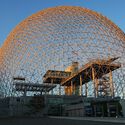
In 1962, architect Buckminster Fuller imagined a floating city that would free humanity from its dependence on Earth. The hypothetical project consisted of massive airborne geodesic spheres that would naturally levitate on warm, sun-heated air and be anchored to mountaintops. Designed to house thousands of people, Fuller's Cloud Nine aimed to ease land ownership politics and housing shortages while helping preserve nature.
More than half a century later, we remain far from realizing Fuller's vision. Creating a truly floating structure on Earth's surface remains, so far, an unattainable ideal. While structural supports remain a necessity, we manipulate their position, intensity, and quantity, performing acrobatics to at least approach the idea of overcoming gravity—a desire that has long fascinated humanity.
The myth of Icarus and Daedalus, flying carpets, and castles in the air are just a few of the dreams that illustrate this fascination, permeating various aspects of society and human existence. In practical terms, however, gravity is challenged in different ways. In painting, Kazimir Malevich—an avowed inspiration for Zaha Hadid—depicted weightless compositions of geometric figures floating against white backgrounds. He even went so far as to exhibit his paintings by hanging them in a way that made them appear to float on the wall.
Related Article
Floating Cities of the Past and Future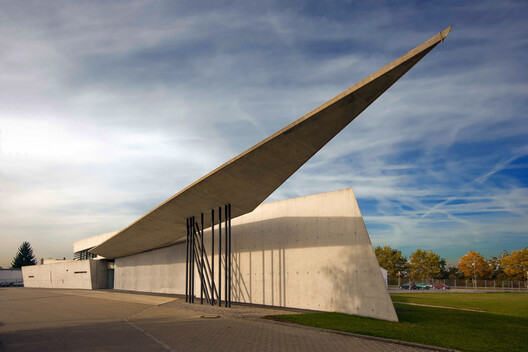
In design, Marcel Breuer used bent tubular steel in 1926 to create a seat that suspended the user over empty space, rather than resting firmly on four sturdy legs. In cinema, Alfred Hitchcock's film Vertigo (1958) addresses—albeit from a different perspective—the idea of gravity and the persistent fear of falling through time and space. Yet, it is in architecture that the quest to challenge gravity becomes most evident.
This lightness stems from several aspects, beginning with utilitarianism. Some researchers argue that stilt houses, built over water or soil, are among the oldest construction methods in the world, and perhaps the first in the pursuit of lightness. Dating back to the Neolithic and Bronze Ages, they persist to this day, primarily in riverine settlements, coastal regions, or floodplains. This is a significant structural typology for the emergence and survival of the concept of floating structures, developed primarily for practical safety reasons.
Moving from utility to spiritual milestones, Gothic cathedrals, for instance, sought to overcome gravity. This time, they did so not in the name of physical comfort, but of spiritual elevation. Their pointed arches, combined with ribbed vaults and a remarkable ability to manipulate light—through stained glass or strategic openings, such as in the dome of the Florence Cathedral designed by Brunelleschi—made these buildings appear to touch the heavens.

Through a lightness achieved by structural and technical boldness, they were configured as spaces destined to elevate the spiritual experience, directing the gaze—and the soul—upward. This subtlety can be interpreted as an attempt to transcend the weight of the body, almost as a denial of finitude itself.
While this grandiosity allowed the spirit to ascend, it also evoked a sense of oppression—of insignificance in the face of its sheer scale. These opposing yet complementary feelings converged toward the same end of subordination. This sensation also manifests in the manipulation of architectural lightness within a completely different context: that of modernism.
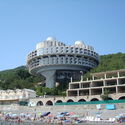
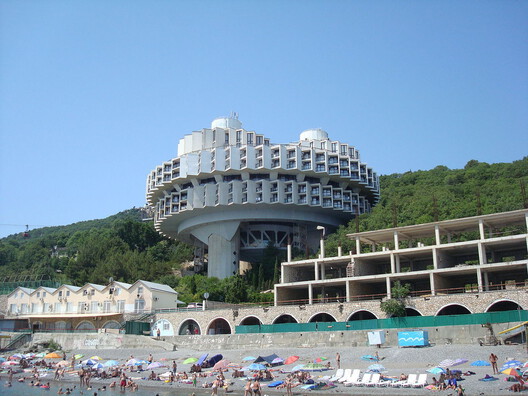
Soviet modernist civic structures, for instance, leveraged advancements in construction techniques—now using steel and concrete—to create massive spans in structures that appeared to float. Here, lightness could represent the power and technical prowess that (almost) defeats gravity. Although the concept of pilotis and the free plan arose from the idea of freeing up the ground to allow the continuity of the natural landscape or urban flow, this structural composition allowed for diverse manipulations and interpretations, such as the Druzhba Sanatorium in Crimea.
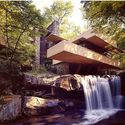
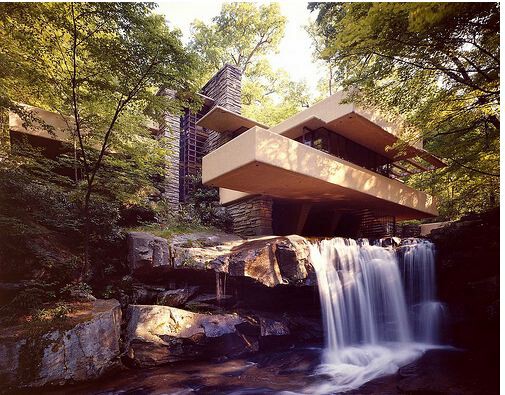
Illustrating the different perceptions created by the same construction technique, in Frank Lloyd Wright's classic Fallingwater, for example, the striking interplay of volumes cantilevered over nature made its mark on history not by imposing a political ideology, but through a symbiosis with the natural environment. However, does challenging gravity by placing the house directly over the waterfall, rather than in front of or around it, not also represent superiority and dominance over nature?
In a precise technique that verges on the impossible, untrained eyes are drawn to a structural illusion that seems simple, yet is grounded in precise calculations of anchoring, counterweights, and extensions. And it is precisely within this extreme "simplicity" that the veneration lies.
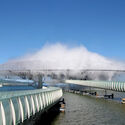
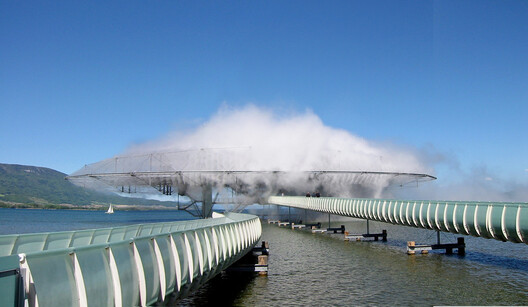
This simplicity has been stretched over the years, making the pursuit of lightness increasingly omnipresent and extreme. Today's architecture, liberated from the canons and constraints of styles, has fostered conditions for independent creative expression. The Blur Building by the American duo Diller + Scofidio for Expo 2002 in Switzerland is a case in point.
Its architectural performance is realized by spraying a cloud of water mist into the air through nozzles distributed across the pavilion's entire metallic structure. The lightness of architecture is thus explored to its fullest potential, as the liquid (or airborne) materiality of the architectural performance lasts only a few seconds—to be repeated moments later.
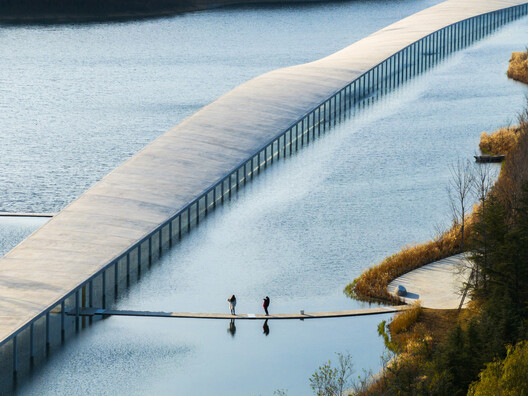
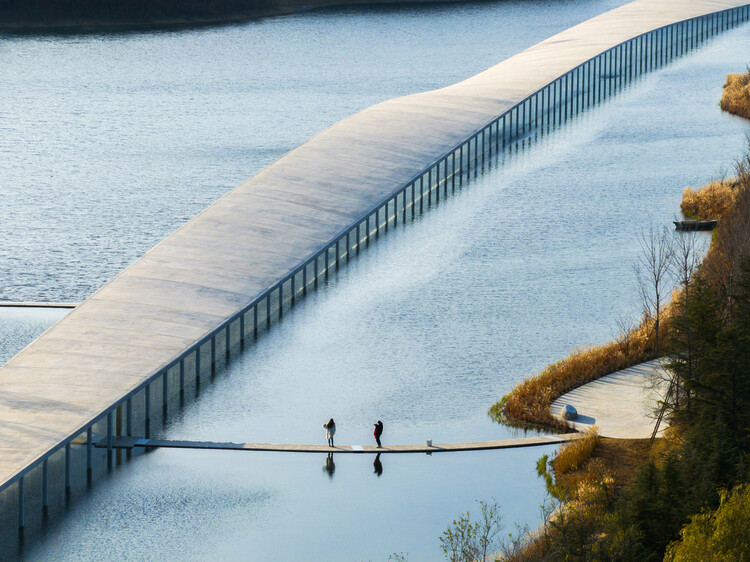
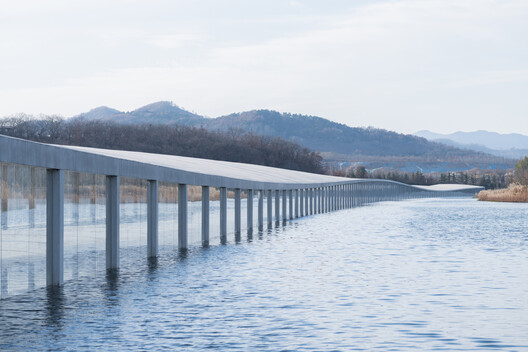
In doing so, the Blur Building breaks with one of the fundamental pillars of architecture—the very idea of permanence. The centuries-old Vitruvian principles—firmitas, utilitas, venustas—are questioned, since the pavilion's architecture does not depend on them to establish itself as a work of art—one that is almost immaterial. The very definition of architectural space is called into question because the work is perceived and experienced not so much as a material enclosing surface, but rather as an architectural event that invites a penetrating, poetic, and immersive experience. These are sensations similar to those offered by the Zaishui Art Museum by junya ishigami + associates, albeit in a more "material" form.
While acknowledging the impossibility of exhausting every possible association between the idea of lightness in architecture and the sensations this gesture can evoke, this article has sought to trace a historical path to investigate, above all, the fascination with overcoming gravity that permeates architectural history.
The initial question of why we want to float in the first place could thus yield several answers: to survive, to project power, for pure delight, to question current architectural canons (as with the Blur Building), but also to envision what architecture could become (as with Fuller's Cloud Nine).
Ultimately, however, the quest for lightness seems intrinsic to the human urge to challenge oneself—to achieve the impossible, becoming capable of dissolving tons of matter with a simple gesture. It is architecture straining its own limits within this contradiction—not always beautiful, but sometimes strange and distressing—revealing, as Marshall Berman famously put it, that "all that is solid melts into air."
This article is part of the ArchDaily Topics: Light, More Light, Lightest: Redefining how architecture touches the ground. Every month we explore a topic in-depth through articles, interviews, news, and architecture projects. We invite you to learn more about our ArchDaily Topics. And, as always, at ArchDaily we welcome contributions from our readers; if you want to submit an article or project, please contact us.
Related Article
Floating Cities of the Past and FutureThis article was written by Camilla Ghisleni. The translation is powered by AI.


