

-
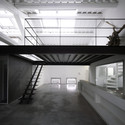
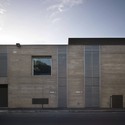
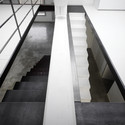
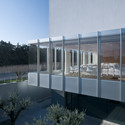
Architects: Goring & Straja Architects
- Area: 850 m²
- Year: 2012
-
Professionals: Varese Controlli, Tetris Design and Build


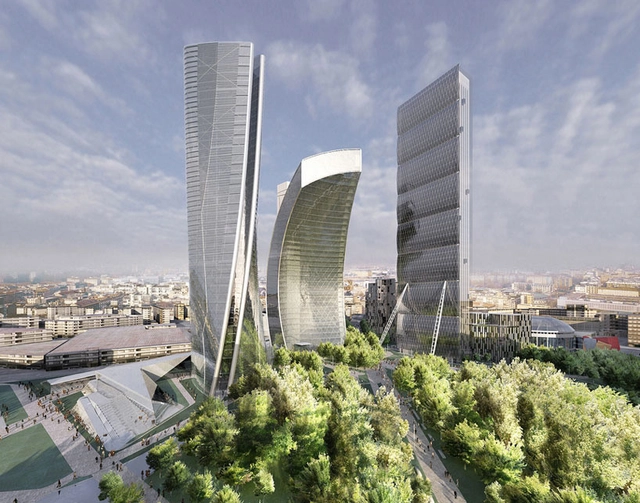
CityLife Milano is an ambitious commercial and residential development on Milan's historic former trade fair grounds: the Fiera Milano. On the surface, over half of CityLife Milano will be covered with upwards of 168,000 square meters of landscaped parkland dedicated to pedestrians and bicycles. This lush, pedestrianized space will be centered around a grand new piazza - 'piazza delle tre torri' - shaped by a trio of towers and surrounded by a cluster of residences, all designed by three world-renowned architects. As previously mentioned, Arata Isozaki and Andrea Maffei has contributed the Isozaki Tower, which is planned to become the tallest skyscraper in Italy at 202 meters and built alongside the curved, 150 meter Libeskind Tower. To complete the triad, Zaha Hadid has designed a twisting, glazed tower, which will rise 170 meters into the skyline.
More on the Hadid Tower and surrounding development after the break...
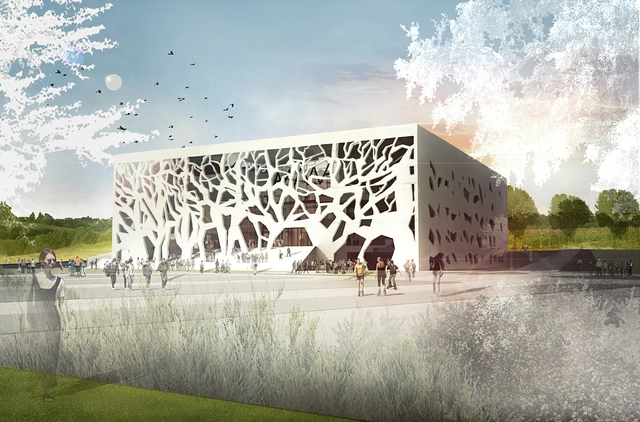
This dynamic cultural center in Grottammare, Italy, will be Bernard Tschumi Architects’ first commission in Italy. Inspired by the city's small medieval center, the roughly 7,000 square meter structure will house a variety of exhibitions, conferences and workshops in an effort to “strengthen people’s ties to the territory with which they identify” by exchanging information about the existing city and envision its possibilities for the future.
The architect's description after the break...
Michele_Nastasi.jpg?1361944557&format=webp&width=640&height=580)
Opening March 11, and on view until April 30, Rome’s Ermanno Tedeschi Gallery (Via del Portico d'Ottavia 7) will offer “Never Say the Eye Is Rigid:Architectural Drawings of Daniel Libeskind,” the city’s first exhibition of architectural drawings by the world-renowned architect. The exhibition includes 52 original drawings from eight diverse Libeskind projects in Germany, Italy, Poland, United Kingdom and the United States, including the architect’s signature work, the Jewish Museum Berlin (2001), and Memory Foundations, Ground Zero (2003), the master plan for the World Trade Center site. More information on the exhibition after the break.
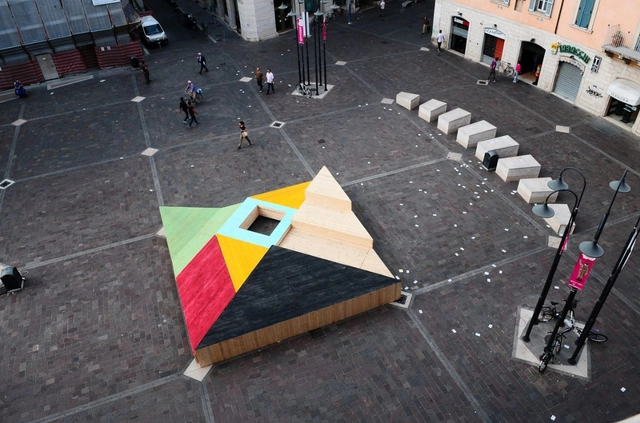
Orizzontale was recently invited by GATR to take part in the 2012 edition of the architectural festival Festarch.lab with a project which imagines and builds upon an architectural installation for the main square of Terni, a town in the center of Italy. With the challenge to design a multifunctional stage, the result was ‘Gondwana’, a mobile archipelago of wooden platforms, which comes in different shapes, dimensions and colors, and invades the square with endless configurations. More images and architects’ description after the break.
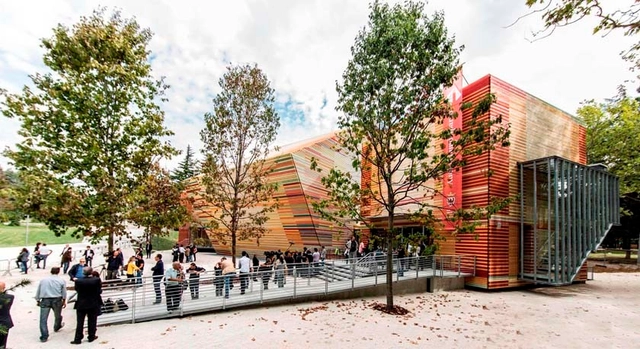
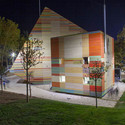
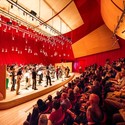
Text description provided by the architects. In April 2009, the central Italian city of L’Aquila was devastated by a crippling earthquake, claiming lives and causing extensive damage to thousands of buildings, including the leveling of the city’s main auditorium venue. Nearing the four anniversary of this tragic disaster, the Italian city of Trento has donated a Renzo Piano-designed auditorium, which was inaugurated in October, in an effort to aid the reconstruction of the medieval city.
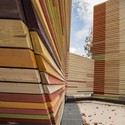
Creating an illusion of instability, the auditorium is formed by three interconnected cubes made entirely of wood (1.165 cubic meters in total) that ironically appears as they had “haphazardly tumbled down” and came to rest upon each other. The entire structure was prefabricated and then assembled onsite by Log Engineering, who pieced it together with 800,000 nails, 100,000 screws and 10,000 brackets.
More after the break...

Looking to redefine the relationship between students, buildings and the city of Milan, Bocconi University challenged architects world-wide to design a “campus for the third millennium”. Although first prize was awarded to SANAA’s courtyard-centric complex formed by a series of undulating figures, OMA’s proposal provides an interesting twist to intercity university campuses.
Formulating a composition of objects that “represents a three-dimensional re-learning of humanistic values”, OMA’s Bocconi Urban Campus proposal sets the stage for Homo Economicus. Two clusters of independent buildings - an “extroverted” new school of management and the “introverted” a-frame student housing tower - are centered around a public amphitheater topped by a canopy of “architectural” umbrellas. While the thirteen story tower shelters the more intimate campus programs and acts as a backdrop to the boisterous new school, all spaces remain permeable to the activities of the surrounding city and establish the most appropriate and stimulating connection.
More photos of OMA's proposal after the break...