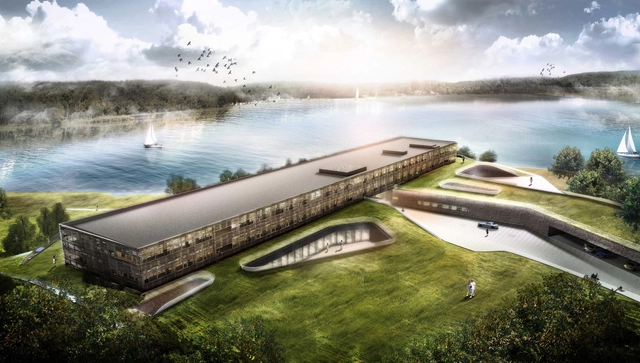
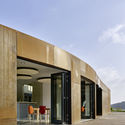
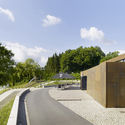
GRAFT has begun construction on its new project, Hotel Bostalsee, a four-star hotel and spa situated lakeside in Saarland, Germany.
Based on the idea of integrating the building with its natural surroundings, the Hotel’s figure has been developed from the local topography, as well as the junction and relationship between the woods and the water.
ART & SPACE Gallery is delighted to present new works by the famous British architect and artist WILLIAM ALSOP for the second time in Munich. You are also cordially invited to attend the lecture by Prof. William Alsop "making life better", organized with the support of the Chair of Building Technology and Climate Responsive Design, Prof. Dipl.-Ing. Thomas Auer, Technical University of Munich (TUM). The lecture takes place on November 26, 16:45-18:15, room No. 0602, Theresianum, TUM
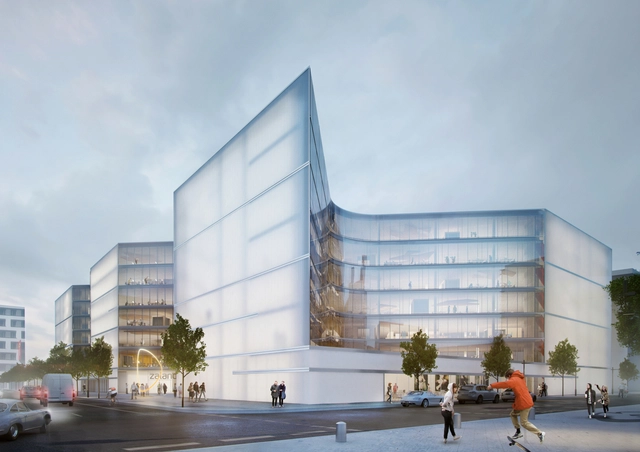
HENN has won the competition to design the new Zalando Headquarters in Berlin. The project will consist of two seven-story buildings, where up to 2,700 employees will occupy 42,000 square meters of office space.
With the new Headquarters, all of the Zalando offices will be brought together, rather than dispersed throughout the city.
The stunning images in this collection by Argentinian photographer Guillermo Srodek-Hart tell captivating stories of the country’s rural commercial establishments. Located in the rural areas outside of bustling Buenos Aires, the commercial establishments—butcheries, bakeries, bars, repair shops, garages, dry cleaners—depicted in this collection by photographer Guillermo Srodek-Hart appear steeped in history, and are packed with details dripping with color. Throughout the collection hangs an air of abandonment, of time passing, or perhaps stopping. Whether or not that is true, Srodek-Hart has memorialized a culture worlds apart from the city that lies a short distance away. The exhibit at Architekturgalerie Munich, supported by Prestel Verlag and Kuckei + Kuckei Galerie Berlin, shows a selction of his works recently published in his book “Stories”, Prestel Verlag, with a foreword by Anne Tucker.
After the Bolsheviks secured power in Russia in the late 1910s and eventually created the Soviet Union in 1922, one of the first orders of business was a new campaign, Novyi bit (new everyday life), which sought to advance many of the most hallowed causes of their newly minted socialism. The initiative’s great success came from the bold designs of Constructivist artists such as Alexander Rodchenko, Vladimir Mayakovsky, and Lyubov Popova. Using a high-contrast visual language and a combination of words and symbols, the graphics were arresting and comprehensible in a post-tsarist country that was largely illiterate, and became some of the most recognizable examples of twentieth century graphics and political propaganda.
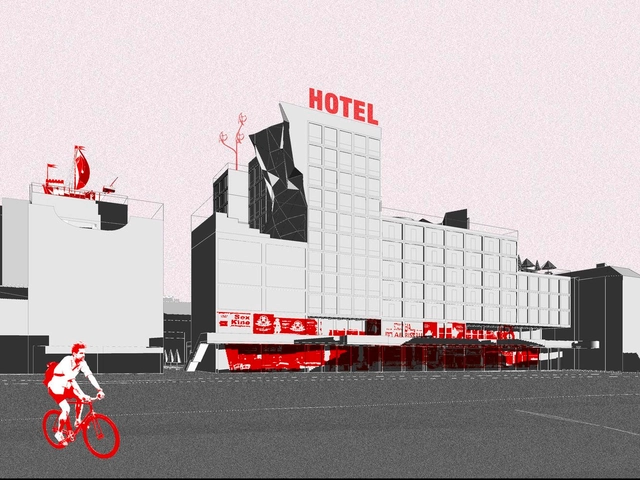
It's hard not to see the connection between the styles of the Constructivists and the unusual graphics created by NL Architects in association with BeL (Bernhardt und Leeser) Sozietät für Architektur BDA for their competition-winning proposal for Hamburg’s St. Pauli neighborhood, consisting of an urban plan of housing and other amenities at the former site of Esso Häuser on the Spielbudenplatz. And, while this stylistic connection may not have been intentionally drawn by the architects - the inspiration for the graphics is not mentioned in the four-page project description - it is oddly appropriate for this particular development.
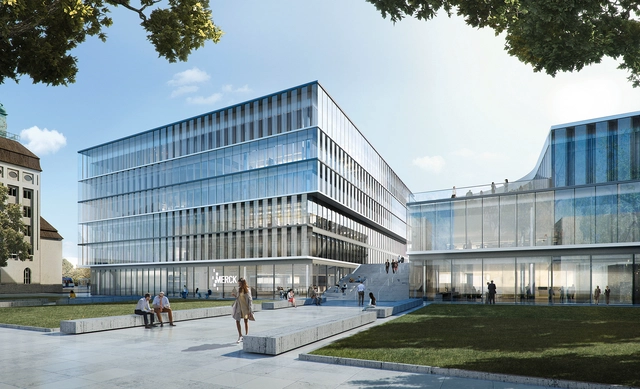
HENN has broken ground on the Innovation Center at pharmaceutical company Merck's corporate headquarters and factory in Darmstadt, Germany.
The new Center follows the site’s pre-established master plan, also designed by HENN, placing the new building complex between two existing company buildings and at the end of what is to become a spacious public square.
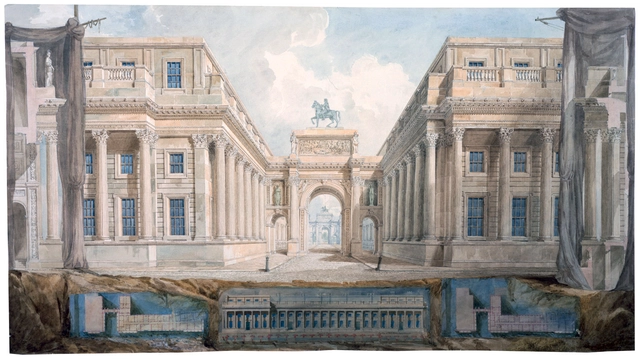
Presentation drawing for the proposed rebuilding of Downing Street with two Triumphal Arches in perspective. Pencil, pen and ink, watercolor & bodycolor ca. 1827
Tchoban Foundation Museum for Architectural Drawing is hosting its second exhibition from Sir John Soane's Museum, showing masterpieces of British Neoclassicism. The exhibition illustrates the ambition of leading British architects of the late 18th century who strove to create new architecture in the Classical tradition that could compete – in terms of public works, private houses, mausolea, interior detail and even furnishings - with the glories of the Ancient World.
























.jpg?1444099109&format=webp&width=640&height=580)
.jpg?1444099163 "© Jörg Hempel Photodesign")
.jpg?1444099442 "© Robert Mehl")
.jpg?1444099182 "© Jörg Hempel Photodesign")
.jpg?1444099521 "© Robert Mehl")
.jpg?1444099109)