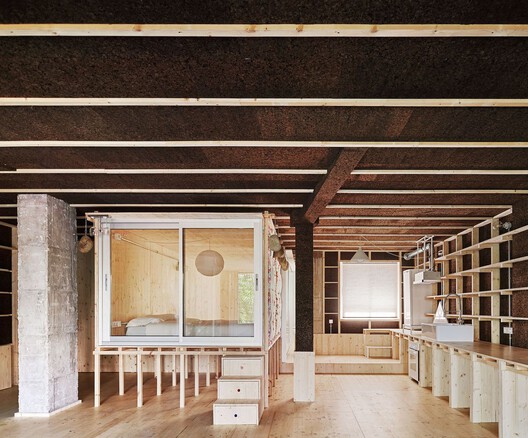
How can we transport ourselves to natural environments when we find ourselves in entirely urban contexts? The materiality of spaces is one of the factors that determines the atmosphere we inhabit. In this regard, the incorporation of natural materials in interior architecture can help introduce textures, colors, and qualities inherent to nature into our daily spaces. In this article, we explore the specific use of cork as a resource in interior design and the different ways it can transform the experience of a space. Cork is the bark of the cork oak, a tree species that, when harvested without harming the tree, can be transformed into a material suitable for multiple applications in architecture and design.
Three Little Pigs House / EME157
Continuity between exterior and interior finds material expression in this Madrid home, where the cork used on the facade extends into the interior spaces. The material also appears on a sliding door that allows the kitchen to be closed off or integrated into the rest of the home, becoming an element capable of transforming the spatial configuration. Its natural texture and tone maintain a visual link between the envelope and the interior, while its mobile presence allows the same material to participate in both the architecture and the daily dynamics of living in it.


