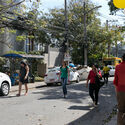
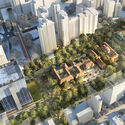
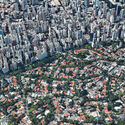
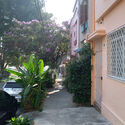
More People, Fewer Trees? In the face of the climate crisis, tree-lined streets—once merely desirable—have become an essential attribute for quality of life in São Paulo. Meanwhile, population density in the infrastructure-rich expanded center seems to be the most efficient path for the capital's growth. But are these two goals truly at odds? Does higher density inevitably mean more concrete and fewer trees? In a recent column for Jovem Pan, architect and urban planner Helena Degreas highlighted the ongoing loss of urban canopy in the city. In her view, this is a reflection of the "unbridled densification resulting from the guidelines of São Paulo's Strategic Master Plan, combined with regulations regarding tree removal along urban transformation development axes." In just four years, the Pinheiros Subprefecture alone reportedly lost over three thousand trees. Indeed, defending the city's "green lungs" is one of the central arguments supporting the historical resistance of residents in neighborhoods like Jardim América, Jardim Europa, Alto de Pinheiros, and Pacaembu to any changes in zoning laws that would encourage population density in these areas. On the other hand, according to research conducted by the Coalition for Urban Transitions, an initiative of the New Climate Economy, and the Urban Land Institute, evidence shows that increases in urban density are linked to declines in both local and per capita carbon emissions and energy consumption. This reduction in emissions is driven by factors such as decreased private vehicle use, greater energy efficiency in buildings, less built infrastructure, and fewer land-use changes on urban fringes. Consequently, dense cities are greener cities. These factors underpinned the argument made by architect and urban planner Anthony Ling in defense of proposed changes to the 2015 Zoning Law in his article "The Struggle of São Paulo's Elite to Exclude the City," published in Caos Planejado. To mark World Environment Week (June 5 to 9) and contribute to this controversial debate, I cross-referenced the number of street trees per square kilometer (vertical axis) with inhabitants per square kilometer (horizontal axis) across São Paulo's 96 districts, sharing the analysis in a LinkedIn post. If it were true that population density and green density in São Paulo necessarily move in opposite directions, we would see a clear negative correlation between the two variables. However, as the chart below shows, that is not the case. As the chart demonstrates, several districts have both green and population densities above the city average—such as Jardim Paulista, Vila Mariana, Consolação, and Perdizes. In Jardim Paulista, however, part of this high green density is due to the leafy neighborhood of Jardim América, where heritage preservation and zoning laws restrict construction and high-rises—consequently keeping population density low. The same occurs in the Perdizes district, which includes part of the Pacaembu neighborhood. In fact, focusing on the top of the chart, where districts with above-average green density are located, we do observe a slight negative correlation between green density and population density. Alto de Pinheiros has low population density but boasts the highest number of street trees per square kilometer in the city. As we move to the right on the chart toward districts with higher population densities, we see a drop in green density, as in Santa Cecília, República, and Bela Vista—though it is worth noting that even these districts remain above the city average. It is also true that higher population density, even in green areas, can mean fewer trees per capita. Bela Vista and República, for instance, despite their above-average green density, are among the districts with the lowest number of trees per inhabitant (highlighting the relevance of developments like Cidade Matarazzo in Bela Vista). Conversely, Butantã, despite having a green density close to the average, is one of the districts with the highest number of trees per inhabitant. However, it is when we factor price into the analysis (represented by circle size) that São Paulo reveals its segregated nature once again, as previously identified by Properati, the consultancy that compiled the green density and price data—while population density data was sourced from the City Hall website. Broadly speaking, the districts with the highest green density are also among the capital's most expensive. Furthermore, wealthy areas concentrate most of the city's parks, such as Ibirapuera Park (Vila Mariana), Parque do Povo (Itaim Bibi), Trianon Park (Jardim Paulista), and Augusta Park (Consolação). In other words, the benefits of green spaces in São Paulo also appear to be a privilege reserved for the few. The contrast between the two "Itaims" is particularly striking: on one hand, Itaim Bibi is green, wealthy, with below-average population density and nearly 150 street trees per thousand inhabitants; on the other, Itaim Paulista is low-income, densely populated, and has few street trees (just 25 per thousand inhabitants). To be clear, I am not suggesting that the construction of new buildings along the urban transformation axes is not leading to tree removal—I myself deeply regretted the removal of a massive, century-old tree on a plot on Avenida Pompeia, near my home, to make way for a new building. The issue, however, may not be high-rise development and population density in themselves, but rather a lack of oversight and strategic planning to preserve existing trees—or to promote urban reforestation. As Helena Degreas herself points out, "in the city of São Paulo, tree planting is carried out by subprefectures on a compensatory basis—meaning that for every tree removed within a subprefecture's territory, another must be planted anywhere else in the city. It is at this point that issues related to local microclimate, soil permeability, and biodiversity are bypassed solely by the logic of real estate density." Her proposal to plant trees in the exact location where they were removed makes perfect sense. "Removing a tree from my street and planting it elsewhere makes no sense when it comes to local microclimate and resident well-being," she rightly argues. Furthermore, urban greening or even creating small garden beds on sidewalks almost always falls on property owners, without proper planning or public sector incentives. Structured, coordinated initiatives could significantly improve the microclimate and quality of life for those who use these public spaces. When properly planned, population density tends to create more resilient, efficient, diverse, and prosperous areas, both socioeconomically and environmentally, as evidence suggests. Thus, what the resistance to density in certain areas seems to reveal, rather than a legitimate defense of the city's green spaces, is the old, disappointing defense of established privileges. Extremely well-located, close to high-paying jobs and major cultural and leisure facilities, areas with high green density and low population density are among the most expensive in the city. "What they want to maintain is the quality of life in their own neighborhood—the silence, the greenery [...] but to call that public interest? No," stated Flávio Villaça, one of Brazil's most prominent urban planners, quoted by Ling in his article. Via Caos Planejado.