
With studies estimating that by 2050 nearly 70% of the global population will live in cities, planning for more sustainable and balanced urban development has become imperative for the coming decades. This discussion invariably hinges on a more assertive choice of construction materials that yield greater urban and environmental benefits. In this context, a material re-emerging as a more sustainable choice for urban infrastructure is wood, particularly when paired with new technological advancements, which is being reintroduced into cityscapes due to its versatile characteristics and its ability to align with the construction of tomorrow.
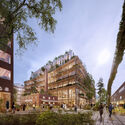


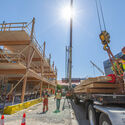

Sometimes referred to as "the concrete of the future", wood is challenging conventional perceptions of building materials, as the industry increasingly recognizes its structural qualities and adaptability to a wide range of applications. Unlike traditional materials such as concrete and steel, which consume large amounts of energy and emit a significant amount of carbon during production, wood is a renewable and reusable resource that has a lower environmental impact during fabrication and installation. It is also a lightweight material relative to its strength, possesses good thermal properties, and is highly durable, provided it is properly installed and maintained.



