One of the leading names in Brazilian photography, Hans Gunter Flieg (1923) worked in the fields of industry, advertising, and architecture. His images document the country's industrial development and verticalization, particularly in the city of São Paulo, starting in the 1940s. Through highly technically sophisticated photographs, he documented industrial facilities, machinery, buildings, and objects, challenging the boundaries between the objectivity of documentary photography and formal rigor.
To honor his work and his centennial, celebrated this year, IMS Paulista opens the exhibition Flieg. Everything That is Solid on Tuesday, August 22, at 6:00 PM. With free admission, the exhibition reviews the career of the photographer, whose archive has been held by IMS since 2006. The selection features around 180 images, two videos, and items such as cameras and albums. The exhibition is curated by Sergio Burgi, photography coordinator at IMS, with assistance from Mariana Newlands. At the opening (8/22) at 6:00 PM, the curator will give a presentation introducing the exhibition.
Flieg's life and career interweave across two continents with the history of the 20th century. The photographer was born in 1923 in the city of Chemnitz, Germany, to a middle-class Jewish family. In 1939, Flieg studied photography in Berlin with Grete Karplus, a professional associated with the city's Jewish Museum, which was closed by the Nazis. That same year, his family immigrated to Brazil to escape the persecution of Jewish people. The family settled in São Paulo, and from 1945 onward, Flieg began his career as a professional photographer, working primarily for corporate clients.
Flieg photographed for companies such as Willys-Overland, Mercedes-Benz, and Marcas Famosas S/A, pioneers of the automotive industry in Brazil. He also worked for major advertising agencies of the period, such as Standard and Thompson. In addition to his commercial work, he served as the official photographer for the 1st São Paulo International Art Biennial in 1951 and documented the construction of the MASP headquarters on Paulista Avenue in the 1960s.
The exhibition is divided into three sections. The first features images of industrial architecture, documenting major projects such as the construction of the Ibirapuera Gymnasium in São Paulo in 1955, and the Jupiá and Ilha Solteira hydroelectric power plants. It also includes photographs of the Duchen Factory in Guarulhos, designed by Oscar Niemeyer in 1954, among others.
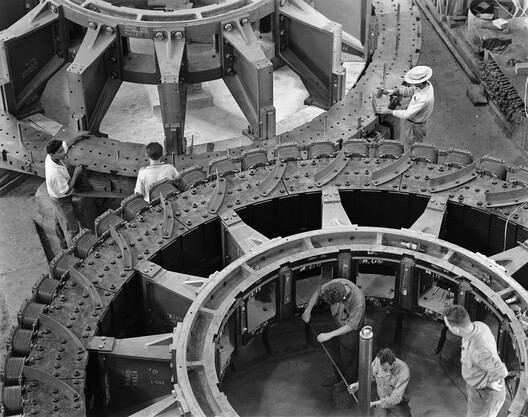
The second section features images taken inside factories, focusing on machinery. Despite being intended for commercial purposes, the images highlight the sculptural qualities of this industrial equipment, focusing on its lines and forms. The curator comments on the photographs: “Flieg's work was deeply influenced by European modernism, combining mastery of the formal composition of the photographic image with absolute control over lighting, exposure, and film processing. With high formal rigor, his industrial photography also allows structures, equipment, and industrial objects, though documented in an objective and direct manner, to lead in many cases to images with a strong abstract bias. This expands and updates the relevance of the photographer's output within the context of modern and contemporary photography in Brazil.”
In the third and final section, visitors will find product images taken for the advertising and artistic markets, aimed at illustrating catalogs and newspaper advertisements. These include, for example, photographs of tires, typewriters, calculators, tool sets, and furniture. The section also features photographs of the glass easels designed by Lina Bo Bardi, captured when the photographer documented the opening of MASP, and photos of Max Bill's sculpture Tripartite Unity, which won the sculpture prize at the 1st São Paulo Biennial in 1951. These meticulously composed images utilize contrasts of light and shadow to highlight the qualities of each object. In a 2014 interview with IMS, the photographer emphasized: “The goal is to show the product in the best possible way. Whatever you do, it has to be well done.”

On display until January 2024, the exhibition also invites reflection on the social transformations underway today in both the workplace and the arts, as Burgi notes: “Reinterpreting Flieg's archive in the year he turns 100, now that we are in the third decade of the 21st century—characterized by the construction of a knowledge and information society as opposed to the industrial society of the mid-20th century—allows his work to be understood through new perspectives.”
On this theme, the curator adds: “Flieg's gaze on an industrial society that aspired to be and became modern in postwar São Paulo, without breaking, however, with the mechanisms of reification, alienation, and power of its time, leads us to reflect now, decades later, on a post-industrial society likewise immersed in deep and radical transformations and contradictions, where once again all that is solid melts into air.”
Exhibition "Flieg. Everything That is Solid"
Opening: August 22, at 6:00 PM, featuring a presentation by Sergio Burgi
Dates: August 23, 2023, to January 28, 2024
Free admission
Address: Avenida Paulista, 2424
Hours: Tuesday to Sunday and holidays (except Mondays), from 10:00 AM to 8:00 PM
This article was written by ArchDaily Team. The translation is powered by AI.