
The phenomenon of building new cities around the world is gaining momentum in an effort to mitigate the effects of climate change, contain mass migration and brain drain, or improve the poor quality of life in some cities—a reality highlighted by pandemic lockdowns, among many other reasons. Urban planners and professionals in architecture, engineering, and other disciplines undoubtedly face major challenges, raising the question: should we concentrate all our efforts on creating new urban centers, or focus instead on improving conditions and addressing the issues of existing ones?
.jpg?1652371287)
Led by international firm Gómez Platero on the urban planning front, the project, named +Colonia, aims to create a natural expansion of the historic Uruguayan port city of Colonia del Sacramento onto lands located one kilometer east of the port. The Uruguayan government has already approved the start of construction for this city, which aims to build housing for 30,000 people, generating 6,000 new jobs in the knowledge economy and 2,000 in construction and services.
The site covers approximately 515 hectares, featuring a 7 km front of natural coastline along the Río de la Plata with white sands, two quarries, and a lagoon. It is located just 40 minutes from Buenos Aires and nearly two hours from Montevideo.
.jpg?1652371339)
Set to be developed over a 10-year period, the proposed new city forms a development platform with mixed and flexible programming. It aims to expand Colonia's productive matrix while creating an open community that fosters a new relationship between nature and the city, based on environmental sustainability, renewable energy, and respect for the landscape. This integration spans from one end of the site to the other, transitioning from the more urban western area, close to the established city, to the more natural eastern side.

The urban design proposes a polycentric, alveolar cellular structure at different scales to multiply the frontages of each hub. The natural landscape infiltrates this structure, and its nature-connected urban units adapt to the site's geographical features and are programmed based on demand.
Inspired by the values of younger generations—such as freedom, diversity, inclusion, and environmental respect—+Colonia bases its planning on two main pillars: sustainability and technology. The project incorporates separate networks: one for drinking water and another for graywater, which will be recycled for irrigation and other uses. This approach aims to create a double positive impact on water use, consumption, and purification.

Regarding mobility, the plan prioritizes pedestrian traffic along green paths and the use of shared bicycles and electric scooters. Surrounded by natural landscape, the various urban hubs will be able to establish shared thematic and programmatic zones based on their proximity. The primary road infrastructure network will connect the urban hubs and link their centers, creating two interspersed public space systems: one composed of natural parks and another of urban roads. Notably, the development of each hub will require a secondary public road network tailored to its specific program.
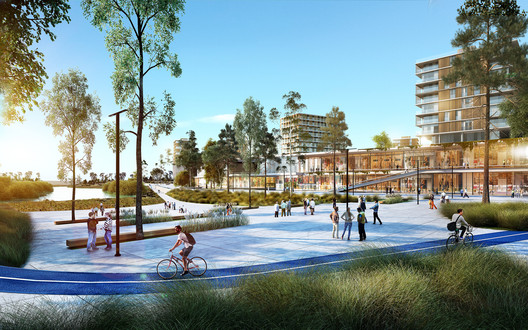
The concept centers on building a network of public natural spaces to consolidate a new system of interstitial parks, recognizing and highlighting inland landscapes while preserving habitats and natural ecosystems. By incorporating sports circuits, recycling facilities, smart home IoT systems, and resource and cost efficiency, the project aims to involve the community directly in its development.

Community participation is a central premise of the project, which plans to utilize blockchain technology to achieve democratic, decentralized decision-making. Through this system, residents will be able to help decide matters such as how to best utilize public spaces. Consequently, +Colonia is envisioned as a city co-created by its residents, helping to establish a vibrant cultural life.

Ultimately, over 50% of the land will be dedicated to parks, wetlands, and public coastline, while an additional 20% to 30% of the buildable area will be allocated to the public road network (both primary and secondary). To integrate with the existing urban area, the project comprises shops, offices, schools, medical centers, green spaces, and companies, aiming to attract new residents—particularly young professionals—from Buenos Aires, Montevideo, and other regional cities. While the first residents are expected to move in by 2023, questions remain: how do you encourage people to settle in a brand-new city, and what strategies can be used to foster a sense of belonging?

Although concerns were raised during the project's review process regarding the environmental impact of such a development on an area currently home to many tree species, various sustainable policies are in place, monitored by Uruguay's National Directorate of Quality and Environmental Evaluation (Dinacea). The area is divided into sectors corresponding to the project's growth and consolidation phases. The initial phase focuses on the master plan for 200 hectares located along the western boundary of the site, between the established city and the road to El Calabrés Beach. There are two phases defined by the path of the La Caballada stream, the first linking to the existing city and the second extending east of the stream.

This article was written by Agustina Iñiguez. The translation is powered by AI.

.jpg?1652371339 "A New City in Uruguay? Learn About the Project to Build 30,000 Homes in Colonia")


.jpg?1652371287 "A New City in Uruguay? Learn About the Project to Build 30,000 Homes in Colonia")


