
Peru, a country of rich heritage and ancestral wisdom, won two awards at Expo 2020 Dubai for the Peru Pavilion, which captivated visitors through the concept of "Timeless Peru." First, the trade publication Exhibitor presented the pavilion with the World Expo Award in the People’s Choice Awards category, following an online vote where people from around the world selected their best overall experience from the expo.
Additionally, on March 30 of this year, the Peru Pavilion won the Gold Award at the BIE Day Awards in the Self-built pavilions – Category B (between 1,750m2 and 2,500m2) category. The award recognized three key aspects: architecture and landscape, exhibition design, and theme interpretation.
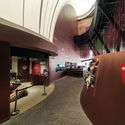
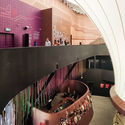
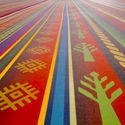
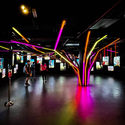

Based on the concept of "Timeless Peru," the pavilion's designing architects drew inspiration from both concrete and abstract elements of the country's cultural, natural, and historical heritage. Located in the expo's "Mobility" district, the pavilion aligns with the criteria designated for its location. As such, the design abstracts the characteristics of traditional, unique forms of mobility and connectivity from Peruvian culture, such as the caballitos de totora (reed watercraft) and the Q'eswachaka bridge. Both are the result of weaving techniques, where the interlacing of fibers achieves a goal of connectivity and unity.

Therefore, the pavilion's envelope was designed as a woven volume. This structure is not only a visually striking representation of Peruvian culture but is also lightweight, sheltering and enclosing the interior exhibition space. Similarly, a woven element serves as the centerpiece of the building, welcoming visitors throughout their journey.
Visitors enter the exhibition from the side of the pavilion, where the textile envelope is subtly lifted while maintaining its volumetric presence. The entrance path represents the Q'eswachaka ichu-grass bridge, isolating and transporting visitors from the bustling exterior into a serene, detached circular space. Here, visitors experience direct contact with a void open to the sky, where the woven boundaries become the main focus of the space.

Furthermore, Andean duality is an inherent principle within the worldview of Andean communities, reflecting in many aspects of Peruvian culture. Consequently, this principle served as a key strategy in designing both the architecture and exhibition of the Peru Pavilion. As architects Boris Barriga and Samuel Povis explain, "In both the exhibition content and the architectural gestures, we always sought to maintain a balance rooted in this duality. The most prominent elements are the lightweight, luminous central element (life) adjacent to the heavy, metallic element connected to the ground. The former features a concave geometry connected to the sky, while the latter has a convex geometry connected to the earth."

The pavilion stands out for offering an exceptionally diverse experience to visitors. Since its opening in October 2021, the pavilion has exceeded expectations, welcoming over 1,400,000 visitors. In its entirety, the Peru Pavilion provides an immersive journey through culture, history, landscape, and gastronomy that, combined with the warmth of the Peruvian people, created a unique sensory experience deserving of these accolades.
This article was written by Vania Masalías. The translation is powered by AI.


