
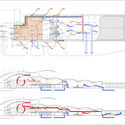
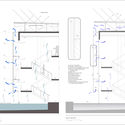
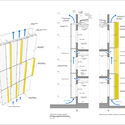
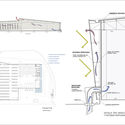

When we speak of passive climate control, we refer to techniques that, with little to no energy consumption, create the appropriate temperature, humidity, and air quality conditions for comfort and habitability, partially or fully replacing active mechanical systems. Typically, these strategies are based on natural environmental parameters—such as air currents, the earth's thermal stability, and solar paths, among others—to regulate heat gain in the summer and heat loss in the winter, achieving optimal thermal comfort.
Incorporating strategies that leverage the advantages of geothermal energy, such as earth tubes; the thermal mass phenomenon, like Trombe walls; or the Venturi effect, such as cross ventilation, is a rational choice. Not only does it help develop better indoor spaces, but it also yields substantial energy savings that benefit both users and the environment. Air conditioning systems, for example, are not only expensive to run but also highly detrimental to the environment, accounting for approximately 10% of global energy consumption. In fact, according to the International Energy Agency, mechanical cooling systems are projected to account for 37% of total global energy demand by 2050.



