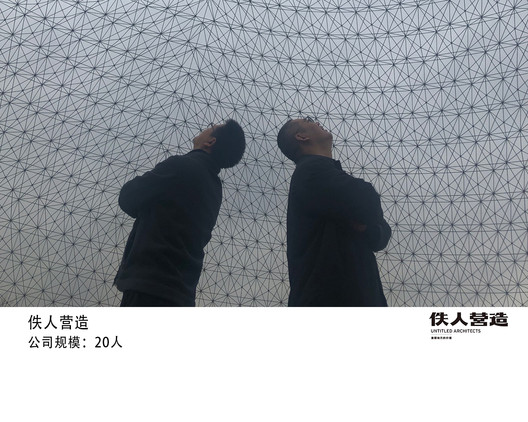
Wang Hao (born 1978) is the co-founder of Atelier Anonymous. In 2013, he held the solo exhibition "Free Structure: New Chinese Dwellings" at the Shanghai Design Center, and was awarded the German *Bauwelt* First Work Award in the same year. He participated in the Shanghai Urban Space Art Season in 2015, and exhibited at the 15th Venice Architecture Biennale in 2016. In 2020, he co-organized the "Timber Structure Renaissance" exhibition with the K11 Art Foundation (KCG) in Shanghai, and received the Natural Build Award | Young Architect Discovery Award.
Qiu Zhefeng (born 1979) is the co-founder of Atelier Anonymous. In 2008, he published the book *The Forerunner: China's Future in a Small Town*. In 2012, he curated the "Society" project for the City Pavilions program at the 9th Shanghai Biennale. In 2013, he was invited to participate in the 55th Venice Biennale, curating the exhibition *Shanghai and Venice: City Center, Diankou, Lima, and Palermo*.
In Chinese tradition, "Yiren" (anonymous craftsmen) is a collective term for all artisans, whether humble or great. Throughout the long course of history, these nameless or hidden craftsmen built ancestral halls, temples, bridge pavilions, government offices, and local dwellings—classical typological spaces loaded with historical significance. Atelier Anonymous views architecture across time as a continuum. Every architect is an active participant and interpreter in a thousand-year-old lineage of intellectual gatherings and spiritual resonance. Within this intertextual network of collective creation, traditions rooted in local Chinese soil serve as a shared spiritual origin. The spatial practices of Atelier Anonymous are dedicated to discovering the uniqueness of vernacular culture and regional identity. Addressing various scales—from villages and market towns to cities—and adopting a vernacular spatial philosophy, the studio explores the social order and tectonic logic of spatial extension within a contemporary context, pursuing urban design and architectural practices that refine traditional crafts, awaken the language of materials, and reshape structural systems.


.jpg?1640575949 "Shanghai & Shaoxing | Atelier Y: Project Architect, Assistant Architect, Resident Architect, Interior Designer, Intern")


