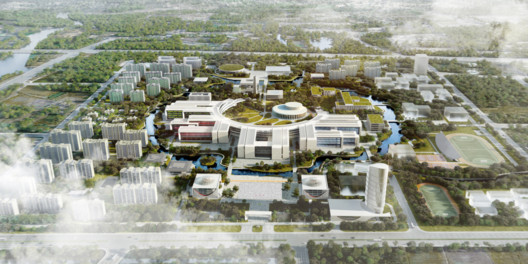
Universities, particularly in China, represent a critical transition period where exam-oriented learning gives way to independent thought. Prior to higher education, students largely absorb established knowledge within a singular campus environment; afterward, they must project their own creative and innovative ideas into a complex social landscape. Today's society demands more than ever from higher education. College should not merely be a place to acquire a trade; more importantly, it must teach life-enriching wisdom, foster critical inquiry and independent thinking, offer problem-solving methodologies, build personal knowledge systems, and cultivate the ability to connect and integrate into a broader social network.
How does Chinese higher education respond to the demands of our time?
How can higher education spaces meet future pedagogical needs?
Can campus spaces shape educational methods?
Can they foster independent student thinking?
In this issue, ArchDaily interviews Sun Wei, the lead architect behind Westlake University and the Sino-French Aviation University (Managing Partner at HENN and Principal of HENN China). Together, we discuss the evolution of higher education models in China, using the master plans of these two universities as case studies to explain the design process and share insights into campus architecture.


