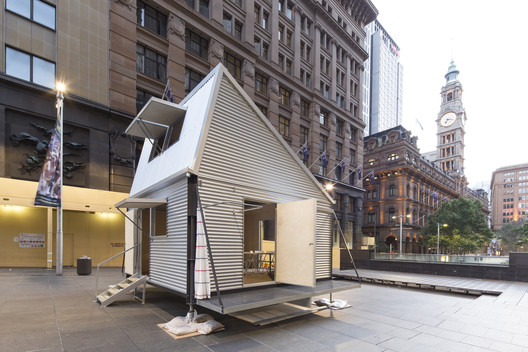
Following a natural disaster, architecture plays a fundamental role not only in rebuilding damaged structures but also in providing comfort and security for those affected. Successful post-disaster architecture must address both the immediate need for short-term shelter and long-term reconstruction and stability. With this in mind, we have compiled four examples of post-disaster architecture, ranging from built prototypes designed for rapid assembly to unbuilt proposals whose solutions stand out for their efficiency.
Emergency Shelter / Nic Gonsalves + Nic Martoo
Conceived as a retreat for victims to regain a sense of control after natural disasters—facilitating the recovery process through habitation—this shelter employs a flat-pack solution with a simple kit of parts. Designed as a cube where all vertical faces are identical, it results in a repetitive assembly sequence. Each face is composed of grids into which wooden panels are inserted, consisting of only two repeating components. The structure is secured by a wooden dowel at each end, ensuring the rigidity and integrity of the entire assembly.


