The COVID-19 pandemic has exacerbated various sanitary and infrastructural deficiencies in developing nations, particularly Angola, which already bears the burden of successive economic recessions.
The outskirts of major urban centers, with Luanda as a paradigmatic case, are critical territories for the spread of the disease. Home to nearly one-third of the country's population—80% of whom live in highly precarious urban conditions—a combination of factors creates an incredibly complex scenario. These challenges include a lack of basic sanitation, high built and population densities, overcrowded housing (averaging three people per room), inaccessibility for urban services (such as firefighters, waste collection, and police), a lack of public spaces and green areas, unsanitary indoor conditions, heavy reliance on the informal sector, and limited access to food security and healthcare services.
Under these conditions, lockdowns and social distancing become an "almost impossible mission," posing complex challenges to building resilience among the most vulnerable households and preventing community transmission at all costs.
The measures imposed by health authorities to reduce infections have a strong spatial component that fundamentally changes the way spaces are inhabited.
In these extremely precarious contexts, home confinement measures are an unattainable utopia for residents of peripheral neighborhoods. The exposure to new vulnerabilities in the face of the biological threat of COVID-19 exacerbates the already worrying socioeconomic conditions, with direct negative impacts that further widen existing social inequalities.
Against this backdrop, and taking advantage of the lockdown to foster social connection through virtual networks, a multidisciplinary group of experts holistically addressed mitigation measures for the impact of COVID-19. Their goal was to formulate short-, medium-, and long-term reflections and recommendations across various areas, including urban planning and management, basic habitability, informal commerce, food security, governance, and health and hygiene.
The publication of these recommendations, which can be accessed for free here, serves as a milestone and a record of this unprecedented multidisciplinary collaboration, aiming to be fruitful and effective in partnership with related institutions.
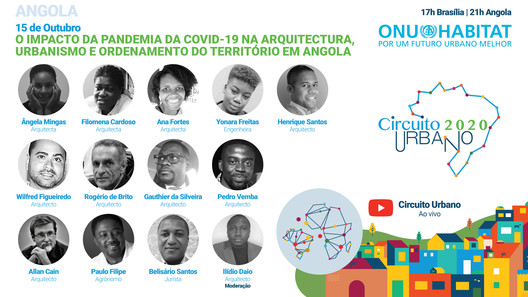
Additionally, this Thursday, October 15, the publication's coordinator, Ilídio Daio, will moderate a debate featuring Angolan architects, engineers, agronomists, and legal experts. The online event will take place at 5:00 PM Brasília time (9:00 PM in Angola) on the UN-Habitat Urban Circuit YouTube channel.
This article was written by Ilídio Daio. The translation is powered by AI.