.jpg?1587578185)
.jpg?1587578185)
The La Carcova Educational Park project is defined as an ongoing, long-term collaborative effort, initiated by the creation of a university network united by a common goal in a specific territory with many unmet basic needs.
A national and international network of educational institutions has been established. Through their respective schools and institutes of architecture, they are conducting a collaborative exchange and joint production program focused on the development of full-scale structures through collective and community construction workshops with the active participation of students and local community stakeholders. This collaborative network includes: Taller de Experimentación Proyectual /TEP and Laboratorio de Experimentación Tecnológica /LET (IA-UNSAM, Argentina), Taller a77 (FADU-UBA, Argentina), Cátedra Walter Gropius (FADU,UBA - DAAD), Matéricos Periféricos (FAPyD-Universidad Nacional de Rosario, Argentina), and Laboratorio de Dispositivos (FAUD-Universidad Nacional de Córdoba, Argentina) in collaboration with the SuE and IRGE Chairs (University of Stuttgart, Germany). The initiative is financially supported by the DAAD (German Academic Exchange Service), the STO Foundation, and the German NGO Aktion Palca.

The team at the Biblioteca Popular La Carcova serves as the local community partner for the project's development. This educational and cultural institution is a cornerstone of the neighborhood, with active initiatives and concrete space requirements. It is located on a larger public plot leased to the Municipality of General San Martín by the company CIMET, in the Province of Buenos Aires.
The overall work strategy is framed within the concept of "Educational Territory," an objective established by the University of San Martín (UNSAM) to guide the transfer of knowledge to the municipality's most underserved areas. Based on this concept, the project is developed in coordination with the public space initiatives of the General Directorate of Urbanism of the Municipality of General San Martín.

To this end, an expansion project for the Biblioteca Popular La Carcova was developed alongside a broader master plan for the Educational Park, allowing for its gradual implementation at a manageable scale. Working closely with the leaders of the beneficiary organization facilitated a participatory process, building consensus and trust between institutional representatives and local residents.
The first phase of the project focused on analyzing and developing the architectural program for the future growth of the Biblioteca Popular La Carcova. Organized as an international workshop involving students from the University of Stuttgart and FADU-UBA, alongside students from the UNSAM Institute of Architecture, this interpretive workshop aimed to define a consensus-based program. The overarching goal was to transform the current library site into the future Educational Park. Listening to community needs, current activities, future aspirations, and desires sparked an exercise in collective imagination. This resulted in several design hypotheses that were presented back to the community, who helped shape the final project through their feedback and daily experience.

Once a single architectural program was agreed upon, each participating academic unit developed preliminary design proposals for the expansion of the Biblioteca Popular La Carcova. They used this shared brief as a roadmap, while applying their respective design approaches.
At the end of the design and supervision period, the students presented their various expansion proposals to the beneficiaries and faculty from the participating universities. Based on this, the leaders of the Biblioteca Popular La Carcova selected three projects from each university, establishing the framework for the future phases of the development.

The Laboratorio de Experimentación Tecnológica, a core course in UNSAM’s architecture program, was tasked with the constructive adaptation and technical development of the project's first stage. This involved researching construction methods compatible with the available budget and logistics.
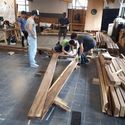
Technical documentation was produced, structural consultations were conducted, and prefabrication of the elements for the first on-site installation was completed. This phase took place at Investigaciones del Futuro, a research and fabrication workshop located near the University of San Martín campus.

The result is a wooden structure whose roof will not only provide much-needed shade on-site but also establish a meeting point, creating a landmark of identity and community pride for La Carcova.
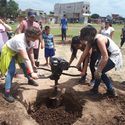
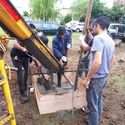
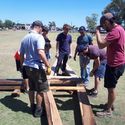
Following this, the assembly of the structure began through an ongoing collective construction workshop, bringing together students, faculty, and local residents. The project is expected to continue and expand over time to complete the remaining phases established through mutual agreement and collaborative work.

Academic engagement in underserved areas through the construction of community facilities and habitat improvements represents a way of conceptualizing the discipline and knowledge that carries an aesthetic and political dimension. It demands a high level of commitment, as it generates community expectations that must be fulfilled, and is directly immersed in the lives of people facing systemic challenges. As an ongoing, constantly evaluated effort, this work must also be supported by a broader network that includes not only the university and its outreach policies but also government entities with local jurisdiction.
Ultimately, the fundamental premise of these efforts is rooted in the notion of architecture as a social good and a cultural product of the community that creates it. This perspective views architecture as a discipline that, through its capacity to build identity, helps secure a fundamental human right: access to a dignified habitat where basic needs are met to support a full life.

This article was written by Belén Maiztegui. The translation is powered by AI.
.jpg?1587578185 "La Carcova Educational Park: Universities Join Forces for a Collective Social Project in Argentina")


.jpg?1587409816 "La Carcova Educational Park: Universities Join Forces for a Collective Social Project in Argentina")


