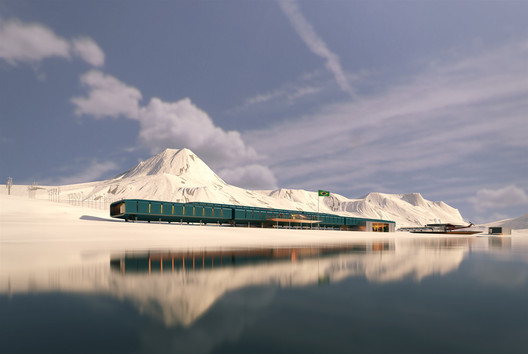
Construction of the Comandante Ferraz Antarctic Station, the Brazilian Navy's research base in Antarctica, is complete after three years of work on the planet's most extreme continent. A masterpiece of architecture and engineering, the facility features 700 tons of steel structures, an aerodynamic shape to withstand winds of up to 200 km/h, and a stilted base to prevent winter snow accumulation from reaching the building.
The project began in 2012, when the previous station was destroyed by a fire and the Navy commissioned the Institute of Architects of Brazil (IAB) to organize a public architectural competition for a new Brazilian base in Antarctica. The winning proposal was submitted by the Curitiba-based firm Estúdio 41, designed by architects and urban planners Fábio Henrique Faria, Emerson Jose Vidigal, Eron Costin, João Gabriel de Moura Rosa Cordeiro, and Dario Correa Durce.
Combining living quarters and research spaces, the Antarctic Station features its own power, water, sewage, and telecommunications infrastructure, housing 18 laboratories in the main building, seven isolated units, a helipad, and wind turbines. For the architects, the greatest challenge was designing the building like clothing—an artifact that protects and provides comfort against extreme cold. It was a technological performance challenge, but one that also took aesthetics into account.

This project is of strategic and symbolic importance for Brazilian architecture for several reasons. First, it succeeded in demonstrating to society the benefits of holding public architectural competitions for public works. In 2013, initiatives of this kind were still rare, but they have grown over the years.
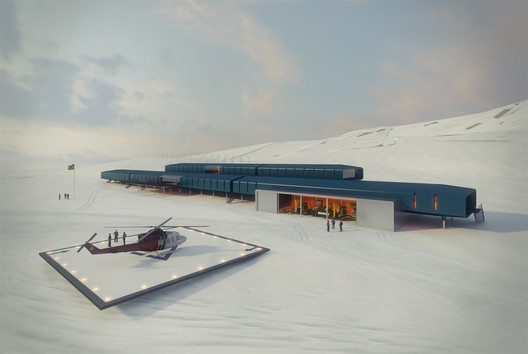
Another highlight of the project was the use of Building Information Modeling (BIM) technology throughout the design phase, in partnership with the team from the Portuguese firm Afaconsult, led by civil engineer Rui Furtado. According to Emerson, BIM served as a link between the architects and the engineers on the project, reconciling different technical visions of the same object.
The project also highlights Brazil's international reach and technology transfer, as construction was carried out by the Chinese firm China National Electronics Import and Export Corporation (CEIEC) at a cost of R$ 370 million. Engineers from Afaconsult spent nearly a year in China supervising preparations, which included the production and pre-assembly of the structures.
Via CAU/BR
This article was written by CAU/BR. The translation is powered by AI.