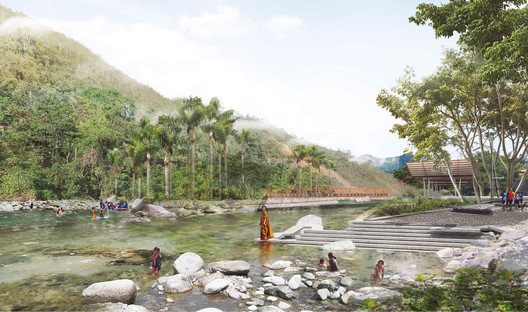
With the goal of promoting the development of innovative urban ideas and proposals that can be implemented in the execution plans of the Provincial Municipality of Satipo, this entity—through its Sub-Department of Urban Development and Infrastructure, in collaboration with the Colegio de Arquitectos del Perú Regional Junín—launched the Satipo National Ideas Competition 2019: "Intervention on Jr. Colonos Fundadores and Treatment of the Satipo Waterfront" Ideas Competition.
As its name suggests, the project consists of two intervention areas: on one hand, it proposes an intervention on two blocks of Jr. Colonos Fundadores through pedestrianization, pavement treatment, and urban furniture design; on the other hand, it outlines the design of the Satipo Waterfront with an urban program that includes a bike path and sports equipment, as well as pavement treatment and urban furniture.

“The city we wish to build is a place tailored to those who inhabit it. A place capable of responding to the needs and desires of its residents, granting rights and opportunities. Safe, healthy, sustainable, supportive, and vital cities. Cities for people.” This was the primary premise for integrating the proposal into the urban context, which simultaneously required considering factors such as Sustainable Mobility, Equity and Diversity, Human-Scale Urban Design, and Economic and Cultural Promotion. Based on these criteria, the jury—composed of architects Karina Puente, Angus Laurie, and Ricardo Cebrián—has announced the results:
First Place
LLONAZAMORA Team:
Rafael Zamora
Michelle Llona
Carolina Zegarra
Cristian Zúñiga
Kevin Malca
Juan Villalón
+
Xud Arquitectura Team:
Nicolas Moser
Asiel Nuñez
Erick Bergelund
Lonny Ponce
"...The project proposes an intervention that helps positively define Satipo's relationship with its river, integrating the community and different stakeholders, reinforcing current activities along the river, and introducing new ways of interacting with it. In addition, the proposal addresses risk scenarios by creating a design that does not attempt to 'bend' nature and the river's changes, but instead adopts a resilient and adaptive approach to them, generating new dynamics, activities, and spaces as the river levels rise and fall. (...)," the winning team describes.
María Alexia León Angell
Lucho A. Marcial Kuehne
María del Rosario Huamán García

The jury highlighted:
1st Honorable Mention


"...The project proposes a riparian forest, a tropical Amazonian landscape (linear park) along the banks of the Satipo River to regenerate a hinge space between the city and its territory, which is currently experiencing environmental and cultural neglect. It involves reclaiming the continuous, daily, transverse relationship of life between the two marginalized banks of the river, integrating the rural agro-productive and forestry life of communal identity with the dynamics of existing commercial urban neighborhoods, thereby creating an economic-intercultural space for exchanging goods and knowledge that will have a social impact, improving lives on multiple scales. (...)," the team states.
The jury highlighted:
2nd Honorable Mention

Luis A. Coarite Asencio
Josue Sedano Alva
Edgar Torres Romaní
Jusara Segovia Quichca
Frank Carmen Medina
Issac M. Huamaní Santa Cruz
Carla Callupe Cotera
"...Rivers have transformed places and shaped landscapes. In their paths, they have carved out valleys, ravines, and natural ecosystems of flora and fauna. They constantly alter their courses; their paths are changing and indeterminate. Ultimately, rivers shape and reshape natural territories and feed artificial ones, such as cities. Satipo offers us a space to conceive the city from the river, as a structuring axis in the urban configuration.
Establishing a structural framework based on the river involves using a device that enables an exchange from the river to the city and from the city to the river through intermediate public spaces adapted to the existing environment—a natural environment that fosters a two-way dialogue. These are basic values that the contemporary city has forgotten, despite having always coexisted with water. (...)," the team reflects.


The jury highlighted:


This article was written by Delia Bayona. The translation is powered by AI.

