When talking about Argentine architecture, does a native style exist? The question is complex, as Argentina's DNA contains a mixture of contributions from various origins, ranging from Indigenous peoples to immigrants from diverse global regions. The country is as rich as it is diverse.

This diversity is expressed in the country's cities and buildings. Walking through the capital, or a hidden small town in a province, one can see colonial-era constructions coexisting with modern and contemporary designs. There are also those in "English" or "Italian" styles, which hundreds of immigrants built with their own hands.

Geographical diversity is also a factor: the landscape features rainforests, plains, hills, steppes, waterfalls, and glaciers. Creating a style that responds to a climate like that of Buenos Aires would not be suitable for Misiones or Salta.
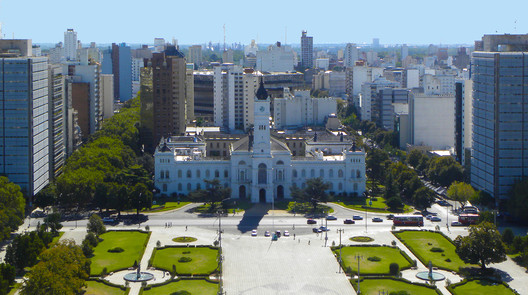
Even so, over the years, several architects have aimed to create a native style to unify and represent the country. Let's review some of their ideas.
.jpg?1555103484)
Alejandro Christophersen
Among the first generation of architects to seek a national style and character was Alejandro Christophersen. The architect warned that Argentina had become overly Europeanized and proposed creating a regional architecture.
Christophersen believed that to understand and convey the nation's identity, it was necessary to study its past—specifically, the Spanish colonial art and architecture brought to Argentine soil by Jesuit missions.

Study not to copy, but to learn: taking what was good and logical and adapting it to new technologies to generate an architecture that responded to the demands of "modern" life while reflecting the local climate, land, mentality, customs, and spirit.

However, he understood that the creation of this new style was a gradual process that would require time. It was not something that would appear overnight, nor could it be imposed. Its development had to be organic, occurring slowly over time.
Martín Noel: National Aesthetics
Sharing similar ideals with Alejandro Christophersen was Martín Noel, perhaps one of the greatest exponents of Neocolonial architecture.

Around 1910, as Argentina celebrated its centennial, Noel aspired to create a style that would identify the nation. Opposing the French influence dominating the city's architecture, he also turned his attention to colonial-era design.
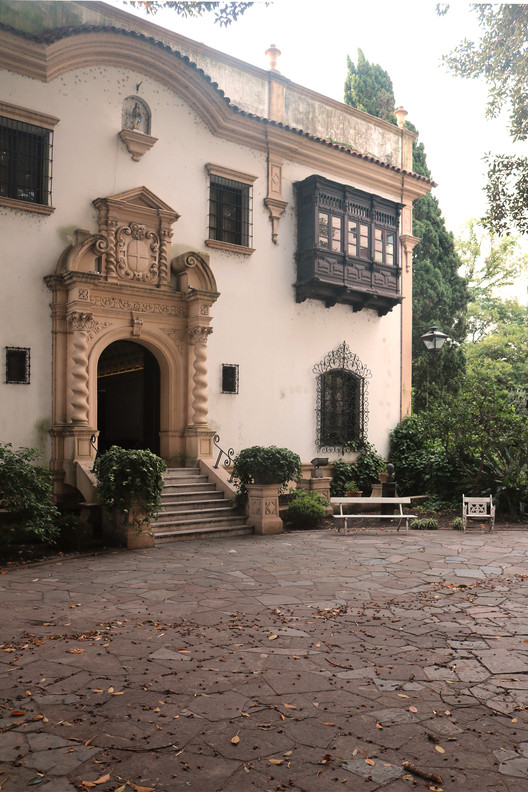
He traveled throughout Latin America, conducting a detailed study of Hispanic-period American architecture and the value of pre-Columbian cultures. He sought a tradition—a national architecture based on local roots, remembering and reevaluating where the country came from.

Alejandro Bustillo: The Regional Style
Among the second generation of architects was Alejandro Bustillo. While his architecture was undoubtedly rooted in French academicism, he created and advocated for the preservation of a "regional style."

He believed that the French-inspired architecture of downtown Buenos Aires could not be the same as that of, for example, the snowy southern mountains. Consequently, he developed a "regional style."
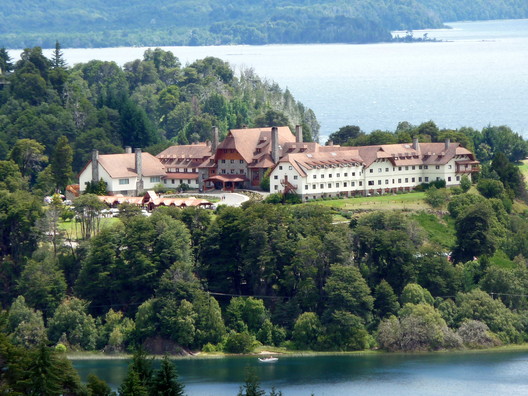
Bariloche was his cornerstone. In 1938, the Llao Llao Hotel opened, redefining his architectural approach. Leaving behind French rustication and Paris stone, he utilized regional construction techniques and local materials, including cypress, larch, and tuff stone.
The architect did not falter when the building burned down in 1939, replacing much of the wood with local stone while respecting the original design.

Such was his eagerness to preserve this regional style that he drafted a series of regulations to prevent construction with non-local materials. Today, the municipal building code requires a minimum of 30% local materials.
Claudio Caveri: The Casas Blancas
Within the third group was Claudio Caveri, along with several architects who built the "Casas Blancas" (White Houses). The term was first analyzed in an article written by Rafael Iglesia in *Summa* magazine. It refers to a group of buildings constructed in the mid-1950s that, as the name suggests, featured whitewashed walls.

It emerged as a critique of the rationalism and functionalism of the Modern Movement. Although it never became a formal movement, the group of architects shared common principles.

The idea of the house as a machine felt uncomfortable, impersonal, and inhuman. At this time, not only in Argentina but across the Americas and Europe, there was a growing rejection of the Modern Movement's coldness.
Consequently, the goal of these Argentine architects was to humanize architecture. They returned to the regional past, incorporating elements such as thick walls, galleries, towers, and indigenous shelters (*tolderías*)—features of the architecture of Northwest Argentina and the Pampas ranches (*estancias*).

They broke away from geometric order, symmetrical axes, and smooth walls. Plaster finishes had a more artisanal, less perfect texture. It was an expressive architecture that, nevertheless, had roots in Le Corbusier. At the time, the creator of Villa Savoye was in India, experiencing one of his most sculptural periods while experimenting with the malleability of concrete.
The desire to humanize architecture and make it more handcrafted reduced the use of industrialized techniques and elements. This led to increased costs, making the style less accessible and difficult to sustain over time.
Final Reflections
Throughout history, there have been multiple attempts to establish a distinct style. Each attempt had different characteristics but shared a common goal: to create an architecture that unites and identifies the country. One only needs to walk down the street to realize that Argentine architecture is heterogeneous and does not conform to a single style.

It is interesting to note that while so many architects sought a unifying national style, they were unable to make it endure. But why? What happened?

On one hand, although there were many attempts, they were largely sporadic and isolated. There was no continuity to allow a single style to develop; instead, each generation proposed its own ideas.

Christophersen's assertion that a style cannot be imposed, but is rather a process that occurs organically over time, seems accurate. Without time, no idea can fully develop.

Furthermore, in the search for a native style, architects focused heavily on typologies and symbols from the past rather than on current customs and traditions. Focusing on how people live, socialize, structure families, and daily habits could shed light on domestic life and what Argentine architecture could become. This would provide a more faithful reflection of the country's essence.
Glenn Murcutt often says that a house is like a suit—the best ones are custom-made. It would be interesting to see the development of an Argentine style, or perhaps simply common characteristics that serve local customs and ways of living. This would allow for an architecture that is truly made to measure.
This article was written by Mariana Etulain. The translation is powered by AI.


.jpg?1555103484 "In Search of the \"Argentine Style\"")