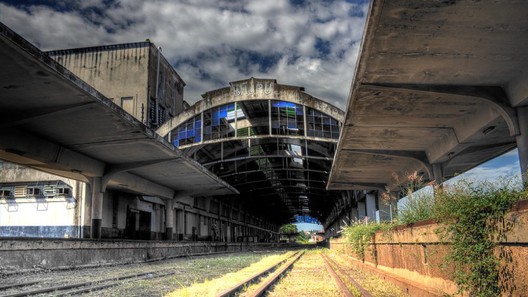
At the height of the railways in the mid-20th century, the state of São Paulo had around 500 railway stations. With the end of long-distance passenger train services during the 1980s and early 1990s, much of this heritage was abandoned, and those structures that escaped looting and vandalism eventually collapsed due to a lack of maintenance. Today, fewer than 50% of these stations remain standing, according to the Brazilian Association of Railway Preservation (ABPF).
A lawsuit filed by the Federal Public Prosecutor's Office (MPF) now seeks to compel the federal government to restore abandoned railway stations across six municipalities in the Bauru region of inland São Paulo. The lawsuit also demands the regularization of unlawfully occupied properties and that this heritage be put to an “efficient, moral, and legal” use.

The petition, filed with the 1st Federal Court of Bauru, covers stations and tracks in the towns of Agudos, Avaí, Cabrália Paulista, Duartina, Pederneiras, and Piratininga. Similar lawsuits have already been filed in São Paulo, Itapeva, and Sorocaba. The assets, which now belong to the federal government, were once part of the defunct Paulista Railway (Fepasa) and the Federal Railway Network (RFFSA). Investigations launched by the MPF identified squatted, vandalized, and abandoned areas and properties.
Federal Prosecutor André Libonati, who filed the lawsuit in Bauru, stated that the legal action is restricted to properties currently unused by concessionaires. According to Libonati, houses and stations could be used by local governments, which would take responsibility for their maintenance, while the land could be zoned for parks, social housing, or auction.
In Pederneiras, the 1913 Paulista station building in the city center was restored by the local government. In addition to housing the Municipal Department of Culture and Tourism, it now hosts a cultural center. A restored railway warehouse also serves as the municipal theater. “The complex was abandoned until 1998. Today, it is the city's postcard landmark,” said Joaquim Bueno, who is responsible for the building's security.
However, neglect is the norm in most cities. In Pederneiras itself, the old 1910 Guaianás railway station was stripped down to the last brick. Only a portion of the metal columns that once supported the platform roof remains standing. The site is currently occupied by 80 families from a social movement. “We were living in a camp by the side of a highway, and this land was sitting unused,” said 35-year-old farmworker Valdinei Ribamar.
In Avaí, the station of the Estrada de Ferro Noroeste do Brasil, built in 1906, lies in ruins. Even the building's original doors and windows were looted, and the interior has become a dumping ground. “This used to be the heart of the city, bustling with passengers and cargo. Today, it’s just sad,” said retired stationmaster Pedro Mendes Neves, 77, the last person to hold the post.
In September 2017, the municipal government submitted a formal request to the federal government for the transfer of the building, but the process is still pending, according to cabinet advisor Fabrício Berbel. “We plan to renovate the space and install our local historical museum there.”
Other MPF lawsuits address the abandonment of railway heritage. In São Paulo, a class-action lawsuit filed in 2014 seeks the reactivation of the Santos-Cajati branch line, which operated passenger services until 1997. Rumo, the concessionaire of the São Paulo rail network, stated that reactivating the line is not within the scope of its concession agreement. Of the original 40 stations, only 12 remain, some of which have lost their original architectural features, such as those in Itanhaém and Juquiá.

In 2015, the MPF filed a lawsuit to compel federal agencies and the local municipality to restore the Itapeva Railway Station complex in southwestern São Paulo.
The building was designed in 1909 by architect Francisco de Paula Ramos de Azevedo, who also designed the Pinacoteca and the Municipal Theater of São Paulo. At the time, the local government cited a lack of funds to invest in the property. The lawsuit has not yet reached a final ruling, and the abandoned building is now at risk of collapsing.
In Sorocaba, the State Public Prosecutor's Office filed lawsuits to recover the 143-year-old Sorocabana complex. In late 2005, the station building and surrounding warehouses were transferred to the municipal government. One of the warehouses now houses the Sorocaba Museum of Contemporary Art, but the main station building remains abandoned.
The ABPF has also succeeded in restoring some railway sections by establishing tourist train routes, such as the Campinas-Jaguariúna line. Across the state, 45 stations and railway complexes have been listed as heritage sites by the state historic preservation authority, with an additional 27 currently under study.
The Secretariat of Union Patrimony (SPU) stated its interest in finding efficient uses for the non-operational properties of the defunct RFFSA, but is currently hindered by missing or incomplete documentation for these old stations. According to the department, the subdivision and identification process required before any transfer can take place has begun, but it remains highly complex, involving 55,000 properties nationwide.
Via Haus.
This article was written by HAUS. The translation is powered by AI.