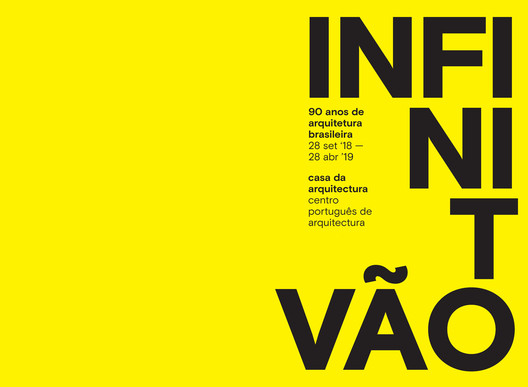
Possibly the largest exhibition dedicated to Brazilian architecture held outside the country since Brazil Builds, shown in 1943 at MoMA, opens today at Casa da Arquitectura in Matosinhos, Portugal. The Portuguese Centre for Architecture is also presenting the exhibition "Duas Casas" (Two Houses) by Paulo Mendes da Rocha, who will receive the title of Honorary Member of Casa da Arquitectura at a ceremony on September 30. This exhibition will feature the Gerassi House and the House on Rua do Quelhas in Lisbon, which was co-designed with Portuguese architect Inês Lobo.

With a name inspired by Gilberto Gil's lyrics in "Drão" ("True love is in vain | it extends infinite | immense monolith | our architecture"), the exhibition is curated by Brazilians Fernando Serapião and Guilherme Wisnik, presenting part of the "Brazilian Architecture Collection" to the public for the first time. See the full program here, which will feature appearances by Paulo Mendes da Rocha, Adriana Calcanhoto, Eduardo Souto de Moura, Isa Grispum, Manuel Aires Mateus, Camila Pitanga, and José Miguel Wisnik, among others.
The archive, unprecedented even in Brazil, features around 103 projects and 50,000 items from the country's modern and contemporary production, including drawings, photographs, models, films, ceramics, and documents. The collection was built over two years through more than 200 donations from architects and their heirs. It will be preserved by the Portuguese Centre for Architecture to foster research and form future exhibitions from the CA collection.


ARCHITECTURE, A BRIDGE OVER THE ATLANTIC - José Manuel Dias da Fonseca and Nuno Sampaio
“I know there are leagues separating us
So much sea, so much sea
I also know, my friend, that we must
Sail, sail”
Tanto Mar
Chico Buarque
INFINITO VÃO is the first initiative to emerge from the permanent archive of Casa da Arquitectura – Portuguese Centre for Architecture. The work began two years ago, following the institution's decision to build its own collection by forming various curated archives focused on specific regions and timeframes.
The Brazil Collection—the first consisting entirely of non-Portuguese projects, curated by Fernando Serapião and Guilherme Wisnik—showcases the diversity of architectural production from modernism to the contemporary era across 90 years of Brazilian architecture. It features an incredibly rich archive of original material from 103 projects, including over 4,700 physical items and 45,500 digital files, such as texts, drawings, and models, generously donated by more than 150 contributors. In addition to this collection, there are 150 books and publications from Casa da Arquitectura, along with a set of digital documents and authorized facsimiles provided by various public and private governmental, educational, and cultural institutions. Together, they form a unique documentary resource capable of generating new interpretations of Brazilian architectural production from the 1920s to the present day.
INFINITO VÃO—which comprises a wide range of initiatives, including an exhibition, a publication, a digital research platform, and an extensive program of activities across Portugal and Brazil—aims to introduce Brazilian architecture to new and broader audiences globally through intersections with music, cinema, and literature.
Rather than merely offering historically circumscribed readings—even if framed within the context of Brazil's diverse cultural production—it seeks to provide a perspective on the outstanding achievements of recent decades. In doing so, it promotes a contemporary, current, and even forward-looking vision of the architectural production of various generations of professionals.


INFINITO VÃO - Fernando Serapião and Guilherme Wisnik
In architecture, a span (vão) is something to be bridged, a challenge to overcome. It means reducing supports, expanding slabs horizontally, and launching into the open air, "opening up an immense light at ground level." Yet, in Portuguese, vão is also used to designate a project or action that ends in failure: something done "in vain" (em vão).
“True love is in vain / It extends infinite / Immense monolith / Our architecture,” go the lyrics of Gilberto Gil in "Drão," a beautiful song about a breakup. It is a perfect understanding of architecture as a suture for what is lost, transforming—in the transition from the personal to the collective realm—loss into a challenge to be overcome in space, far from the ground, along the line of the infinite.
In Brazil, modernization emerged as a leap over the country's underdeveloped state. In the case of architecture, it was a leap over the absence of two traditions: the classical, on one hand, and the artisanal, on the other. This was a colossal leap given the immense scale of the territory—a challenge embraced by an ambitious aesthetic avant-garde allied with remarkable engineering.
Brazil is a country "condenated to be modern," as critic Mário Pedrosa stated, viewing this condemnation as a liberation from traditions. It represents the ability to transform what could have been done in vain into the tangible cultural triumph of the free span (vão livre); indeed, for Brazilian architects, the word vão is almost always synonymous with freedom.


The exhibition is organized into six sections:
FROM GUARANI TO GUARANÁ - 1924 – 1943
Who invented Brazil? The Portuguese navigator Pedro Álvares Cabral, as described in Lamartine Babo's carnival march? Or the modern arts of the 1920s and 1930s? Leaping from indigenous romanticism and slavery to an industrial and urban culture, atop a still patriarchal social base, Brazil reinvented itself in a modern guise. It took less than 15 years to go from Warchavchik’s first scandalous houses in São Paulo, through the "miracle" of the Ministry of Education and Health in Rio de Janeiro, to the Pampulha complex in Belo Horizonte. This was the dizzying "formation" process of Brazilian Modern Architecture, documented in the 1943 Brazil Builds exhibition at the Museum of Modern Art in New York. Its origins lie in Lucio Costa’s 1924 journey to the historic city of Diamantina, which led him to admire the "poor" rationalism of colonial civil architecture—a Luso-Brazilian vernacular that would later be identified with modern austerity.
THE BASE IS JUST ONE - 1943 – 1957
In the period spanning from Pampulha to the competition for Brasília's Pilot Plan, Brazil experienced the peak of what Tom Jobim, co-writer of "One Note Samba" (Samba de uma nota só), called a "beach civilization." This was the almost utopian realization of a generation of artists who managed to filter the beat of samba into a new harmonic structure, Bossa Nova, and invent a bold architecture of wide spaces and sinuous profiles that sublimated construction efforts and large spans into aerial lightness. In 1939, Carmen Miranda debuted on American soil on the stage of the Brazilian Pavilion auditorium at the New York World's Fair, designed by Niemeyer and Lucio Costa. Back in Brazil, newly planned cities in Amapá and Mato Grosso paved the way for Brasília. An oasis-city, laid out in the shape of a cross in the middle of the savanna (cerrado), in Cabral-like fashion, it stood as a ritual refounding of the country, while simultaneously reenacting the violence of the colonial experience.
AGAINST THE PLATEAUS, MY NOSE - 1957 – 1969
In the 1960s, everything sounded dissonant. Following the 1964 military coup, a dictatorship made Brasília its home. In the anarcho-libertarian spirit of counterculture, driven by critiques of the Modern Movement, artistic avant-gardes accused the technocratic developmentalism of Brazilian architecture in the name of a Third-Worldist "aesthetic of hunger." In Caetano Veloso’s song "Tropicália," the "monument in the country's central highlands" became the incarnation of a sinister dream. While Rio's architecture declined, a vigorous production emerged in São Paulo, the country's industrial center, based on the full use of exposed reinforced concrete, the assertion of weight, and the formal exploration of structures. This cultural project, aligned with the ideology of the Brazilian Communist Party, saw the possibility of political revolution as the fruit of developing national productive forces. Clubs, schools, and even homes were conceived during this period as infrastructure projects.
I SAW A BRAZIL ON TV - 1969 – 1985
In 1969, Artigas and Paulo Mendes da Rocha were arrested by the military regime. Universities and magazines were shut down, songs were censored, and artistic movements went underground. Hydroelectric dams, Amazonian highways, and industrial cities were built under the mantra of the "economic miracle," as echoed in the lyrics of "Bye Bye Brasil" by Chico Buarque and Roberto Menescal. Meanwhile, the large urban centers of the Southeast swelled and favelas proliferated. In the North, Severiano Porto created an architecture that combined modern language with indigenous building traditions. In São Paulo, taking advantage of the loosening of modern orthodoxy, Lina Bo Bardi at Sesc Pompeia and Eurico Prado Lopes and Luiz Telles at the São Paulo Cultural Center created playful buildings where structural didactics were no longer the primary focus.
WHOLE, AND NOT HALF - 1985 – 2001
“We don't just want money, we want the whole thing, not just half.” This fragment from the band Titãs in "Comida," at the beginning of the so-called "national rock" wave, captures the aspirations of a country returning to democracy, eager to implement both social projects and a new way of life. In response to the oppression of the large housing complexes built by the military dictatorship, the Favela-Bairro program in Rio de Janeiro accepted the informal city as a given reality, seeking to upgrade it. In São Paulo, cooperative organizations created alternatives to the model of large contractors and developers, employing brick masonry and collectivist forms of labor. Based in Bahia, João Filgueiras Lima (Lelé) adapted Niemeyer's "free forms" to an industrialized component approach, establishing manufacturing plants to support the construction of the Sarah Kubitschek network hospitals across Brazil. In Minas Gerais, postmodern irony began to emerge in the country "condenated to be modern."
FEELING ON THE SOLE OF THE FOOT - 2001 – 2018
“Here, bums keep feelings on the soles of their feet.” With this harsh line, Racionais MC's describe the violent reality of life in Brazil's large cities at the turn of the millennium. The enactment of the City Statute and the design of prefabricated schools (Unified Educational Centers - CEUs) by the São Paulo municipal government closed the previous cycle and opened a period of optimism. This era was epitomized by the promise of a "spectacle of growth"—economic and social—in the words of President Lula at the start of his administration. During this period, there was a contrasting coexistence between a hedonistic appreciation of architecture, seen in cultural buildings and developments tied to the real estate market, and strong activism from collectives and social movements. Inspired by the "right to the city" slogan, these groups opposed real estate speculation, worked alongside homeless occupations, and fought for new public spaces. Both politically and urbanistically, the current climate in Brazil is highly conflicted.


The complete list includes 90 exhibited projects. See them below in chronological order:
- Casa Modernista da rua Itápolis (1930) - Gregori Warchavchik - Edifício Esther (1934) - Álvaro Vital Brazil and Adhemar Marinho - Caixa d’Água (Water Tower) (1934) - Luiz Nunes - Praça da Casa Forte (1935) - Roberto Burle Marx - Associação Brasileira de Imprensa (1935) – Marcelo and Milton Roberto - Ministério da Educação e Saúde (1936) - Lucio Costa, Oscar Niemeyer, Affonso Eduardo Reidy, Jorge Moreira, Carlos Leão, and Ernani Vasconcelos - Museu das Missões (1937) - Lucio Costa - Conjunto da Pampulha (1940) - Oscar Niemeyer - Pedregulho Housing Complex (1946) - Affonso Eduardo Reidy - Escola-parque (1947) - Diógenes Rebouças - Instituto de Puericultura e Pediatria (1949) - Jorge Machado Moreira and team - Casa das Canoas (1951) - Oscar Niemeyer - Museu de Arte Moderna do Rio de Janeiro (1952) - Affonso Eduardo Reidy - Edifício Lausanne (1953) - Adolf Franz Heep - Angélica (1954) - Jorge Wilheim - Conjunto Nacional (1955) - David Libeskind - Serra do Navio (1956) - Oswaldo Arthur Bratke - First sketches of the palaces of Brasília (1956) – Oscar Niemeyer - Palácio da Alvorada (1956) – Oscar Niemeyer - Pavilhão de São Cristóvão (1957) - Sergio Bernardes - Castro Theater (1957) - José Bina Fonyat - Urubupungá (1957) - Ernest Mange - Brasília Pilot Plan (1957) – Lucio Costa - Museu de Arte de São Paulo (1957) - Lina Bo Bardi - National Congress (1958) – Oscar Niemeyer - Palácio do Planalto (1958) – Oscar Niemeyer - Casa Castor Delgado Perez (1958) - Rino Levi, Luiz Carvalho Franco, and Roberto Cerqueira César - Casa A. C. Cunha Lima (1958) - Joaquim Guedes and Liliana Guedes - Edifício Metrópole (1959) – Gian Carlo Gasperini and Salvador Candia - Casa Boris Fausto (1961) – Sergio Ferro - Cajueiro Seco Housing Complex (1963) - Acácio Gil Borsoi - Casa Mário Masetti (1964) - Carlos Millan - Rio of the Future, Manchete magazine (1965) - Sergio Bernardes - Casa Tomie Ohtake (1966) - Ruy Ohtake - Centro de Convivência Cultural (1967) - Fábio Penteado, Alfredo Paesani, Teru Tamaki, and Aldo Calvo -Teatro Municipal de Santos (1967) – Oswaldo Corrêa Gonçalves, Abrahão Sanovicz, and Julio Katinsky - Parque Anhembi (1968) - Jorge Wilheim and Miguel Juliano - Armênia Metro Station (1968) - Marcello Fragelli and team - Hering Matriz (1968) - Hans Broos - Avenida Paulista (1973) – João Carlos Cauduro, Ludovico Martino, and Rosa Kliass - Edifício Acal (1974) - Pedro Paulo Saraiva, Sérgio Ficher, and Henrique Cambiaghi Filho - Casa Bola (1974) - Eduardo Longo - Chesf Headquarters - Companhia Hidroelétrica do São Francisco (1976) - Assis Reis - Caraíba (1976) - Joaquim Guedes - Centro Cultural São Paulo (1976) - Eurico Prado Lopes and Luiz Telles - Sesc Pompeia (1977) - Lina Bo Bardi - Cafundá (1977) - Sergio Magalhães, Clóvis Barros, Silvia Pozzana, and Ana Lúcia Petrik Magalhães - Capela de Santana do Pé do Morro (1979) - Éolo Maia and Jô Vasconcellos - Environmental Protection Center (1983) - Severiano Porto - Largo 13 de Maio Station (1984) - João Walter Toscano, Odilea Toscano, and M. Kamimura - Brazilian Museum of Sculpture (MuBE) (1986) – Paulo Mendes da Rocha - St. Peter Chapel (1987) – Paulo Mendes da Rocha - Casa Hélio Olga Jr. (1987) - Marcos Acayaba - Guignard School (1989) - Gustavo Penna - Unicamp Student Housing (1989) - Joan Villà - Tube stations (1990) – Abrão Assad and Carlos Eduardo Ceneviva - House at Pernambuco Beach (1990) - Oswaldo Arthur Bratke - Copromo (1991) - Usina CTAH - Hospital Sarah Kubitschek (1991) - João Filgueiras Lima - Favela Bairro Rio das Pedras (1998) - Jorge Mário Jáuregui - Fórum de Cuiabá (2000) - Marcelo Suzuki - CEU Butantã (2001) - Alexandre Delijaicov, André Takiya, and Wanderley Ariza - Guita and José Mindlin Brasiliana Library and IEB (2001) - Eduardo de Almeida and Rodrigo Mindlin Loeb - Galeria Adriana Varejão/Inhotim (2004) - Rodrigo Cerviño - Football Museum (2005) - Mauro Munhoz - Army Housing Foundation Headquarters (2005) - MGS + Associates - Praça das Artes (2006) - Brasil Arquitetura and Marcos Cartum - Museum of Memory and Human Rights (2007) - Mario Figueroa, Lucas Fehr, and Carlos Dias - Pimentas Arts and Education Center (2008) - Biselli + Katchborian - Cantinho do Céu Complex (2008) - Marcos Boldarini - Jardim Edite (2008) - MMBB and H+F - Sebrae National Headquarters (2008) - Álvaro Puntoni, Luciano Margotto, João Sodré, and Jonathan Davies - Studio SC (2009) mk27 - Parque Novo Santo Amaro V (2009) - Héctor Vigliecca - Weekend House (2010) - Angelo Bucci - Humanidade Pavilion (2011) - Carla Juaçaba - Instituto Moreira Salles (2011) - Andrade Morettin - Minimod (2011) - Mapa BR - Galeria Claudia Andujar/Inhotim (2012) - Arquitetos Associados – - Residencial Arapiraca (2012) - Triptyque - Sesc Franca (2013) - SIAA and Apiacás - ITA Basic Sciences (2014) - Metro Arquitetos.
Learn more in our interview with Guilherme Wisnik and Nuno Sampaio.
ArchDaily Brasil
Guilherme Wisnik e Nuno Sampaio falam sobre a exposição INFINITO VÃO e o acervo de arquitetura brasileira em Portugal na CASA DA ARQUITECTURA.

"Infinito Vão – 90 Anos De Arquitetura Brasileira"
September 28, 2018, to April 28, 2019
"Duas Casas"
September 28 to February 10, 2019
Casa da Arquitectura
Avenida Menéres, 456, Matosinhos, Portugal
Information: www.casadaarquitectura.pt
This article was written by Pedro Vada. The translation is powered by AI.

