The 16th International Architecture Biennale China Pavilion will be on display in Venice, Italy, from May 26 to November 25, 2018. On April 27, a press conference for the China Pavilion was successfully held in Beijing, officially announcing this year's theme: "Building a Future Countryside." The curator, Professor Li Xiangning, outlined the curatorial concept and structural framework of the exhibition. He noted that the Chinese countryside has become an open field brimming with diverse possibilities and opportunities, making the theme "Building a Future Countryside" a direct response to this year's Biennale theme, "Freespace." The exhibition features six sections—"Production," "Tourism," "Community," "Culture," "Dwelling," and "Future"—showcasing recent rural projects by Chinese architects. It aims to return to the birthplace of Chinese culture to recover forgotten values and overlooked possibilities, offering a vision for the future of our countryside.
The press conference was hosted by Liu Zhenlin, Deputy General Manager of China External Art Exhibition Co., Ltd. During the event, Li Jinsheng, Party Secretary of China Arts and Entertainment Group, delivered an opening address. Additionally, Wang Mingxian, Editor-in-Chief of the China Public Art Yearbook and Researcher at the Institute of Architectural Design of the Public Art Academy at the China National Academy of Painting, spoke on behalf of the Expert Review Committee for the China Pavilion Selection, expressing high expectations for the pavilion's presentation at this year's Biennale.
Following the speeches, an introductory video for the China Pavilion was screened. Participating architects Philip F. Yuan (Archi-Union Architects) and Hua Li (TAO - Trace Architecture Office) introduced their respective works. Other exhibitor representatives, including Shui Yanfei (Naturalbuild) and Li Han & Hu Yan (Drawing Architecture Studio), as well as sponsors and media representatives, also attended the event.

China National Pavilion at the 16th International Architecture Biennale "Building a Future Countryside"
Preview: May 24–25, 2018
Main Exhibits
BingDing Wood Kiln, Zhang Lei, AZL Architects
Xinzhai Coffee Manor, Hua Li, TAO (Trace Architecture Office)
An Old-New House, John Lin + Joshua Bolchover, Rural Urban Framework (RUF)
Xidian Memory: A Town of Memory, Liu Yuyang, Atelier Liu Yuyang Architects
Mountain Dwelling, Water Dwelling, Forest Dwelling, Dong Yugan
In-Bamboo, Philip F. Yuan, Archi-Union Architects
Cloud Village, Philip F. Yuan, Shanghai Digital Fabrication Engineering Technology Center (Outdoor)

A. Production
BingDing Wood Kiln / Zhang Lei
Huateng Pig House Exhibition Hall / Li Yikao
Taiyang Commune Eco-Farm in Lin'an / Chen Haoru
Songyang Zhangxi Brown Sugar Workshop / Xu Tiantian
Wuyishan Bamboo Raft Factory / Hua Li

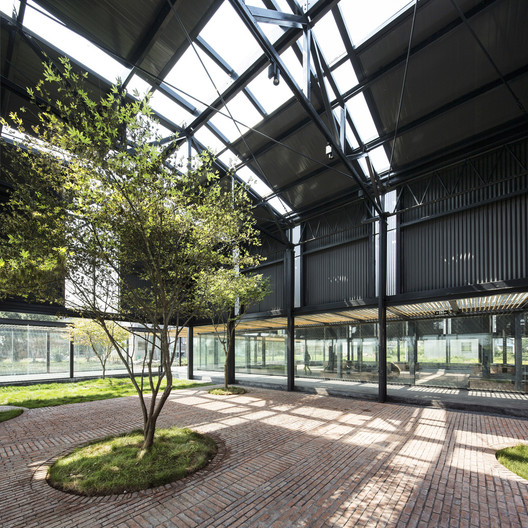
B. Tourism
Xinzhai Coffee Manor / Hua Li
Leap Over Mogan / Jin Jiangbo
Yucun Lost Villa / Naturalbuild
Seven Gardens House / Bofeng Architecture
Yunxi Shen'aoli Bookstore / Zhang Lei
Jianamani Visitor Center / Zhang Li

C. Community
A New Old House: Rural Recycling / Rural Urban Framework (RUF)
Angdong Hospital / Rural Urban Framework (RUF)
Yunus China Center Lukou Grameen Rural Bank / Zhu Jingxiang
Shimen Covered Bridge / Xu Tiantian
Rural Construction Practice in Zhongguan Village, Guizhou / China Rural Reconstruction Institute
One Foundation Tianquan County Xinchang Township Central Kindergarten / Atelier Deshaus
Caimiduo Farm Restaurant and Lifestyle Market / Zhao Yang
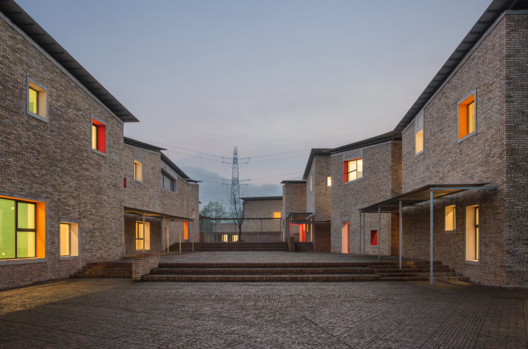
D. Culture
Xidian Memory Installation / Liu Yuyang
Louna Rural Practice Series / Li Xinggang, Seung H-Sang, Ryue Nishizawa
Banwan Village Regeneration / Lyu Pinjing
Huashu Village Studio / Atelier Archmixing
Lianzhou Museum of Photography / O-office Architects
Xiaozuo Art Museum / Dong Yugan

E. Dwelling
Mountain Dwelling, Water Dwelling, Forest Dwelling / Dong Yugan
Erli Court Residence in De'an County, Jiujiang / Dong Yugan
Yangliu Village Reconstruction / Hsieh Ying-chun
Captain's House / Dong Gong
Jintai Village Reconstruction / Rural Urban Framework (RUF)

F. Future
Cloud Village / Philip F. Yuan
In-Bamboo / Philip F. Yuan
Shitang Internet Conference Center / Zhang Lei
Taobao Village Half-Acre City / Drawing Architecture Studio
Reading the Village from the Air / Li Zhenyu

One of the major challenges facing the contemporary built environment is the future of rural development. As the frontline of contemporary architectural practice, China is undergoing rural construction at a speed and scale unprecedented in the West. Architects, artists, developers, and capital are converging onto this stage of limitless opportunities.
Returning to a pastoral lifestyle has long been the ideal dwelling concept for traditional Chinese scholars. In contemporary times, however, habitation is deeply intertwined with national policies, capital investments, infrastructure, and technology. While modernization and technology have delivered the promise of comfortable living with clean spaces and digital connectivity, they have also, to some extent, severed the link between rural life and its traditions. Faced with the monotonous rural housing brought by rapid urbanization, architects are attempting to chart a middle path between tradition and modernity, leveraging advanced technology while seeking a deep connection with local heritage.
From the Loess Plateau that nourished Chinese civilization to the poetic water towns of Jiangnan, and from the vast black soil of the Northeast to the picturesque landscapes of the South, the scale and diversity of China’s contemporary rural development are globally unprecedented. Crucially, this development has birthed new solutions rooted in distinct Chinese characteristics. Through industrial mobilization, self-built housing by villagers, and cultural revitalization initiatives, thousands of villages have transformed into active construction sites. At the same time, innovations such as the internet, logistics networks, and the sharing economy offer major opportunities for future rural development models.
"Building a Future Countryside" outlines and presents this very picture. Moving from poetic dwellings to local production, from cultural practices to leisure and recreation, and from community building to pioneering innovation, these six threads map out the spatial and typological trends of contemporary Chinese rural development, charting a free framework full of opportunities.
Curator Li Xiangning: "The goal of this exhibition is not simply to evoke 'nostalgia.' Rather, we hope to return to the birthplace of Chinese culture to uncover forgotten values and overlooked possibilities, and from there, envision our future countryside."
Curator and Curatorial Team
Li Xiangning, Curator
Li Xiangning is a professor, deputy dean, and doctoral advisor at the College of Architecture and Urban Planning at Tongji University. He is a member of the International Committee of Architectural Critics (CICA), and Vice President and Secretary-General of the Architectural Criticism Committee of the Architectural Society of China. He has curated numerous exhibitions on contemporary Chinese architecture and urbanism and published several academic monographs. He also serves as the Editor-in-Chief of Architecture China and President of the China Architecture Foundation. He has collaborated with various international museums and academic institutions, and served on juries for numerous international awards and architectural competitions.
Assistant Curators: Yao Weiwei, Mo Wanli, Gao Changjun
Research Team: Zhang Xiaochun, Lin Lin, Deng Yuanye
Exhibition Design: Liu Yuyang, Zhang Ziyue
Graphic Design: Ni Minqing, Li Jixin
This article was written by 韩爽 - HAN Shuang. The translation is powered by AI.


