
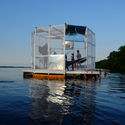

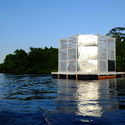
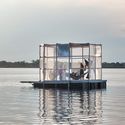

Floating is one of humanity's oldest ways of living and traveling. Today, this ancestral practice is drawing significant interest due to the increasing frequency of flooding caused by climate change.
Riverside communities in the Amazon rainforest have used various floating strategies for centuries. By studying local architectural solutions and utilizing contemporary materials technology, architect Marko Brajovic and designer Nacho Martí, co-directors of the Architectural Association Visiting School Amazon, organized an international workshop to experiment with floating architecture.


Participants studied the lifestyle of the Lake Mamori communities, learned natural flotation techniques, and explored material technologies, integrating this knowledge to build an experimental platform.


"Folies Tropicales" is a prototype of floating architecture—a multifunctional space designed as an ephemeral habitat, a classroom, and a venue for celebrations and ceremonies. It addresses a fundamental need for typological, technological, functional, and aesthetic/ethical experimentation.

Floating is a state of mind, and in this dimension, "Folies Tropicales" serves as an observatory from which to understand both the external and internal worlds, which are increasingly subject to profound changes.

PROJECT INFO
Project Name: "Folies Tropicales"
Location: Lake Mamori, Amazonas, Brazil
Year: 2018
Authors: Marko Brajovic + Nacho Martí
Institutional Support: Architectural Association Visiting School Amazon
Technical Partnership: Ecofloat (Amanda Pamato, Adi Neto, and Eduardo Amaro)
Acknowledgments: What Design Can Do, Lake Mamori Community, Korokoró
Project and Fabrication Team: AAVSA (Sonia Syed, Andreia Bento, Marcele Lauande, Maria Elena Salas, Mehek Merchant, Mila Montezuma, Carlos Duarte, Vian Rasool).
This article was written by Marko Brajovic. The translation is powered by AI.


