The Architecture and Landscape Ideas Competition for the Pasarelas San Borja and Surroundings announced its winning proposals during an event held on Thursday, September 6, at the National Headquarters of the Chilean Association of Architects (Colegio de Arquitectos de Chile). The main objective of the competition was to recognize, through a qualified and representative jury accredited by the sponsors, the best urban design ideas that help define intervention criteria and generate proposals for the San Borja neighborhood.
A total of 86 interdisciplinary teams registered for the competition, with 34 proposals successfully submitted and evaluated. The jury awarded first, second, and third place, along with three honorable mentions. Additionally, a Neighborhood Mention was awarded to two projects highlighted by the Neighborhood Advisory Commission during the evaluation process.
Discover the winning projects below:
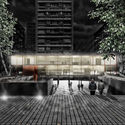
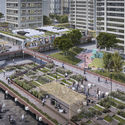
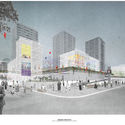
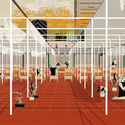

First Place

Proposal: Corredores San Borja
Authors: Oscar Luengo + Álvaro Parraguez
Team: Francisca Feliu, Marcos Muñoz, Beatriz Herriet, Matías Ramírez
Official Description: The initial strategy proposes the walkways as spatial corridors connecting towers, plazas, and perimeter activities, allowing for fluidity and articulation between the complex's disconnected indoor and outdoor spaces. The design outlines a promenade on both upper and lower levels, shaping a spatial experience centered around support structures that double as tree-lined axes accompanying the walkways. This approach seeks to provide continuity, creating a fluid route for movement and lingering integrated into daily activities.
The second strategy recognizes the walkways, corridors, and tree-lined paths as public vessels. Designing the plaza as a gathering space involves a variety of themes that respond to its surroundings: the Arts Plaza facing the GAM; the Gastronomy Plaza, which caters to students, healthcare professionals, and the residents of the San Borja neighborhood; the Play Plazas, which address a lack of park space by connecting it with a corridor of games and recreational activities for children; and the Events Plaza for multipurpose activities. Consequently, the corridors define a perimeter containing a void where gatherings and activities converge, shaping a public space.
While the initial interventions establish continuity, articulation, and containment, the third strategy functions similarly to a software plugin. This approach aims to add supplementary functions to the spatial and programmatic structure of the walkways, creating a literary cafe corridor, an art corridor, a play corridor, a green corridor, and a multipurpose corridor. These activity plugins, or programmatic corridors, are volumes that complement the walkways, projecting the public realm and fostering continuity, containment, and activation.

Second Place (+ Neighborhood Mention)

Proposal: Ensamble San Borja
Team: Daniela Moder Estrada, Clara Miguens, Rodrigo Ruiz Medina, Victoria González, María Lorena Carballo, Nicolás Benedetti, Marina Constanza Hurst
Description: The project proposes the urban linkage of the Lastarria and San Borja neighborhoods by continuing a pedestrian route made up of their commercial, cultural, and educational zones, establishing a physical connection and a participatory community system through artistic, cultural, and recreational programming.
The strategic location of the walkways makes them essential for connectivity. Therefore, landscaped ramps are interwoven to ensure universal accessibility, connecting with various pedestrian stretches on the perimeter streets. Programming is introduced to humanize the public space through socialization, which is key to maintaining a steady, dynamic daily flow of people and enhancing safety.
San Borja is envisioned as a living space that mutates according to needs and adapts to demands—compressing uses, expanding knowledge. It houses people but also distributes, protects, and guides them, stimulating perception and evoking feelings of freedom.


Third Place

Proposal: Circuito de Activación Temporal
Team: Beatriz Coeffé Boitano, Pablo Montecinos, Giancarlo Acosta, Carlos Jorquera, Camila Pascual
Description: As a proposal that is open-ended in its physical and temporal form, this project offers a mutable and flexible system that reflects contemporary times. Our responsibility is to ensure that architecture does not become obsolete; if it does, we become accomplices to its failure.
The project's primary decision is to leave the structure of the walkways untouched, maintaining their current condition while highlighting their urban profile through artistic interventions on their surface. The edges are reclaimed to enhance pedestrianization, opening up the spaces to free use and connecting them to activation devices, while incorporating universal accessibility criteria through ramps and elevators.
A series of catalyst programs are proposed within the walkway circuit, designed to activate the site through sporadic and diverse uses. These function in the same way as familiar nomadic structures: open-air markets, temporary amusement rides, traditional fairs, pop-up concerts, and street theater. The devices allow for constant programmatic variation, enabling a wide spectrum of layouts and spatial situations. The final configurations will be defined by the community. As an initial proposal, the following tentative uses are outlined: an urban garden, public workshops, a community center, a multipurpose space, and El Pedregal Plaza.
The route between the proposed devices is consolidated as an urban art circuit, taking advantage of the canvas provided by the walkway walls. Additionally, the project utilizes scaffolding systems for their lightweight, temporary nature, as well as their potential for easy physical and spatial assembly. The resulting structure is ethereal and abstract, introducing a new scale for leisure and cultural action while fostering creativity and unexpected encounters.


Honorable Mention (+ Neighborhood Mention)
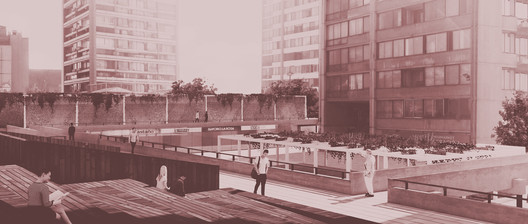
Proposal: Pasarelas San Borja
Team: Osvaldo Salazar Mikacic, María Milagros Suárez, Yamil Najul, Adriana Hernández, Paula Hermida.
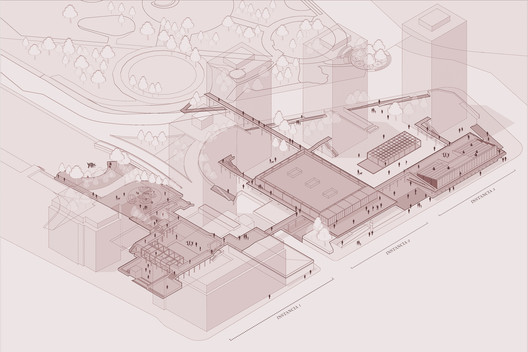
Honorable Mention
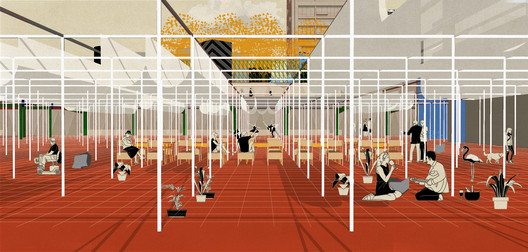
Proposal: Incompleto: una superficie retroactiva
Team: Fernando Toro Cano, Pablo Rojas Bottner, Catalina Briones, Miguel Acuña, María Loreto Cerda, Eugenia Rojas, Valentina Mardones, Fabián Reyes, Camila Ulloa, Francisca Soto, Andr&--123;s Rojas
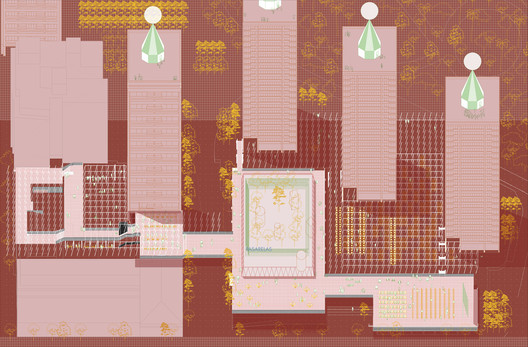
Honorable Mention
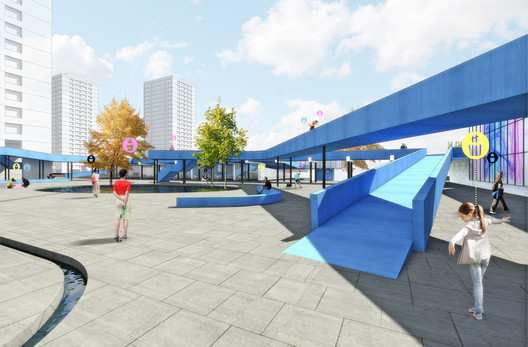
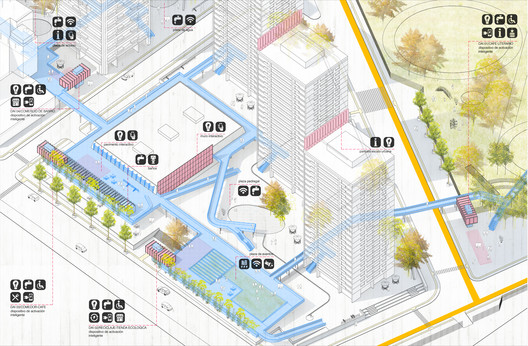
Proposal: Smart San Borja
Team: Claudia Oliva Saavedra, Sebastián Laclabère, Philippe Laclabère.
The jury consisted of Bernardita Lorenzini, representing the Municipality of Santiago; Carmen León, president of the San Borja Neighborhood Association; Teodoro Fernández as recipient of the National Architecture Award, Emilio de la Cerda as a heritage specialist architect; Pola Mora as a contemporary architecture specialist architect; Federico Mesa as international guest architect, and Cristián Undurraga, elected as the participants' representative. Additionally, a Neighborhood Advisory Commission was formed by residents of Towers 3, 4, 5, and 6 of the San Borja neighborhood, who had speaking rights during the jury's evaluation process across various discussion and review sessions.
The competition was jointly organized by the Municipality of Santiago, the San Borja Neighborhood Association, and Pasarelas Verdes, produced by Grupo Arquitectura Caliente, funded by the Ministry of Cultures, Arts, and Heritage, and sponsored by the Chilean Association of Architects and the Association of Architectural Offices of Chile (AOA).
Update: the list of first-place team members has been modified today [September 7] at the request of the project's authors. The official press release originally did not include all members of the honorable mention titled "Incompleto...". Both technical details have been updated.
This article was written by ArchDaily Team. The translation is powered by AI.