
On August 6, the NOVA Design Award 2018 announced its competition finalists. The NOVA Design Award 2018 is the inaugural edition of the NOVA Design Award (NDA). Under the theme of "Future Living Space," the competition explores the possibilities of residential living over the next decade within a residential space of under 50 square meters with a ceiling height of no more than 6 meters in a first-tier Chinese city, aiming to build a physical prototype of "future living."
The competition selected five finalists from 131 submissions across more than 20 countries to enter the final round of judging.
The Finalists:
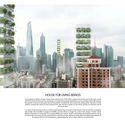
Project: HOUSE FOR LIVING BEINGS
Participants: Patricia Yus, Vincent De Borger (Spain)
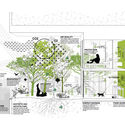
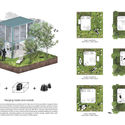
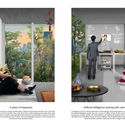
Climate change, resource scarcity, and environmental degradation caused by urbanization are urgent global challenges. Recognizing the millennia-long significance of forests to the Earth, the designers envisioned an ecological living space where humans and nature coexist in harmony. Through thoughtful spatial planning, the boundary between interior and exterior is completely dissolved. In this "urban oasis," every plant serves as an organic provider of environmental data, which is analyzed by AI to regulate temperature and humidity, reduce pollution, and create a healthier, more livable environment.


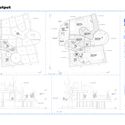
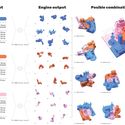
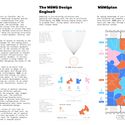
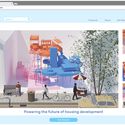
Project: WǒWū
Participants: Edgar Rodriguez Lozano, Diego Pulido Torres, Lauren Felix Valencia, Alejandro Marquez Romero, Alberto Vera Zavala (Mexico)
Climate change, resource scarcity, and environmental degradation caused by urbanization are urgent global challenges. Recognizing the millennia-long significance of forests to the Earth, the designers envisioned an ecological living space where humans and nature coexist in harmony. Through thoughtful spatial planning, the boundary between interior and exterior is completely dissolved. In this "urban oasis," every plant serves as an organic provider of environmental data, which is analyzed by AI to regulate temperature and humidity, reduce pollution, and create a healthier, more livable environment.

Project: DIAGONALS 2025
Participant: Phillip Stien (United States)
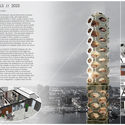
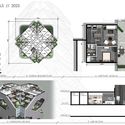
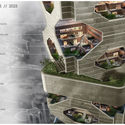
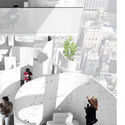
This proposal responds to the extreme density of urban housing and the waste of spatial resources in the suburbs. By designing "aerial blocks," it shapes a vertical community that entirely subverts the form of traditional residential buildings. Here, every three floors share a ramped staircase and a green courtyard, inviting residents to step out of their private homes and integrate into a tangible collective community.

Project: HOUSE OF iFURNITECTURE
Participants: Hung Nguyen, Dung Vu, Binh Nguyen (Vietnam)
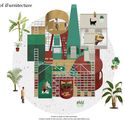
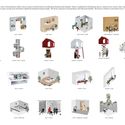
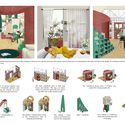
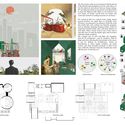
While the mobile internet brings convenience, it also distances people from one another. The designers believe that even at home, people habitually retreat to their rooms to use their phones, leading to a lack of genuine interaction. Therefore, they hope to reconstruct the concept of "home." The design concept of "iFurnitecture" (intelligent architectural furniture) bridges the gap between minimized architecture and maximized furniture. By suspending functional units with independent programs, it constructs a micro-community that fosters interaction and brings family members closer together. Furthermore, each family member can freely select their "iFurnitecture" to express their individuality.

Project: Residential Printer: A Flexible Life
Participants: Yining Bei, Wenbo Yi (Tianjin, China)
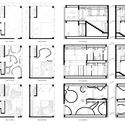
The designers envision that by 2025, people will be able to design their own homes using 3D printing technology. Users can purchase an architectural design online and then realize it through 3D printing. Except for the kitchen and bathroom, all other spaces and furniture are adaptable, allowing residents to freely change functions within the same space based on their needs. Unlike traditional construction, 3D printing enables more diverse spatial configurations, such as undulating curved topographies, making residential spaces more experimental. Furthermore, the entire 3D-printed residential building features a material recycling center. When tenants move out, their materials can be reused by new residents, achieving "zero waste." Based on current technological projections, by 2025, it will take only 10 minutes to print a 50-square-meter home.



The finalists will present their design concepts at the NOVA DAY event on August 25, when the NDA will select and announce the final winners.

Jury:
Wang Qian | Chairman and Co-President of NOVA Property Investment Co., Ltd
Carlo Ratti | Founding Partner of Carlo Ratti Associati and Director of the MIT Senseable City Lab
Anouk Legendre | Co-founder of XTU Architects
Oke Hauser | Creative Lead of MINI LIVING
Peng Yuzhen | Architect, Former Design Director and Environmental Designer at IDEO Shanghai
Becky Quintal | Head of Content at ArchDaily
Zhang Han | China Regional Manager and Executive Editor at ArchDaily
On August 10, the NDA launched its public voting platform, inviting the public to vote for their favorite "future living space." Voting will close on August 20, 2018, at 11:59 PM Beijing Time (CST). The results will be published on the NDA official website and will account for 10% of the final score.
About the Organizer:
NOVA Property Investment Co., Ltd (NOVA) was co-founded in 2015 by founder Wang Qian and strategic investor Warburg Pincus. In 2016, NOVA completed the equity acquisition of Yicheng Creative, an operator specializing in existing property renovation and value-added services. By integrating Yicheng Creative's expertise in investment, renovation, and operations, NOVA established an integrated "acquisition-renovation-operation" asset management model. In 2018, the Government of Singapore Investment Corporation (GIC) officially announced its investment in NOVA, becoming a shareholder.
Leveraging its strong capital and operational capabilities, NOVA has rapidly expanded its asset portfolio across China's first-tier cities. The company focuses on investing in commercial assets in premium locations, renovating them into apartments, offices, and unique commercial complexes tailored to local contexts for long-term rental and asset management. Product innovation and multi-format operations represent NOVA's core competitive strengths, distinguishing it from peers.
Currently, the company has 41 projects in operation or under construction, representing a total investment of nearly RMB 12 billion and a total area of 400,000 square meters across first-tier cities such as Shanghai and Beijing. Its operating brands include base, N², and Yixi, aiming to establish a brand alliance to meet the positioning needs of different formats.
The company currently employs a team of over 180 people. Its key partners include Vanke, InfraRed Nan Fung, Sino-Ocean Group, Jingu Trust, Tiantong Hongji, Sunac, and Shanghai Jinwaitan Group, among others. In November 2017, as the exclusive partner, NOVA announced a partnership with BMW Group's MINI brand to co-create the world's first MINI co-living initiative—MINI LIVING.
News via: NOVA Design Award
This article was written by Laurene Cen. The translation is powered by AI.

