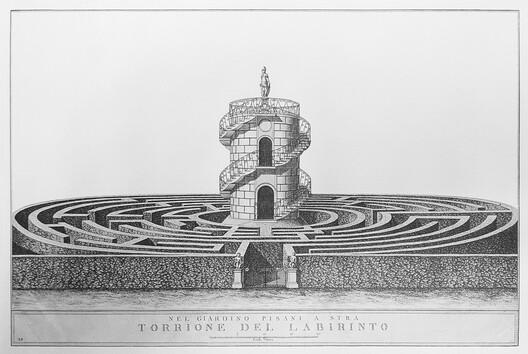
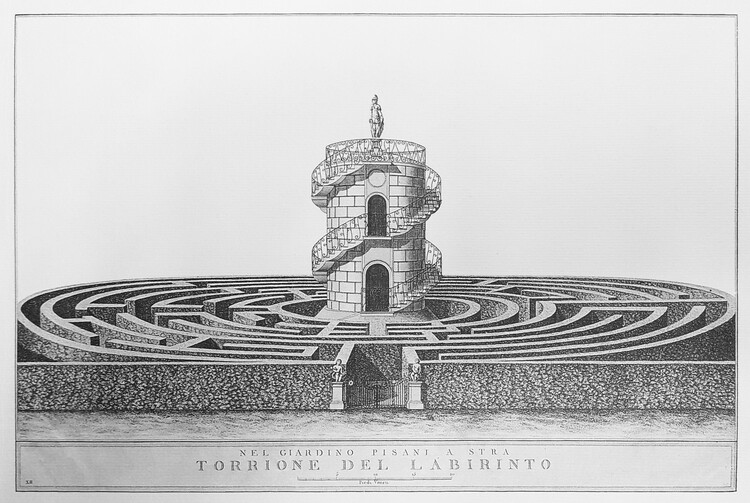
Architecture is typically understood through principles such as order, clarity, and functionality. In O Livro dos Labirintos, Francesco Perrotta-Bosch proposes another entry point: thinking about the discipline through the labyrinth—a structure that, since its mythical origins, has operated through detours, ambiguity, and disorientation.
Drawing on the Labyrinth of Crete, attributed to Daedalus in Greek mythology, the author shifts the discussion on the origins of architecture to a realm less associated with constructive rationality and closer to spatial experience. The book's guiding question is direct: why would architecture have begun with a form that subverts linearity and legibility?


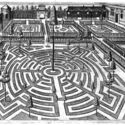
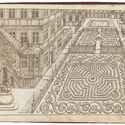
The result of five years of research conducted within a dual-degree PhD program at FAU USP and Università IUAV di Venezia, the publication is organized as a long-term investigation. Spanning nearly four thousand years, the labyrinth is analyzed not as an isolated object, but as a principle that recurs across different historical contexts.
From Greco-Roman antiquity to medieval cathedrals and early modern gardens, the book traces the transformation of this structure to its presence in contemporary programs, such as museums, airports, and shopping centers. In these instances, the labyrinth ceases to be a literal figure and instead operates as a logic of spatial organization: a sequence of routes that shapes the user's experience over time.
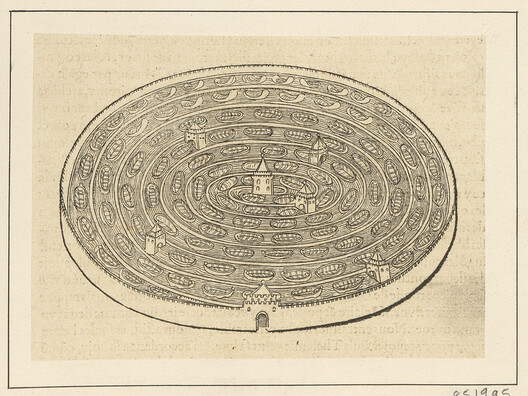
By proposing this reading, Perrotta-Bosch challenges the modern tradition that privileged spatial transparency and immediate orientation. Instead of a space presented in its entirety and predictably, the labyrinth introduces the concept of an environment that reveals itself progressively, incorporating error, backtracking, and uncertainty as integral parts of the architectural experience. The book draws connections across different fields, bringing together architecture, literature, and the visual arts. Authors like Jorge Luis Borges and Julio Cortázar appear alongside works by Richard Serra and designs by Álvaro Siza, building a diverse framework that underscores the interdisciplinary nature of the subject.
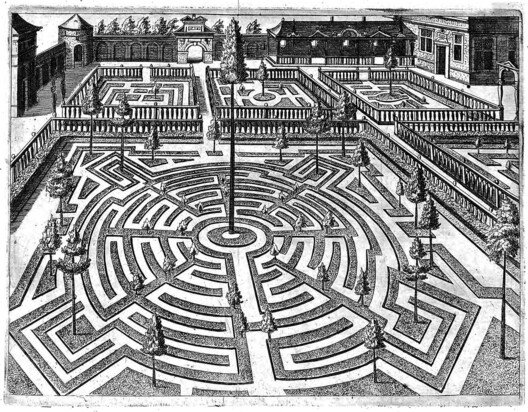
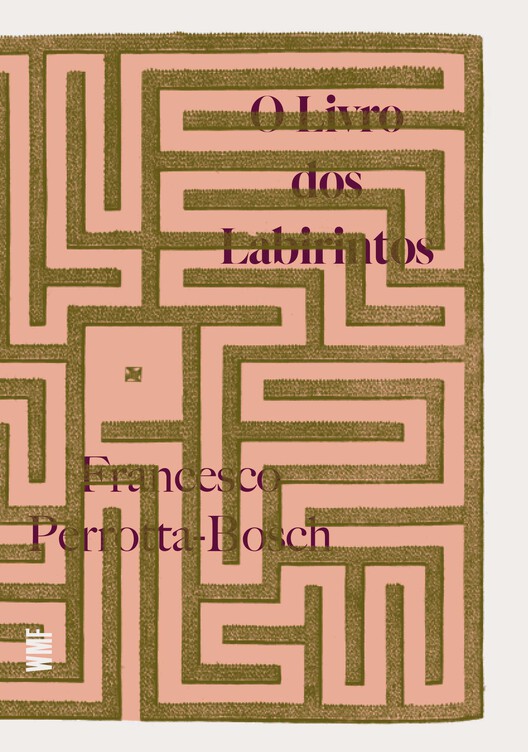
The graphic design, developed by Gustavo Piqueira (Casa Rex), mirrors this approach by proposing a non-linear reading. Within its own structure, the publication embodies the very principle it investigates: movement as a method and disorientation as a tool for understanding.
Rather than merely reconstructing the history of a symbol, O Livro dos Labirintos proposes a shift in perspective on architecture itself. In a context shaped by increasingly precise mapping systems and optimized flows, the labyrinth repositions space as a field of discovery. As such, the book suggests that architecture is defined not only by the efficient organization of the world, but also by its capacity to deal with that which escapes control—where the journey, rather than the destination, becomes central.
Prior to O Livro dos Labirintos, Francesco Perrotta-Bosch published Lina: uma biografia (2021), a biography dedicated to the career of architect Lina Bo Bardi. Drawing on extensive research and previously unpublished primary sources, the book presents the architect's life and work, covering projects such as MASP, Sesc Pompeia, and Solar do Unhão, as well as examining her relationship with Brazilian culture.
This article was written by ArchDaily. The translation is powered by AI.


