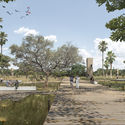
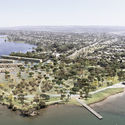
The office Atelier77 was awarded third place in the Public Competition for the Lake Paranoá Waterfront Masterplan. Atelier77's proposal aims to reclaim and restore public spaces along the shores of Lake Paranoá, balancing public use with ecological equilibrium to foster a sustainable occupation of the territory. It designs an urban infrastructure structured around three design layers—ecosystem, transport, and the integration of uses and activities—to create a vibrant waterfront.
The jury, chaired by Ângelo Bucci, highlighted the quality of the project's preservation of Cerrado phytophysiognomies, the incorporation of ecological corridors, sustainable drainage, and the integration of cultural uses, as well as the transport infrastructure featuring a new LRT line and catamaran services. The proposal suggests an active occupation of the waterfront, introducing a wide range of facilities and activities to ensure permanent use, preservation, safety, and the subsequent activation of the shoreline. The scheme emphasizes the importance of designing far beyond a simple park, providing a democratic and accessible waterfront for all.
Read on for an excerpt from the project description.
Description text provided by the project team.
The Orla Livre (Free Waterfront) project is a sustainable process of environmental and social restructuring for the Lake Paranoá shoreline. It recovers not only the integrity and diversity around the lake but also functional space for leisure and urban life, promoting a sense of ownership among its users. It explores new forms of interaction between the population, nature, technology, and the element of time, which is inherent to the project's implementation phase.
Orla Livre is a major catalyst for the transformation of Brasília. Upgrading the waterfront for public use, democratizing access, establishing new public transportation systems, reclaiming illegally occupied areas, fostering habitat connectivity, and ecologically restoring degraded zones are all steps in a process of change. This change centers on Lake Paranoá but subtly and democratically transforms the entire city.

The Orla Livre project aims to reclaim and restore public spaces along the shores of Lake Paranoá, balancing public use with ecological equilibrium to foster a sustainable occupation of the territory.
To achieve this, it focuses on three overlapping operational layers designed to create a synergistic scenario:
ECOSYSTEM LAYER—promotes connectivity between protected areas through ecological corridors, environmental restoration, and the protection of Cerrado remnants.
TRANSPORT LAYER—establishes a new public intermodal transport infrastructure integrated with both the existing system and the Orla Livre project.
ACTIVITIES AND USES LAYER—creates a democratic space for the population of Brasília, providing areas for leisure, recreation, education, and culture.
Ecosystem

The Cerrado is the second-largest biome in South America. In terms of biological diversity, the Brazilian Cerrado is recognized as the richest savanna in the world, featuring an extreme abundance of endemic species and sheltering 11,627 cataloged native plant species.
There is a vast diversity of habitats, resulting in a remarkable variation of species across different phytophysiognomies.
Despite its recognized biological importance, the Cerrado has the smallest percentage of strictly protected areas among all global biodiversity hotspots. Only 8.2% of the biome's territory is legally protected under conservation units, of which a mere 2.8% fall under strict protection categories.

Consequently, driven by urbanization and agribusiness, the Cerrado has already lost 46% of its native vegetation, and is projected to lose an additional 34% by 2050. This could lead to the extinction of 1,140 endemic species.
To prevent the extinction of these species, ecological restoration actions are required alongside the preservation of remaining vegetation and existing protected areas. The Cerrado is composed of a mosaic of phytophysiognomies—including forests, but primarily savannas and grasslands characterized by the coexistence of grasses, shrubs, and tree species.
Design Guidelines
The Lake Paranoá Orla Livre project aims to achieve synergy between the use of waterfront spaces by Brasília's population and the preservation of Cerrado fauna and flora. It introduces multifunctional spaces that fulfill both social and ecological functions. The goal is to reintroduce or bolster urban biodiversity, bringing its ecosystem services back into the urban environment.
In terms of landscape ecology, the design plans for structural ecological corridors to connect existing conservation units and areas of environmental interest, facilitating gene flow between them.
The linear park along the lakefront acts as an ecological corridor, linking protected areas and remaining native vegetation. Designed for public use, the park is interactive, bringing the biome closer to the community, offering leisure spaces, and promoting environmental education and ecological awareness.

The park also features biodiversity research centers to monitor the biome. These centers will include nurseries for raising seedlings for reforestation and cultivation of native species.
Given the biome's significance to the territory's water balance, the project integrates functional landscaping that promotes sustainable urban drainage. Stormwater runoff will be channeled to the lake via bioswales that filter the water naturally before discharge. These bioswales also serve an educational purpose, bringing the management and potential of stormwater to the surface.
Following the same functional and educational principles, phytoremediation areas are planned for new shoreline buildings, treating wastewater using filtering gardens before returning the treated water to the lake.
Transport
Democratic occupation of the Lake Paranoá waterfront requires broad and unrestricted access for the population.

The project proposes four different modes of transport:
All systems are interconnected, featuring hubs at strategic locations to ensure optimal flow.
Intermodal connections are situated at strategic nodes along the waterfront, primarily in areas with a higher density of attractions. These hubs link the various transport systems to foster integration and connectivity.
The new public transportation system integrates with the existing network and features transfer hubs connecting both. It links to the metro in Asa Sul, to buses at various points around the lake (including the BRT system), and via LRT to the Airport, located near the lake.
Activities and Uses
Lake Paranoá displays highly diverse characteristics along its shoreline, reflecting varied demographic and socioeconomic dynamics in neighboring areas, as well as distinct levels of transport infrastructure and urban facilities.

The project intends to homogeneously upgrade the waterfront to elevate the lake across all its zones. "Access for all" also means "attractions for all"; therefore, different programs and amenities must be distributed around the entire shoreline.
The project promotes:
Floating Facilities
To enable a full range of activities around the lake, the design introduces floating facilities capable of providing a more balanced distribution of infrastructure for cultural, educational, commercial, or leisure uses. The temporary presence of programs such as a floating cinema, music stage, or market offers cultural activities to all points along the waterfront, establishing a citywide cultural agenda that enhances the appeal of the installations themselves.
Mooring points for these structures are planned around the lake, featuring steps descending to the water that can serve as seating tiers, decks, or support areas, directly engaging with the floating facility docked at any given time.

Various types of facilities are planned, including a cinema, swimming pool, leisure deck, viewpoint, restaurant, market, exhibition space, theater or music stage, alongside technical equipment such as waste-removal vessels.
Architects
Location
Paranoá Lake, Brasilia - Federal District, 70297-400, BrasilAuthor
Priscila Marinho de MatosCollaborators
Thorsten Nolte, Nanda Eskes, San Jandrey, Fernando Cunha, Andrea Baran, Arthur Naressi, Miguel CarrascoProject Year
2018