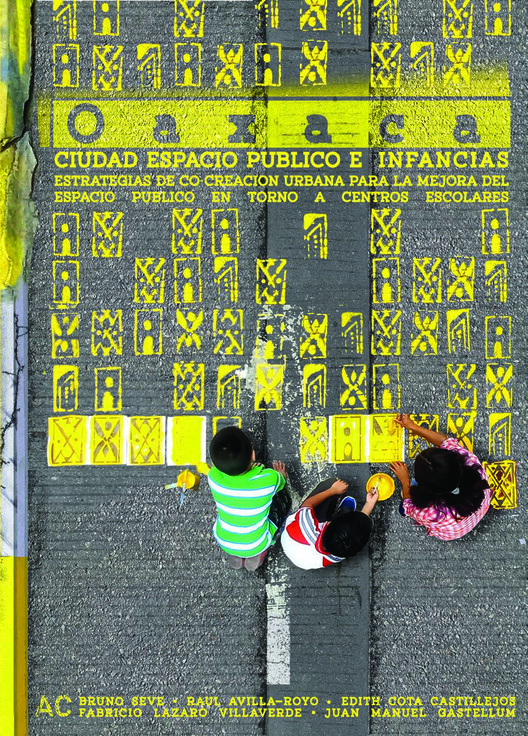
"Who wants to play?" "Meeeeeeeeeeee!"
Excited children shout in unison in response to an organizer of the "City, Public Spaces, and Childhood" workshop. Over a few intense days, architecture students from four universities interacted with more than 70 children aged 6 to 12, along with their families and the teaching staff of the public primary school in the Alemán neighborhood of Oaxaca de Juárez, Mexico. The initial goal: to develop a needs assessment for the school's urban environment. The program included exploratory routes, diverse artistic activities to describe, imagine, and map their neighborhood (colonia), collaborative games, debates, conversations, laughter, tamales, impromptu concerts, and numerous meals with families and the COMVIVE (Neighborhood Life Committee). However, what was intended to be limited to a diagnostic assessment evolved—given the open methodology and latent opportunity—into a tactical urbanism operation in which the participating community reclaimed and transformed the public space in front of the school. The Tequio—days of voluntary community work for the common good—involved neighbors from the COMVIVE, architecture students, and the primary school community. In three days and with a minimal budget, 930 square meters of neglected public space, previously used as a parking lot, were converted into a large, playable, multi-use plaza, safe both day and night. A community public space co-designed, co-built, and currently co-managed by its local residents.


