
The construction of the Rita Maria Bus Terminal, the winning design of a national architectural competition, dates back to the late 1970s, coinciding with the construction of the South Bay Landfill (Aterro da Baía Sul) on Santa Catarina Island, in Florianópolis. The landfill, with landscaping by Roberto Burle Marx, was part of a contemporary strategy to modernize the city's road network.
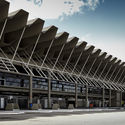
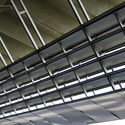
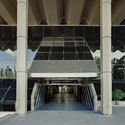
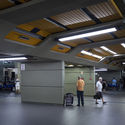

The winning preliminary architectural design of the competition, organized by the State Secretariat of Transportation and Public Works in 1976, was submitted by a team led by Uruguayan architects Yamandú Carlevaro (1934) and Enrique Brena Nadotti (1937), in collaboration with Argentine architect Ricardo Monti. Construction involved complex logistics due to the structural proposal and, after several interruptions, the terminal was finally inaugurated in 1981.
"The architectural language corresponds to an expressionist conception that is fully integrated with and affirms the functional dynamics, using noble and contrasting materials, incorporating the entire network of the complex building systems into the overall spatial composition." (Carlevaro; Brena, 1981)

The Rita Maria Bus Terminal is designed as a large nave, with two distinct facades in its layout: one that welcomes the urban user—the city-facing front—standing as the last built monument seen by those leaving the city before crossing the bridges; and the other, the bus platform area for departures and arrivals—the urban rear—aligned with the waterfront.
"The basic materials consist of structural elements of exposed concrete without special treatments, smoked colorglass, black rubber flooring, and lightweight partition and ceiling elements rendered in contrasting colors against the monochromatic scheme of the overall composition." (Carlevaro; Brena, 1981)


The use of a large reinforced concrete structure, stripped of any cladding, reflected the technological modernization required for a city that aspired to become a metropolis. The architectural language adopted for this "passenger machine" translates into a refined Brutalism, deliberately crafted in high-performance exposed concrete. This was no longer the combative Brutalism that championed the "truth and/or honesty of materials," but rather a polished Brutalism of exposed concrete, adopted here as an urban aesthetic.
The discourse of technical rationalism permeates all the testimonials recorded in the authors' publications, sounding like a statement of principles. These are principles of architectural design, but also of professional conduct, applied to the design of a complex building that functions as urban infrastructure while maintaining a high degree of internal coherence.

"The solution is a systematized spatial-functional and constructive complex that organizes services, seamlessly resolving the dual flow of the machine (vehicular traffic) and the user (human flow)." (Carlevaro; Brena, 1981)
In the design of the Rita Maria Bus Terminal, aligned with the global modernist currents of the period, the affirmation of rationality as an aesthetic expression becomes clear. The poetics of Brutalism served as a counterpoint to technical progress—not only in terms of constructability, but also in building systems and services—as a corollary of modernity.

"(...) the basic concept that guided this project was the separation of loading, unloading, and supply flows, facilitating and securing the performance of functions. Its physical manifestation is a linear reinforced concrete building with a structure of longitudinal frames and a precast roof." (Carlevaro; Brena, 1988)

Ironically, despite its waterfront location, the new public facility turns its back on the sea. This apparently set off a trend that led to a proliferation of institutional buildings on the South Bay Landfill, all invariably adopting a layout that ultimately denies the site's maritime identity.
An icon of Brutalist architecture in the capital city, it currently faces the preservation challenges typical of modern heritage, suffering from issues common in Brazil, such as a lack of maintenance and changes to activities essential to a bus terminal. Furthermore, it pays the price for its avant-garde nature, having introduced new materials and construction systems whose durability was largely untested at the time.

Its compositional integrity remains intact, and the building maintains its position as an architectural landmark in the landscape, like a vessel anchored on the landfill...
* Text written in 2017.
** The photographs were published in the print annual ArqSC, 10th edition.
-
Architects: Enrique Brena Nadotti e Yamandú Carlevaro
- Year: 1976
-
Photographs:Ronaldo Azambuja


