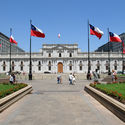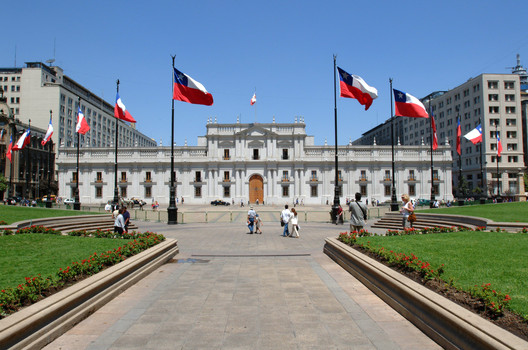
Originally built to house the first Mint of the Kingdom of Chile in the late 18th century, La Moneda Palace has served as the seat of the executive branch of the Republic of Chile since 1845. Today, it houses the offices of the President of the Republic, along with the Ministry of the Interior and Public Security, the General Secretariat of the Presidency (SEGPRES), and the General Secretariat of Government.
Thirty years after the first coin was minted in Chile featuring the image of King Ferdinand VI, colonial governor Agustín de Jáuregui commissioned the construction of a dedicated building for the Mint in 1780. During its first three decades, the Mint had been managed by the perpetual treasurer Francisco García Huidobro, who had purchased the Palacio Viejo (Old Palace)—now the southwestern corner of Huérfanos and Morandé streets—in the heart of Santiago's historic center. Following his death, minting operations were relocated to a former Jesuit college adjacent to the Church of the Company, where the former National Congress now stands.

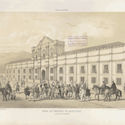
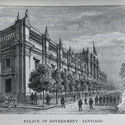
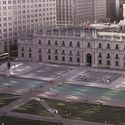
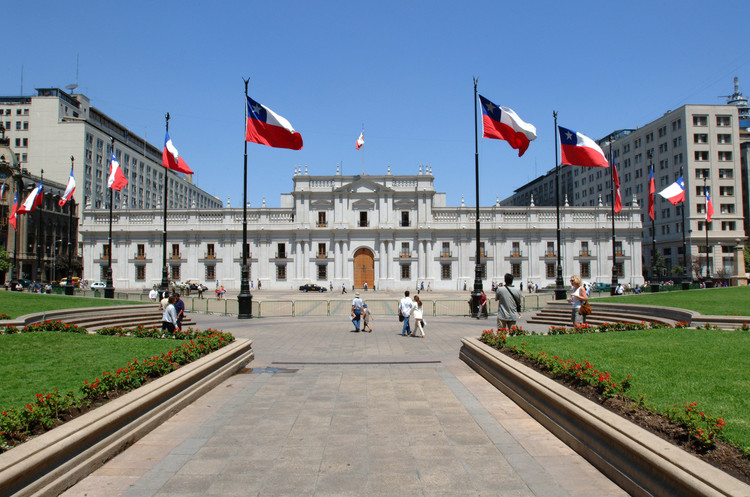

For the Royal Mint project, Jáuregui selected the architect Joaquín Toesca, who arrived from Rome to design and construct projects for the Spanish Empire, including the Santiago Cathedral (1780). Toesca’s challenge was to design a building that would accommodate not only the operational facilities of a mint—namely, workshops, smelting furnaces, warehouses, and coal bunkers—but also the residence for the kingdom’s bureaucracy, ranging from superintendents to weighmasters.
Furthermore, the architect incorporated an unprecedented architectural language for this type of building, introducing "a seal of 'majesty' that had previously belonged solely to temples and palaces, thereby transferring their symbolic character to those administrative buildings that would come to be seen as temples of public happiness" (Guarda, 1997).
Thus, the Royal Mint designed by Toesca features "a pure neoclassical style with Roman Doric influences," as described by the National Monuments Council. The building is an eminently horizontal, two-story volume with a rectilinear composition, conveying the strength and stability demanded by its original (and current) program. Its interior is structured around a series of courtyards—a feature reinforced by later renovations—that convey solemnity and bring natural light into the building's offices. Guarda (1997) also highlights the presence of a "master axis that traverses the floor plan from north to south, expressed in the elevation by monumental porticos that produce an illusionistic receding effect, aided by the smaller proportions of the second and third stories—the latter, unfortunately, now lost."
1784–1805: Construction

The site chosen for this prestigious project was on the banks of the Mapocho River, behind the Santo Domingo Convent in what was known as the Santo Domingo Dump (now the Central Market). However, once excavations began in the spring of 1783, groundwater from the river constantly seeped in, and work was halted pending relocation. Three sites in Santiago's historic center were considered for this task, with a plot belonging to the Colegio Carolino—known at the time as the Solar de los Teatinos (hence the current name of the street to the west of La Moneda)—ultimately being selected.
In 1784, excavations began and materials started to arrive: lime from the Polpaico estate; sand from the Maipo River; red stone from the San Cristóbal Hill quarry; white stone from Cerro Blanco; oak and cypress wood from the Valdivian forests; ironwork from Biscay, Spain; and twenty varieties of bricks baked in Santiago for the construction of lintels, corners, floors, moldings, and walls over a meter thick.
Toesca, however, died in 1799 before the project was completed, prompting Governor Gabriel de Avilés to retain the engineer Agustín Cavallero, who had been appointed director of the fortifications of Panama. Nevertheless, in 1802 the King reaffirmed Cavallero's original posting, and he was replaced by Miguel María Atero and Ignacio de Andía Varela. That same year, the Count of Quinta Alegre successfully proposed building a small square in front of the Royal Mint's main facade to showcase the project and manage the building's runoff, leading to the acquisition and demolition of the houses on the northern sidewalk of the street—known ever since as Moneda Nueva.

In 1805, Governor Luis Muñoz de Guzmán inaugurated the Royal Mint, though construction was not yet entirely complete. The main facade originally featured coats of arms, allegorical busts, and trophies designed by Andía y Varela. These were removed during the first restoration, carried out after the earthquake of November 19, 1822, during the early years of Chilean independence.
In June 1845, President Manuel Bulnes decided to move the seat of the executive branch, along with the ministries and the head of state's residence, from the Palacio de la Real Audiencia (now the National Historical Museum) to the Royal Mint. Bulnes explained to Parliament that in the building where the nation's highest authority resided, "it is not possible to occupy any of its interior quarters without being exposed to imminent danger."
The newly designated La Moneda Palace was divided into three sectors: the presidential residence, the seat of government, and the Mint. The latter continued to operate in the southern sector of the building until 1922, though the minting workshops were not demolished until 1945.

1927–1973: Consolidation of a Republican Symbol

During the first administration of Carlos Ibáñez del Campo (1927–1931), architects Josué Smith Solar and José Smith Miller (Smith Solar & Smith Miller) won the public competition to remodel the southern facade of La Moneda Palace. The winning firm chose to replicate the northern facade designed by Toesca, rightly giving prominence to the original architect's design. "I believe they created a masterful work, which was also an act of humility and modesty," commented architect Mario Pérez de Arce a few years ago, author of a detailed monograph dedicated to the Chilean firm.
The competition was part of Ibáñez del Campo's intention to "create an urban ensemble representing the strength of the state apparatus and national identity around La Moneda Palace" (Gurovich, 2003). The same firm, Smith Solar & Smith Miller, developed a "Capital Civic Center Project," which was enacted as Law 4,828 in 1930, ultimately giving the area its current solemn atmosphere. Urban planning advisor Karl Brunner designed both a civic backdrop around the palace with government buildings and the redesign of the adjacent public spaces. To the north of La Moneda, he remodeled Plaza Portales into Plaza de la Constitución (1942), preserving the monument to Diego Portales; to the south, he created Plaza de la Libertad, featuring a statue of former President Arturo Alessandri, which required the demolition of the buildings separating the palace from the Alameda. Thus, the Civic District was born.
The establishment of the first regulations for the Civic District and its gradual realization between 1936 and 1950 endowed La Moneda Palace with solemnity and monumentality. The visual and conceptual "master axis" noted by Guarda was now a physical one, allowing pedestrians to walk through the block via the palace's courtyards. This gesture became associated with transparency and the practice of democracy; consequently, the subsequent administrations of Eduardo Frei Montalva (1964–1970) and Salvador Allende (1970–1973) allowed pedestrian traffic to pass through La Moneda, just like any other shopping arcade in downtown Santiago.

1973: Bombardment and Renovation

On September 11, 1973, the Armed Forces carried out a coup d'état against the government of Salvador Allende: seven airstrikes and eighteen missiles from Hawker Hunters bombarded La Moneda Palace for six hours. The bombardment triggered a fire that collapsed the second-floor slab and the roof, turning the 10-meter-high building into a high-draft chimney that rapidly spread the flames. As Márquez and Rozas (2014) recall, the fire left only "the thick brick walls, bonded with lime and sand, with the exception of the southern section occupied by the Ministry of Foreign Affairs, which had reinforced concrete slabs."
With La Moneda in ruins and fenced off with wooden planks, the military junta exercised total control from the UNCTAD III building—renamed Diego Portales in honor of the architect of the 1833 Constitution, and currently the GAM. In 1974, a team comprising Hernán Rodríguez, Rodrigo Márquez de la Plata, and Jorge Swinburn was awarded the restoration of the palace, and work began the following year.
As Rodríguez himself explained in 2017 to the Chilean newspaper La Tercera, "the restoration unified the building's design and included new spaces, such as the Montt Varas Room, but there were also demands, such as covering and sealing the entrance at Morandé 80. From an architectural standpoint, the goal was to return to Joaquín Toesca's pure neoclassical style." By the time of its reinauguration in 1981, the water fountain in the Patio de los Naranjos had been moved to the backyard, and H-shaped concrete slabs were installed in the four corners affected by the fire to restore rigidity to the building.
Bicentennial Celebrations: Plaza de la Ciudadanía and the Centro Cultural La Moneda

Following the return to democracy in 1990, successive administrations have carried out various restorations and renovations, the most recent being related to the damage caused by the 2010 earthquake. During the administration of Eduardo Frei Ruiz-Tagle (1994–2000), La Moneda was painted white, while under Ricardo Lagos (2000–2006), pedestrian access through the palace's courtyards was temporarily restored. In 2003, the palace celebrated the reopening of the Morandé 80 entrance, which had been closed since the military coup.
Additionally, to mark Chile's Bicentennial celebrations, the Plaza de la Ciudadanía (formerly Plaza de la Libertad) was inaugurated in 2005. It preserved the statue of Arturo Alessandri at its western end, and the Centro Cultural La Moneda was built underground.

References