

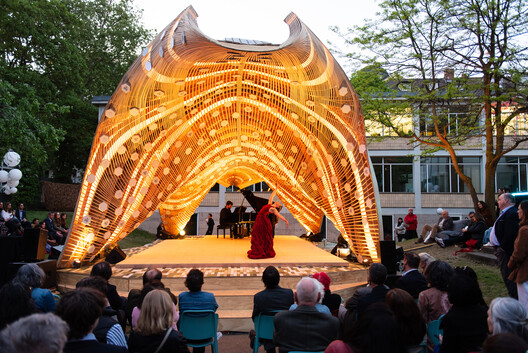
What happens when materiality becomes the driving force of design? How can a cultural infrastructure express its own identity? The Spanish Design Pavilion for World Design Capital Frankfurt Rhein-Main 2026 brings together the country's creative innovation to address contemporary challenges through a reinterpretation of Gaudí's architectural legacy. Conceived as a reversible cultural infrastructure, the project activates public space while expanding the conversation around material use, circularity, and reuse. Rather than reproducing historical forms, the pavilion adopts a contemporary, operational approach. It highlights collaboration among Spanish industry, design and culture, exploring structural and constructive principles rooted in geometry, material efficiency, and the relationship between form and system.
From his student years, Antoni Gaudí displayed a creativity and heterodoxy that frequently puzzled his professors. At just 26 years old, he was already signing off on the design for Casa Vicens, showing his ability to integrate traditional decorative arts—ceramics, stained glass, wrought ironwork, and cabinetmaking—into his architecture. Drawing from close observation of nature, he developed an organic, groundbreaking architecture rooted in tradition. During his studies at the Barcelona School of Architecture, he became familiar with styles from different cultures and historical periods while simultaneously absorbing the theories of figures such as Viollet-le-Duc and William Morris.
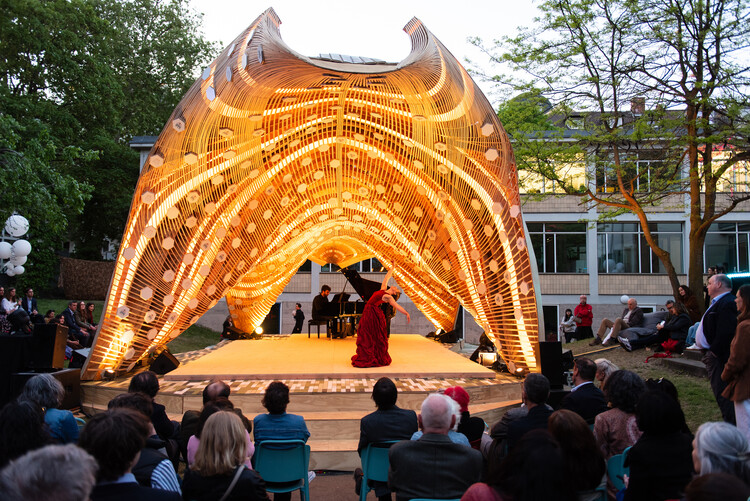
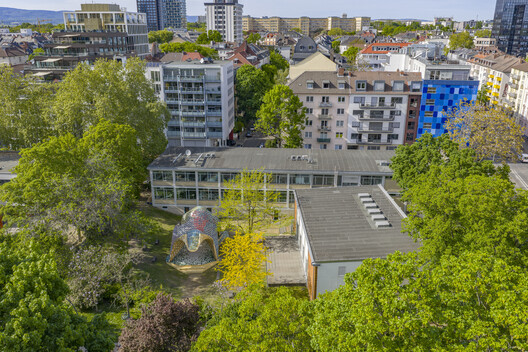
This knowledge shaped his artistic vision, which continued to evolve over the years through new ideas and influences. The organic form of the installation, located in the garden of the Cervantes Institute in Frankfurt, is inspired by the famous salamander at Park Güell in Barcelona. From April 30 to October 30, as part of World Design Capital Frankfurt 2026, ICEX and the Cervantes Institute present the walk-through sculpture "DRAC: Gaudí and the Inhabited Form". The project takes shape as a lightweight modular structure that combines Mediterranean material culture with technical innovation.
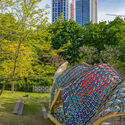
The connection between the 150 m² pavilion, designed by José Ramón Tramoyeres and Manolo García of ggstudio, and the dragon figure at Park Güell reveals how materiality defines both projects, from construction to symbolism. Clad in the "trencadís" technique, the giant reptile stands as both guardian and symbol of the park, evoking the dragon that, according to Greek mythology, protected the fountains of the Temple of Delphi. Created in 1906, the figure was shaped from a metal mesh designed by Gaudí to produce a prefabricated piece made of thin brick. Once installed, it was covered with ceramic fragments adapted to its curved volumetric form. The dragon marks the starting point of the staircase fountain system, supplied by rainwater filtered through the large plaza and stored in the market's cistern.
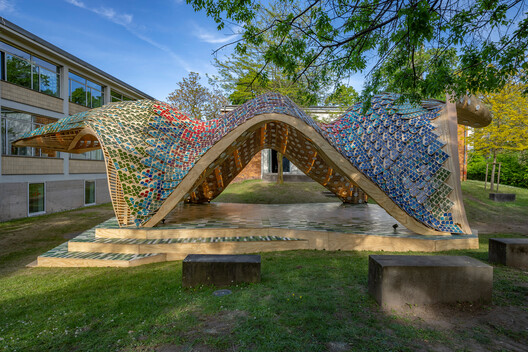
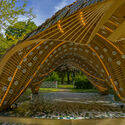
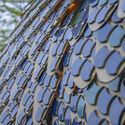
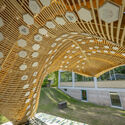
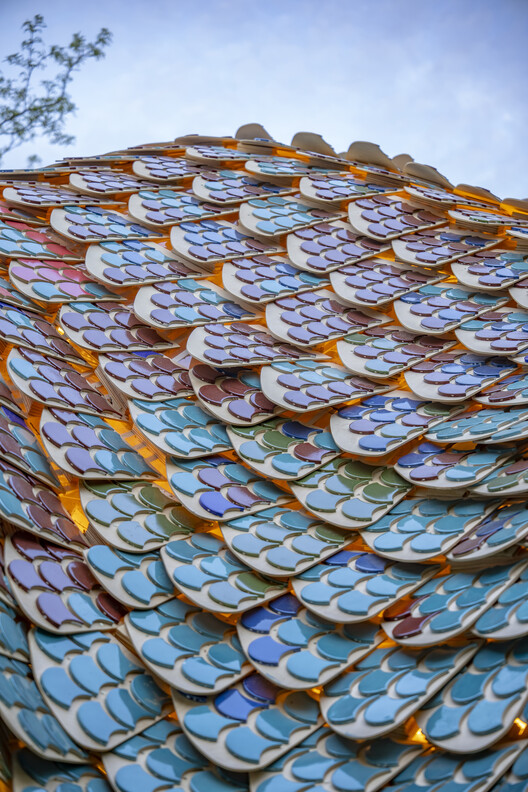
While the "trencadís" technique became omnipresent throughout the park's architecture—as in all of Gaudí's work—the Spanish Pavilion's lightweight modular construction system combines Spanish ceramics, wood, and textiles. The timber structure features a hybrid skin composed of more than 16,000 ceramic pieces, providing color, texture, durability, and depth, alongside textile elements that modulate light, ventilation, and the pavilion's relationship with its surroundings. These materials create a dynamic envelope in which every element adapts to the installation's organic logic, from the components forming the structural base to the scale-inspired outer skin. Taking this approach a step further, the installation translates this logic to the current European context, demonstrating architecture's capacity for social, urban, and economic transformation.
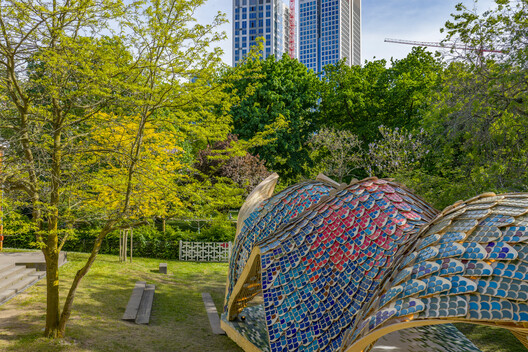
Assembled dry, without permanent foundations, the structure can be completely dismantled and the site fully restored, reinforcing its itinerant character. Designed to leave no trace on the existing building structure, it is intended to undergo multiple life cycles and be transported to different locations. In fact, a complementary exhibition in the lobby of the Cervantes Institute in Frankfurt documents the project's development, offering insight into both its artistic and technical aspects, from Valencian ceramics to the traditional wooden "vareta" technique. A video documenting the creation process also records the project's entire development.
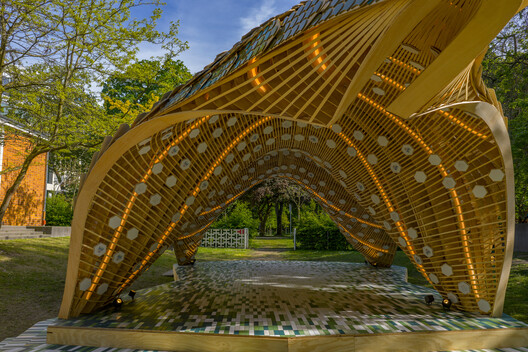
The Spanish Pavilion explores the possibilities of a dismantlable, reusable, and itinerant structure to accommodate diverse audiences and activities within a model of cultural architecture. A multidisciplinary collaboration brings together the work of several companies to showcase the dynamism and innovative capacity of Spain's construction sector. Emedec is responsible for the supply and machining of the wood, while Francisco Simó Pinturas oversees the protective systems. Natucer, Decocer, and Cevica contribute customized ceramic solutions, while Idelightec represents the lighting sector and Lastra & Zorrilla the textile field.
As a contribution by ICEX and the Cervantes Institute to World Design Capital Frankfurt Rhein-Main 2026, the installation invites visitors to walk through it, inhabit it, and contemplate it, while also functioning as an event venue. A sequence of spaces featuring inclined planes and inhabitable surfaces introduces an artificial topography into the garden. The installation becomes seating, a gathering area, and a scenic platform, while also operating as a device for reorganizing urban space and encouraging social interaction and cultural programming.
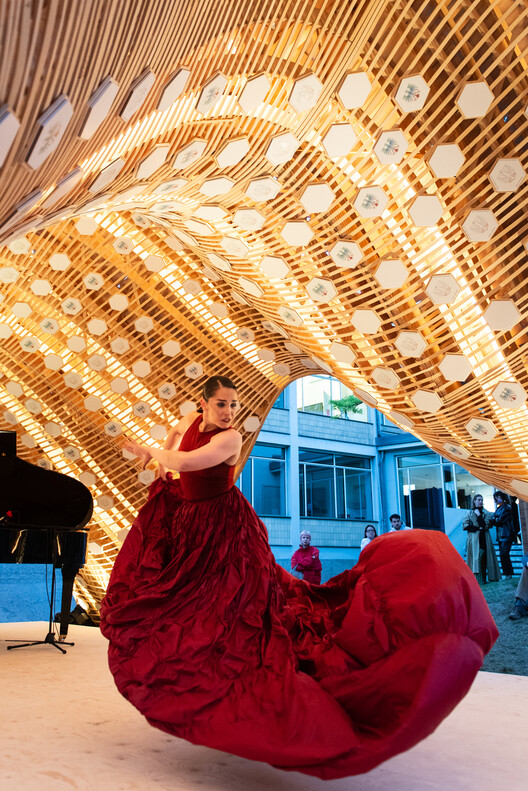
An ongoing program of cultural, professional, and business activities strengthens the dialogue between Spain and Germany, creating new opportunities for collaboration in design, architecture, craftsmanship, and the creative industries. Following the principles of the New European Bauhaus, sustainability, construction precision, and social commitment are integrated into a model of circular, permeable, and reversible cultural architecture. Its organic and continuous geometric design combines different materials in a manner reminiscent of Antoni Gaudí's working method throughout his body of work. As José Ramón Tramoyeres of ggstudio explains: "The project explores how ceramic tradition can be integrated into contemporary systems of prefabrication, digital fabrication, and reversible assembly." By translating principles of structural optimization and material efficiency into a contemporary architectural language, DRAC activates public space as a platform for collaboration, cultural exchange, and collective engagement.


