

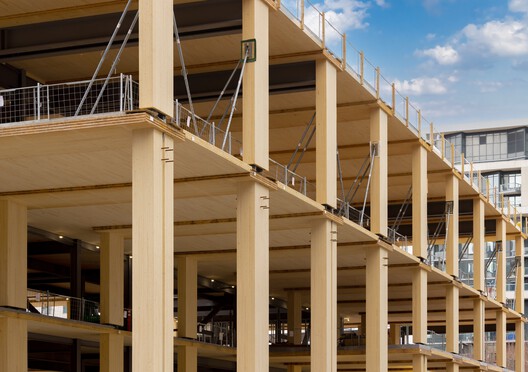
Mass timber has shifted from an experimental niche to a central part of the contemporary debate surrounding sustainable construction. The combination of lower embodied carbon, prefabricated systems, and faster construction timelines has helped position solutions such as CLT (cross-laminated timber) and DLT (dowel-laminated timber) as viable alternatives to concrete and steel in residential buildings, offices, schools, and public facilities around the world. Added to this are the predictability of construction processes and the environmental qualities associated with wood, often linked to user comfort and spatial experience.
Working with a relatively new construction technology also requires changes in the design mindset itself. In mass timber building, behind the structural efficiency and aesthetic appeal of exposed wood lies a complex technical reality involving both structural design and the systems that make up the building assembly. Unlike heavy concrete systems, timber structures have lower mass and a distinct vibrational behavior, allowing airborne and impact sound to propagate more easily between floors. The issue becomes critical in residential buildings, hotels, and mixed-use projects, where floor assemblies must meet rigorous acoustic insulation requirements, particularly regarding STC (Sound Transmission Class) and IIC (Impact Insulation Class) ratings.
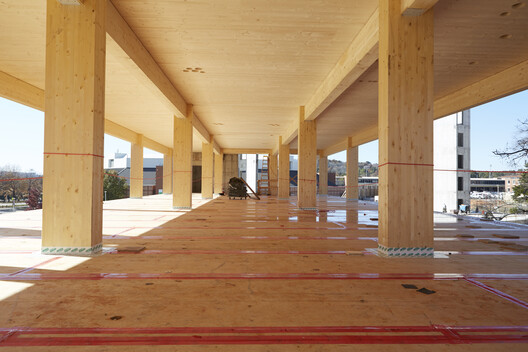
As these limitations became more evident with the growing adoption of mass timber, companies like USG began developing floor systems specifically designed for timber construction, seeking to balance acoustic performance, reduced structural weight, and lower embodied carbon. Without additional treatment, exposed CLT floors often struggle to achieve satisfactory acoustic performance levels for contemporary occupancy standards, directly affecting the occupant experience. Exposed timber ceilings may create visually warm and inviting environments, but if footsteps, impacts, and conversations easily travel between floors, spatial quality quickly deteriorates.
One of the most common solutions to this issue has been applying concrete toppings over timber structural panels. While this adds mass, improves acoustic insulation, and contributes to fire performance, the strategy introduces a new set of contradictions.
at least 75% reduction in embodied carbon' when compared to conventional lightweight concrete, based on a per-inch basis of 1-inch gypsum concrete vs. 3-4 inches of traditional lightweight concrete.'
To achieve acoustic ratings comparable to conventional systems, CLT structures frequently require additional layers ranging from 1 to 3 inches in thickness. While acoustically effective, these solutions significantly increase both the overall structural weight and the building's embodied carbon. According to data from the National Ready Mixed Concrete Association (NRMCA), lightweight concrete production can generate approximately 1,230 pounds of CO₂ per metric ton produced.
In other words, part of the environmental benefit associated with timber construction becomes offset by the need to introduce carbon-intensive materials into floor assemblies. This reveals a recurring paradox in many contemporary projects: while the primary structure helps reduce emissions, the secondary layers required to make the building viable often reintroduce high-impact materials at a significant scale. As the discussion around embodied carbon becomes more nuanced within architecture, attention shifts from primary structural systems to the cumulative impact of secondary layers such as floor toppings, insulation, finishes, and acoustic systems.
Rethinking Floor Assemblies
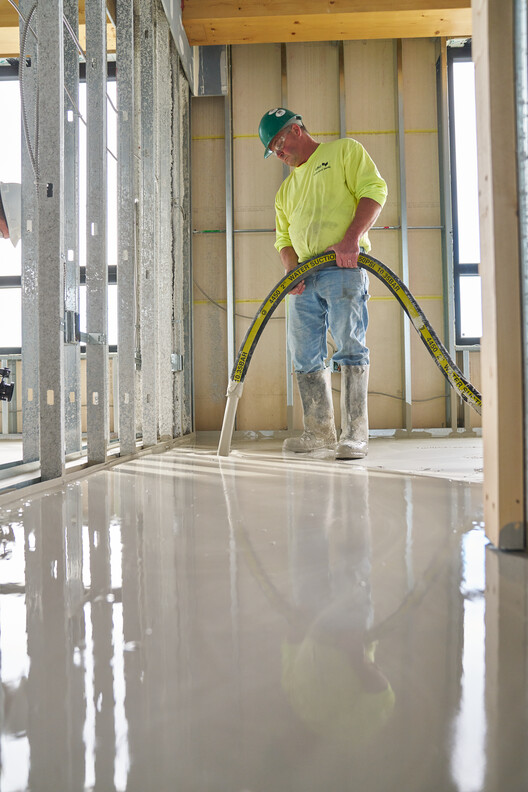
Rather than relying exclusively on large amounts of concrete mass, newer solutions seek to balance acoustic performance, structural efficiency, construction logistics, and carbon reduction simultaneously. Gypsum concrete-based systems have emerged as an alternative capable of combining acoustic insulation, fire resistance, and a lower environmental footprint. In some applications, these systems can reduce embodied carbon by at least 75% compared to conventional lightweight concrete assemblies, considering a comparison between 1 inch of gypsum concrete and 3 to 4 inches of traditional lightweight concrete. Part of this difference lies in the production process itself. While Portland cement depends on energy-intensive manufacturing at extremely high temperatures, gypsum-based binders are produced under significantly lower thermal demands, resulting in substantially lower associated emissions.
At the same time, low-profile acoustic mats have become another important component of these assemblies. Instead of relying solely on additional mass to control sound transmission, these systems use resilient layers capable of absorbing vibrations and impacts more efficiently. Overall performance no longer depends on a single high-density layer, but emerges from the precise coordination of multiple layers, each responding to a specific technical requirement.
USG's Approach to Floor Systems in Mass Timber
Among these approaches, the systems developed by USG help illustrate how floor assemblies are being reconsidered within the context of mass timber construction. Products such as Levelrock® Brand SAM-N™ floor underlayment systems and the SAM-N25™ acoustic mat were developed to respond to the specific conditions created by mass timber building systems.
The SAM-N25™ acoustic mat, for example, is only 5/16 inch thick and, when combined with appropriate floor underlayment systems, can achieve STC/IIC ratings of up to 56/53, performance levels typically associated with much heavier assemblies. This becomes particularly relevant in projects where floor-to-floor height, structural loads, and construction schedules directly influence overall efficiency. Reducing assembly thickness expands spatial flexibility, while lighter systems reduce the loads transferred to the primary structure.
The construction implications are also significant. Because many mass timber buildings rely on prefabricated processes and accelerated schedules, wet trades and extended curing times can compromise one of timber construction's main advantages: speed of execution. In this context, floor underlayment systems begin to directly influence coordination between trades and the overall pace of construction.
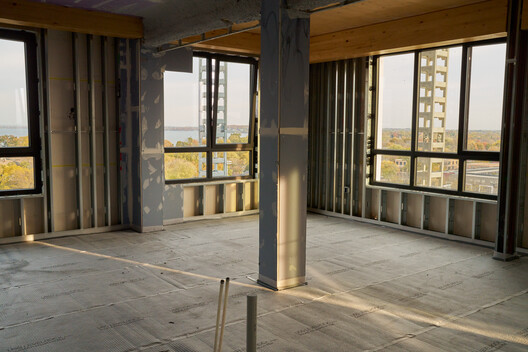
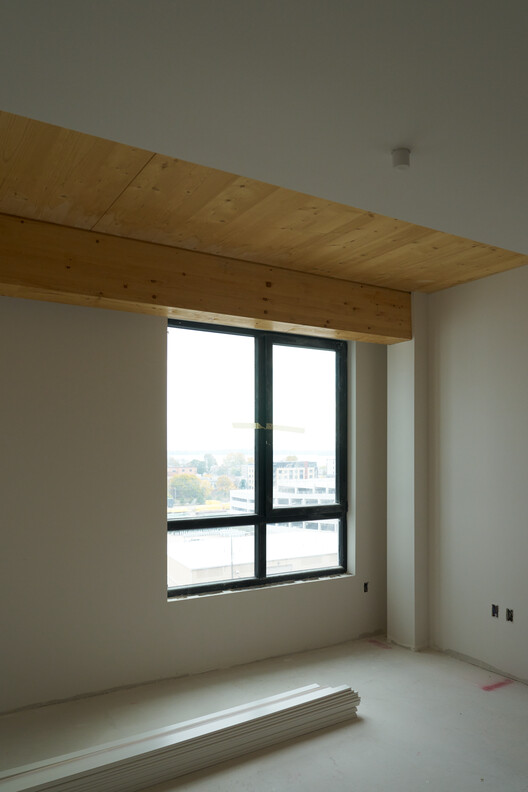
At Baker's Place in Madison, Wisconsin, a 14-story hybrid CLT building, the combination of a low-profile acoustic mat and a 2-inch gypsum concrete layer was used as an alternative to conventional concrete solutions. According to the project team, the process could be completed in just two days per floor: the acoustic mat was installed over the subfloor on one day, followed by the gypsum concrete layer the next. The system also allowed worker traffic to resume the following day thanks to an initial cure time of approximately 90 minutes, minimizing disruptions to successive trades. .
Compared to the logistics of a conventional concrete pour, which often depends on multiple trucks, intense coordination, and longer waiting periods, lighter and faster systems align more effectively with the industrialized and prefabricated logic of mass timber construction.
In addition, according to data provided by USG, replacing conventional lightweight concrete with Levelrock® systems in a 100,000-square-foot building can reduce CO₂e emissions by nearly 50 metric tons over the course of construction. This reinforces how seemingly secondary decisions within floor assemblies can significantly alter a building's overall environmental performance.
Beyond the Exposed Structure
The broader adoption of mass timber in contemporary construction brings growing attention to the complementary systems required to make these buildings perform effectively without compromising their environmental promises. Acoustic mats, lightweight underlayments, and integrated floor systems are no longer treated as secondary components; they function as invisible infrastructure essential to the viability of mass timber itself.
This requires understanding how structure, acoustics, logistics, performance, and carbon operate interdependently within contemporary architecture. Floor and ceiling systems no longer function merely as concealed technical finishes, but instead become active participants in the environmental, spatial, and operational logic of the building. Timber construction may begin with the structure, but its success depends equally on what happens above and below it.


