Emerging in port cities and working-class neighborhoods throughout the nineteenth century, the shotgun house became a durable response to density, climate, and constrained urban parcels, becoming one of the defining domestic forms of the Southern United States. Its narrow footprint, sequential plan, and deeply shaded porches produced a spatial logic that was economical and environmentally responsive before either term became central to architectural discourse. From New Orleans and Mobile to Houston and Louisville, shotgun houses formed the physical fabric of neighborhoods shaped by migration, labor, community, and cultural life. Though often dismissed as ordinary, vernacular construction, the housing typology has long embodied sophisticated ideas about climate adaptation, social adjacency, and incremental urban growth, making it one of the most influential domestic forms in the history of the American city.
In the United States during the 1960s and 1970s, the neighborhoods composed of and sustained by the shotgun house were targeted by large-scale urban renewal campaigns. Federal redevelopment programs, highway construction, and modernization efforts recast dense urban districts as sites of blight, clearing entire blocks in pursuit of new civic centers, public housing schemes, and automobile infrastructure. In many cities, the shotgun house came to symbolize overcrowding and economic decline rather than spatial ingenuity or cultural continuity. Urban renewal planners and politicians dismissed shotgun neighborhoods as symbols of poverty and substandard housing, demolishing thousands of structures in the name of progress. The destruction disproportionately displaced Black communities and erased local social networks that had evolved over generations within the intimate scale of shotgun neighborhoods.
Today, the shotgun house has reemerged as a subject of architectural attention across the Southern United States. A new generation of architects is approaching the typology as a flexible framework for experimentation through renovation, addition, preservation, and reinterpretation. Some projects preserve the narrow composition and spatial compression of the original structure with intentional restraint, while others expand, splice, and abstract the form into a new expression. Across cities facing rapid development pressure and accelerating cultural change, these interventions, while provocative, raise questions about authenticity and gentrification, as well as the uneasy relationship between architectural identity and contemporary design culture. The following projects demonstrate that the shotgun house offers a disciplined and productive constraint within which architects are working toward housing that is more equitable, more sustainable, and more thoughtfully connected to place.
Perrier Residence / CICADA
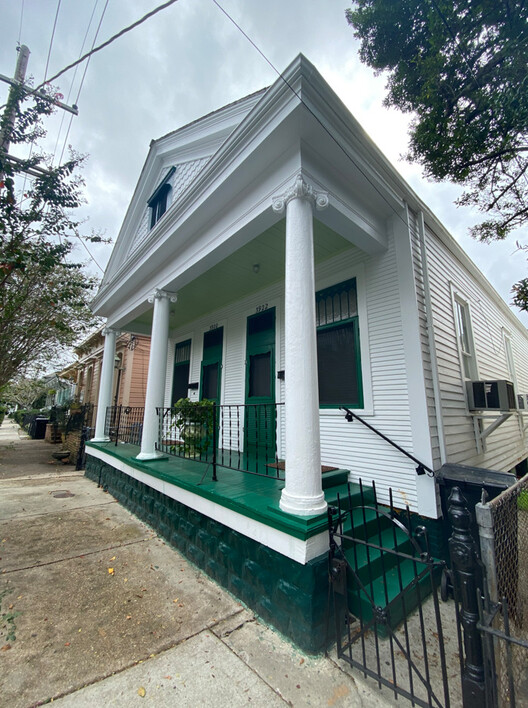
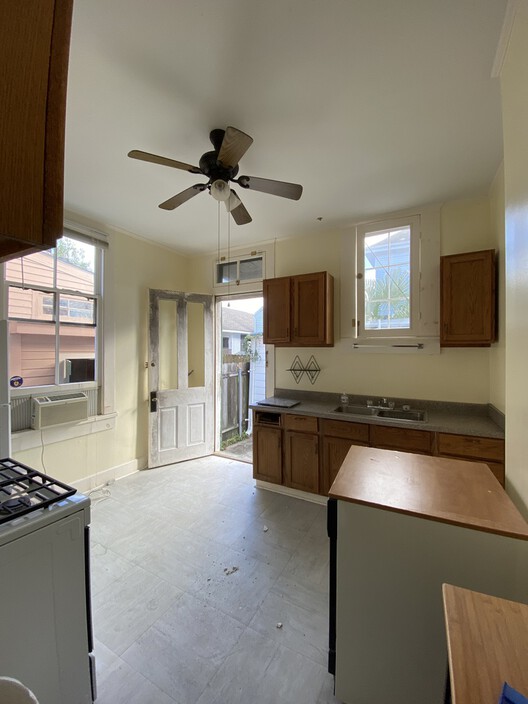
The McGuire's New Orleans shotgun was a classic case of hidden potential. Nestled in the Touro/Bouligny neighborhood and brimming with character, the house had fallen into disrepair.
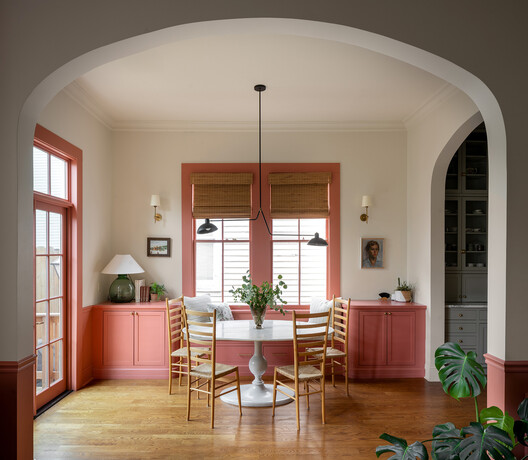
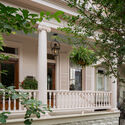
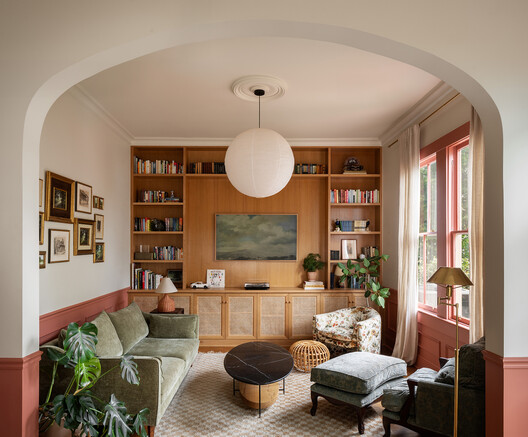
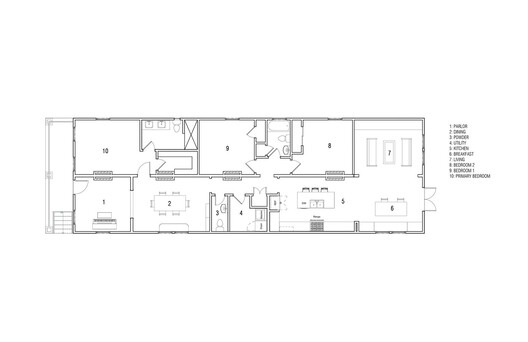
Located in the Touro Bouligny neighborhood, CICADA's Perrier Residence approaches the shotgun house through preservation and restraint. The double-shotgun footprint remains fundamentally intact, with original fireplaces, heart-pine flooring, and historic windows preserved as central to the project's spatial identity. Rather than dissolving the plan into an open-concept interior, the renovation introduces careful openness through arched doorways and integrated storage, maintaining the compressed rhythm characteristic of the typology.
With a love for preservation, the shotgun's core, its fireplaces, and the majority of its historic features remained untouched.
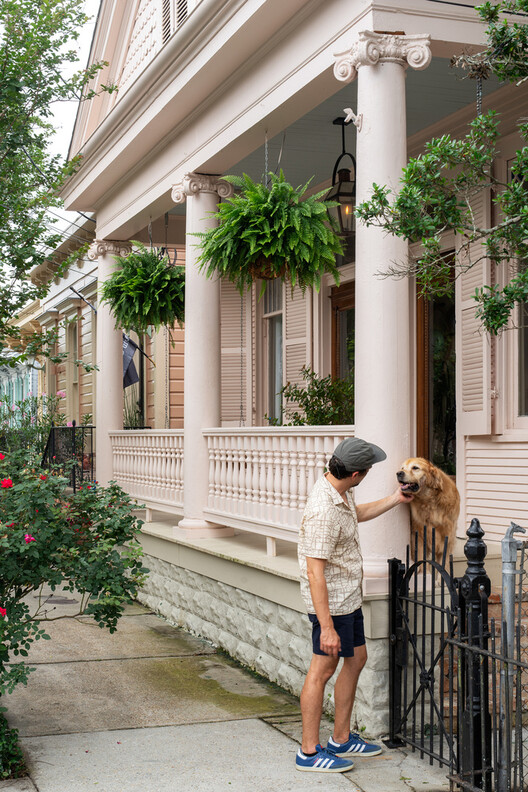
The project's strength lies in its understanding that preservation is the continuation of spatial and social relationships embedded within the house itself. CICADA approaches the renovation through atmosphere, material continuity, and subtle spatial modifications rather than formal disruption. Earth-toned interiors, custom millwork, built-in shelving, and restored finishes produce a sense of warmth that feels closely tied to the scale and texture of the existing architecture. Perrier Residence resists the tendency to treat the historic layer as a shell for contemporary additions by demonstrating how modest interventions can sustain neighborhood identity while accommodating evolving patterns of domestic life. The result is a project that treats the shotgun house as a living framework adaptable without compromising its architectural integrity.
Shotgun Chameleon / ZDES
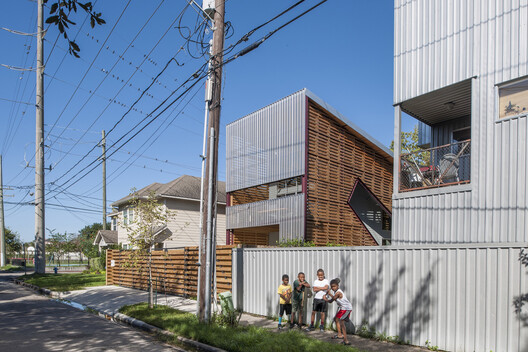
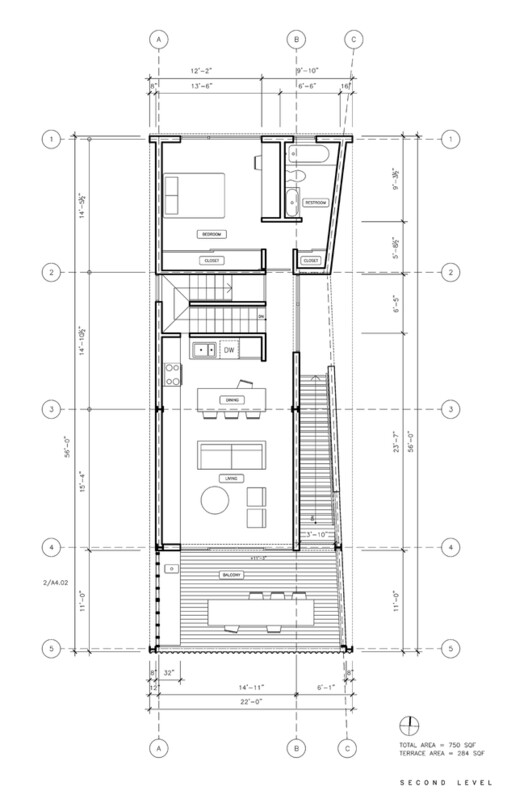
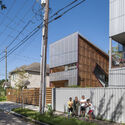
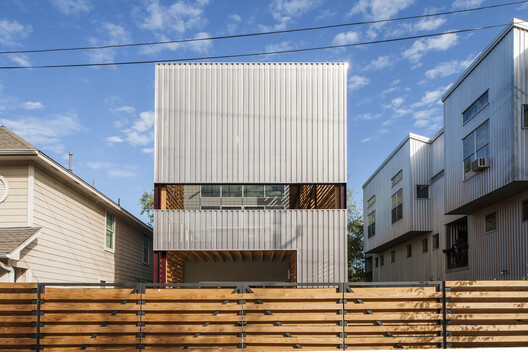
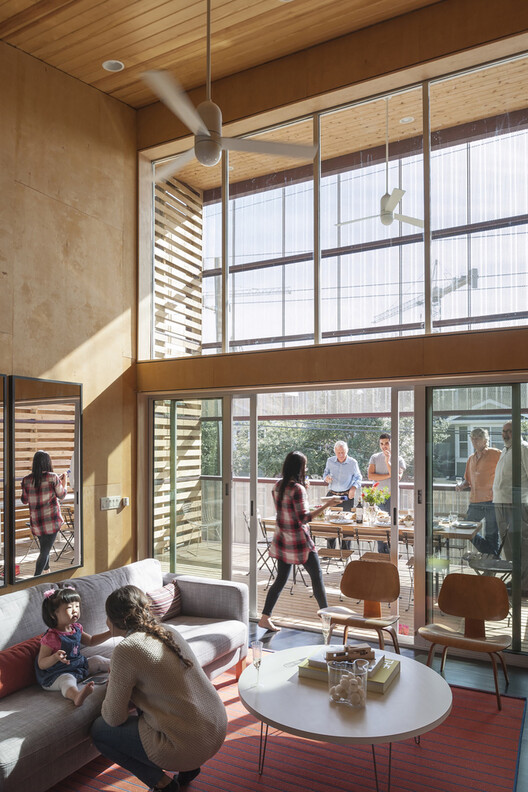
Where Perrier Residence emphasizes preservation, ZDES's Shotgun Chameleon treats the shotgun typology as a framework for environmental translation and climate experimentation. Designed for Freedmen's Town, a historically Black Houston neighborhood with significant cultural heritage, the project isolates and reinterprets defining shotgun principles: cross-ventilation, public-private separation, elevated porch living, and street-interior relationships. Rather than a literal reproduction, the architects develop a contemporary architectural language that remains spatially and climatically connected to the shotgun tradition.
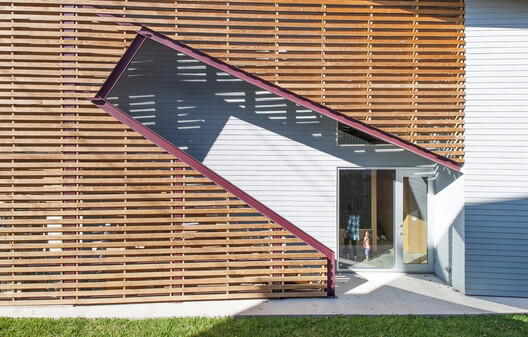
Inspired by Gulf Coast raised shotgun houses and versatility of chameleon skin, Shotgun Chameleon emphasizes programmatic flexibility and response to climate. The chameleon-like front screen element provides a myriad of facade possibilities to adapt this design to different urban contexts and to a variety of solar/wind orientations.
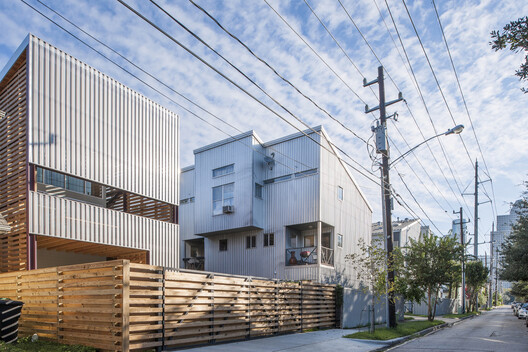
Layered facade screens, operable openings, shaded balconies, and carefully oriented apertures work together to moderate heat gain and channel prevailing breezes. Double-height volumes relieve trapped heat while extending light into the narrow interior. The adaptable front facade, conceived as a responsive skin, shifts in response to orientation and neighborhood conditions through louvers, vegetation, and solar screens. At the same time, the project reconsiders the social role of the porch and balcony within contemporary urban life, using semi-public outdoor space to encourage interaction between residents and the street.
Hill Country House / Miró Rivera Architects
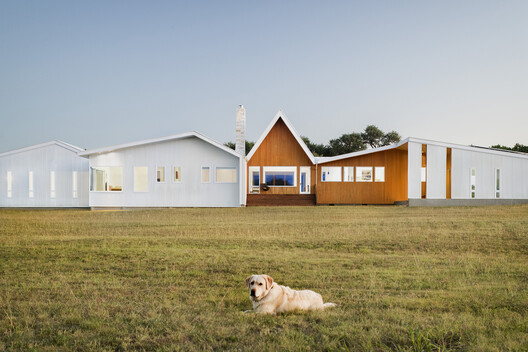
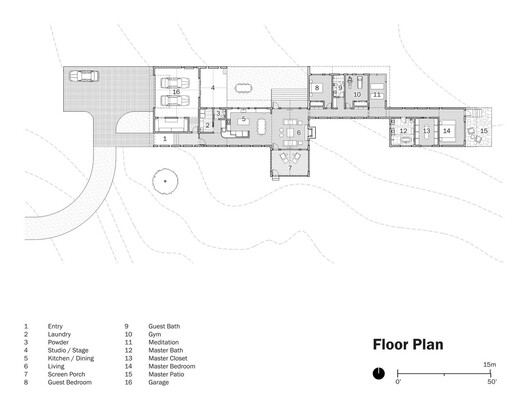
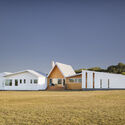
Miró Rivera Architects' Hill Country House offers an unexpected shotgun reinterpretation precisely because it abandons the typology's original urban context entirely. On an expansive rural Texas site, the architects investigate which aspects of the shotgun remain valuable once its spatial constraints are removed. The project retains a linear organizational spine separating public and private functions, but stretches and fragments the plan into a loose sequence of volumes that respond to landscape and light.
In plan, a collection of volumes is arranged along a central spine reminiscent of vernacular "shotgun" cabins, with the public and private spaces of the home situated on opposite ends. The main corridor, which doubles as a gallery, is differentiated by thin vertical windows that balance the requirement for natural light with the need to provide space for hanging artwork.
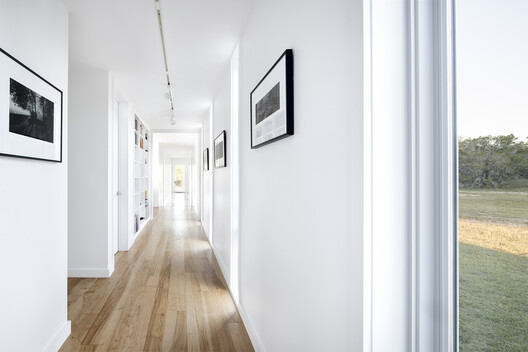
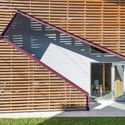
Jagged roof forms echo the surrounding hills while expanding the interior volume, allowing light and air movement that would be impossible within compressed traditional proportions. Outdoor rooms and screened porches dissolve the boundary between architecture and landscape, extending the social role of the front porch into a rural context. Corrugated aluminum, cypress siding, limestone, and pecan flooring reinterpret vernacular materials in a contemporary language.

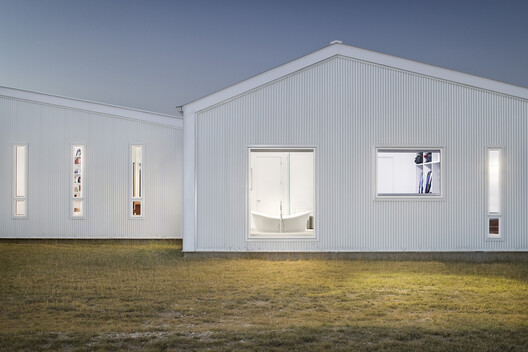
At the same time, geothermal systems, rainwater harvesting, and solar infrastructure position the house as a prototype for a more self-sustaining mode of rural living. If projects like Perrier Residence explore preservation and Shotgun Chameleon investigates climatic adaptation within the city, Hill Country House demonstrates how the shotgun typology can be abstracted and expanded beyond its original urban framework while still retaining its spatial intelligence and communal ethos.
Alligator / buildingstudio
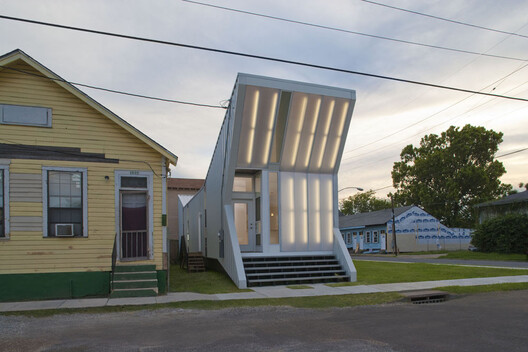
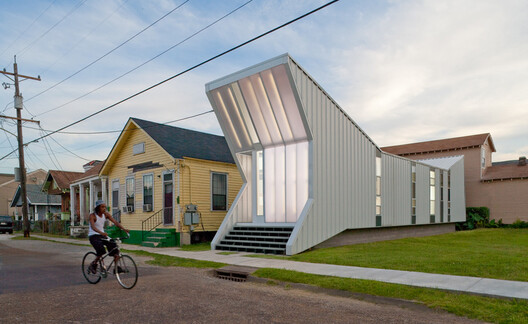
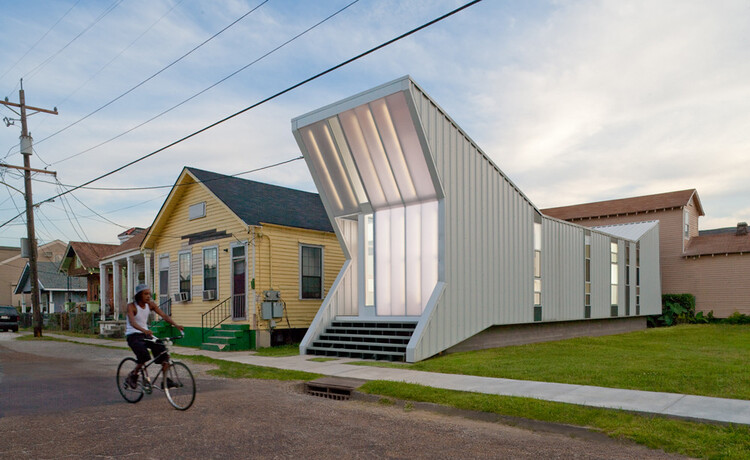
Among contemporary shotgun reinterpretations, buildingstudio's Alligator stands out for refusing to separate architectural experimentation from social urgency. Developed after Hurricane Katrina as part of a grassroots affordable housing initiative in New Orleans' Central City neighborhood, the project reframes the shotgun house as a resilient urban framework for contemporary community life rather than a nostalgic reference.
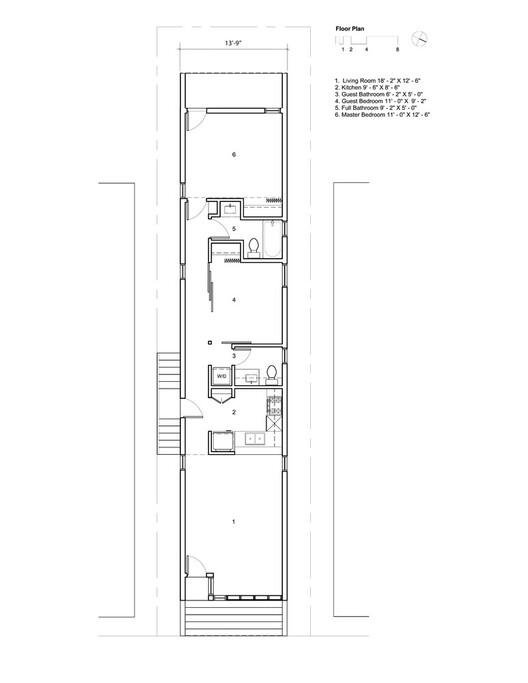
With an unusually narrow lot width of 19 ft, a maximum 13-ft wide scheme was all that was allowed. This resulted in a 960 SF two-bedroom, bath-and-a-half scheme. Nicknamed "Alligator", because of its "open-mouth" profile, it's based on a very common traditional typology in the New Orleans area— the shotgun. This layout is where all rooms align in a single row, front to back, in order to fit the long, narrow lots typical of the City.
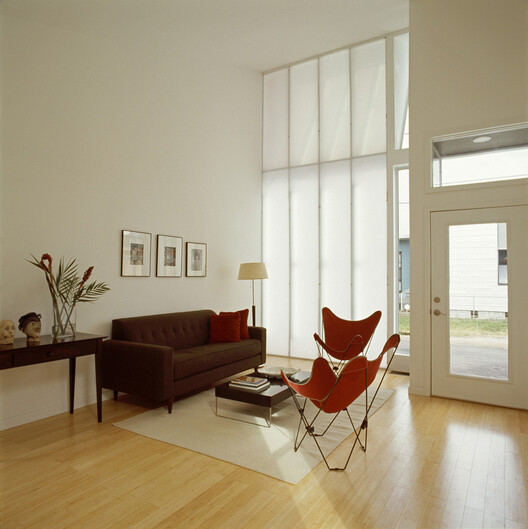
Designed for an unusually narrow nineteen-foot lot, the house transforms severe spatial constraints into opportunities for flexibility and engagement. The translucent polycarbonate facade, illuminated from within, functions almost like a glowing lantern within the streetscape. The metal-grate stoop extends across the front elevation, expanding the porch into an active social platform. Inside, rolling partitions challenge the rigid sequencing traditionally associated with shotgun plans, introducing adjustable privacy within an extremely compact footprint. Corrugated metal cladding, hurricane-resistant detailing, and durable, low-maintenance materials position the project simultaneously as affordable infrastructure and architectural proposition.
What distinguishes Alligator is its acknowledgment that formal invention emerges directly from economic limitation and civic urgency rather than the designer's choice. The house costs approximately $50,000 to build, positioning it as affordable housing rather than a design commodity. In this sense, Alligator recalls the original intelligence of the shotgun typology itself: a housing form born from adaptation, efficiency, and collective proximity rather than architectural excess.
One beautifully designed, affordable house, however exemplary, cannot address the systemic housing crisis that displaced more than 134,000 people from New Orleans after Hurricane Katrina. Scaling such projects requires sustained political commitment to public investment in housing and policies that prevent future displacement. Without these structures, even excellent affordable housing projects risk becoming isolated gestures rather than catalysts for systemic change in housing quality and security.
Aesthetic Consumption and the Politics of Architectural Rediscovery
Across many Southern cities, renewed architectural interest in vernacular housing has coincided with rising property values, accelerated redevelopment, and the aesthetic consumption of historically Black neighborhoods. In New Orleans, Houston, and Louisville, shotgun houses that once symbolized disinvestment increasingly function as desirable architectural commodities, often completely detached from the communities and histories that produced them. The typology's compact scale, walkable context, and distinctive character make it especially attractive within contemporary design culture, where authenticity can be marketable. The very neighborhoods that urban planners condemned as blighted fifty years ago now attract outside capital precisely because they possess what suburban development destroyed: dense walkability, distinctive character, and established social networks.
Architectural preservation, divorced from community stabilization and affordability protections, frequently becomes a mechanism of displacement. Historic district designation can constrain demolition, but cannot prevent rising property taxes, eviction, or sale to outside developers. In Freedmen's Town, Houston, and the Creole neighborhoods of New Orleans, families who maintained shotgun houses through decades of disinvestment now face pressure to sell as property values rise. Preservation efforts celebrate these neighborhoods' cultural importance, even as market forces displace the very communities that embodied that culture.
Contemporary architects approaching shotgun houses cannot, through design alone, resist the displacement pressures accompanying urban revitalization. Those pressures require policy interventions, such as community land trusts, inclusionary zoning, rent control, and community preference policies, which largely fall outside the architect's scope. The danger of the current moment is that architectural innovation around shotgun houses becomes a means of aestheticizing and accelerating the very displacement that threatens these neighborhoods' survival.
Reinterpretation Without Extraction
These projects reveal that contemporary engagement with the shotgun house is more complex than stylistic revival, and this complexity masks a fundamental asymmetry in the preservation field. Until preservation efforts are coupled with community power, affordability protections, and policies preventing displacement, architectural attention risks becoming another mechanism by which historically Black neighborhoods are made attractive to developers and then made inaccessible to their original residents. The shotgun house offers multi-dimensional lessons for contemporary housing: the value of density, constraint, material efficiency, and incremental adaptation. Those lessons only matter if they lead toward housing that is accessible and affordable.
Moving forward, the question is not whether architects should engage with shotgun house typology, but whether that engagement of celebration and experimentation can be integrated with community partnerships for residents facing displacement, with an explicit commitment to affordability and community control. Until then, contemporary shotgun house architecture risks becoming what urban renewal once was: a mechanism for transforming neighborhoods in ways that ultimately serve outside interests more than existing residents.
This article is part of the ArchDaily Topic: 20th Century Design in Flux: A Global Reinterpretation of Architectural History. Every month we explore a topic in-depth through articles, interviews, news, and architecture projects. We invite you to learn more about our ArchDaily Topics. And, as always, at ArchDaily we welcome the contributions of our readers; if you want to submit an article or project, contact us.


