Heritage, in interiors, is increasingly rarer to be only a matter of preservation alone. More often it arrives as friction: the encounter between what a building already is—its plan logic, its scars, its structural inconsistencies—and what contemporary life demands of it.
Some of the most convincing projects today are not those that "restore" an interior back to a single moment, nor those that erase the past under a seamless new skin. They are the ones that stage a relationship between old and new—allowing contrast to do more than tell a story, and letting the clash become a pragmatic tool for construction, budget, and speed.


The recurring pattern is not nostalgia but calibration. Older building stock—whether a 1970s apartment plan, a late-1930s corner unit, or an inherited commercial shell—becomes the substrate for contemporary insertions that remain legible as insertions. Instead of forcing perfect continuity, these projects often accept tolerance, use contrast to hide misalignment, and treat "imperfection" as a design condition rather than a defect. In doing so, they quietly rewrite historical modernist aspirations of seamlessness and clean slate into a contemporary ethic of edited honesty: what is kept, what is sharpened, and what is deliberately left unresolved.

The Clash as Narrative: Time-Layers You Can Inhabit
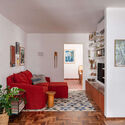
One reason heritage interiors remain compelling is that they make time readable. Not through didactic plaques, but through spatial sequencing and material continuity. In André Fernandes Apartment by João Marujo + Orlando Naj in São Paulo, for instance, the intervention is intentionally "minor" yet narratively precise: it aims to increase spaciousness within an original 1970s floor plan by reworking connections between kitchen, laundry, dining, and living areas. A glass folding door becomes a new hinge between kitchen and living room, increasing both visual and circulatory continuity, while the design's minimalist new finishes are explicitly set in dialogue with the restored striped Ipê parquet flooring—allowing the existing to remain present as a baseline rather than a backdrop to be neutralized. The renovation reads as a form of continuity-through-difference: the apartment's earlier logic is not denied, but it is re-edited.


A similar insistence on legibility appears in Corner Apartment by Prokop Hartl, a complete renovation of a late-1930s Prague apartment. Rather than treating the existing condition as a problem to overwrite, the stated ambition is to preserve and enhance the inherent qualities of the original interior while updating the layout for a young family. That phrase—"preserve and enhance"—captures the contemporary heritage interior's recurring stance: retention is not passive; it is selective and active. Original doors are restored and the authentic oak parquet is refinished, then carefully complemented by newly poured polyurethane flooring that calibrates floor levels to meet the existing parquet. Newly introduced glass-block partitions complete the composition, allowing contemporary program needs to be accommodated without erasing the apartment's inherited material character.

In El Born Loft by Roman Izquierdo Bouldstridge, the conversion of a former commercial space into a dwelling is framed as an "exploration of the void." Even without leaning too heavily on that philosophical language, the project offers a clear architectural lesson: it strips the unit back to its bare bones, exposing the existing stone and brick masonry, then refines the envelope in white to amplify depth and light. Rather than correcting every irregularity, the design lets imperfections remain legible—set in deliberate tension with new, crisp insertions in wood and wrought-iron elements.


The Clash as Construction Strategy: Tolerance, Speed, and Budget
The more under-discussed value of heritage–contemporary contrast is how it changes construction behavior. When a project aims for seamlessness, it often requires expensive corrective work: straightening walls, leveling slabs, thickening surfaces, hiding services, and insisting on perfect alignments in buildings that were never built to contemporary tolerances. By contrast, when a project embraces legible layering, it can accept—and even exploit—imperfection. The clash becomes a way to keep the build efficient, to avoid deep re-lining, and to make detailed junctions more forgiving.
CB's Apartment by Julia Peres.Co Arquitetura names this logic directly by describing the project as "an exercise in spatial reorganization that transforms construction pathologies into opportunities for conscious design." Instead of treating defects as embarrassments to conceal, the project frames them as conditions to be worked with—mediated through a deliberate material strategy: metalwork as planes of interruption and continuity, terrazzo as a surface that carries contrast across inside/outside, and bricks, fabrics, and glass as integrators that shift spatial perception across the day. This is the heritage interior as a kind of intelligent acceptance: a refusal to spend the entire budget on pretending the old is new.

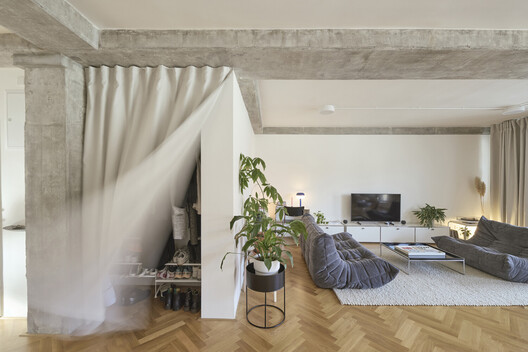
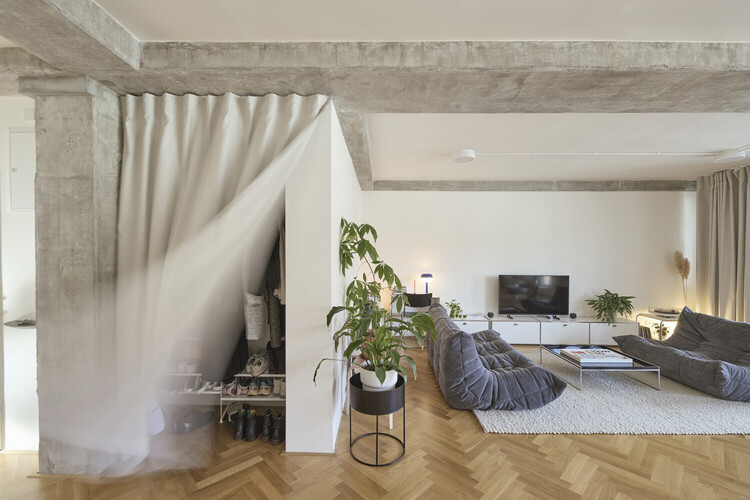
No-Wall Apartment by RDTH architekti in Prague takes an even more direct stance. Its premise—removing almost all walls and doors—begins as a provocation, acknowledging that most people expect separations for basic domestic activities. Yet what is interesting is not the extremity itself, but what it implies about "heritage" in contemporary interiors: that the boundary is no longer necessarily the wall. In older apartments, partitions often carry structural, acoustic, and cultural assumptions about how life is organized. By stripping those boundaries away, the project suggests that today's domestic life may be reorganized through furniture systems, light, and adjacency rather than fixed partitions. In construction terms, it also points to a practical recalibration: fewer walls means fewer junctions, fewer plaster interfaces, fewer surfaces to "perfect." The project becomes a reminder that heritage reinterpretation can also be an economy of means—where spatial richness is achieved through edited subtraction rather than expensive replacement.


The Clash as Urban Memory: Ordinary Buildings, Public Interiors
If the 20th century's architectural history is usually told through canonical objects, the interior projects that now matter most may be those that treat everyday building stock as cultural memory. This is where cafés and small public-facing spaces become unexpectedly important: they are the typologies where "heritage" is encountered by the widest audience, not as protected monument but as daily ritual.
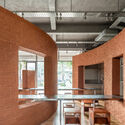
A Local Renewal of Fushan Coffee by MINOR lab in Haikou is explicitly framed through lineage. It references Fushan Town—often identified as the origin of coffee cultivation in Hainan—and notes that Fushan Coffee, established in the 1970s, has been embedded in regional daily life for decades. The interior is positioned as a medium for that story, allowing visitors to encounter history, production, and locality through spatial organization and material strategy rather than didactic display. The intervention largely retains the original façade's material character with only modest restoration, while inside it keeps the two-way concrete frame readily legible—then sets it in contrast with a newly imposed order of curved walls and punctuated seating finished in hand-textured surfaces. In this sense, "heritage" shifts from façade preservation toward narrative continuity: an interior that teaches local history through inhabitation and materiality tension.


The Extension Atelier in Kyiv by MAVA design, for example, begins with an empty shell in a residential complex and frames its primary challenge as spatial organization: separating open and private zones despite a large number of columns in the center of the space. While not a "heritage" project in the strict sense, it is instructive because it shows another form of inherited condition—structural constraints that pre-exist design intent. The contemporary interior becomes a negotiation with the existing shell - at times, to leave it naked and exposed, delineating limitation, perimeter, and spatial boundary, rather than investing in heavy wall finishes. In that sense, it shares a key logic with adaptive reuse: the designer works not from zero, but from a given field of obstacles, and composition emerges through selective emphasis rather than total control.


Heritage as Edited Continuity, Not Perfect Restoration
What these projects collectively suggest is that contemporary interior reinterpretation is increasingly negotiated through a productive tension between imperfection and precision—not as nostalgia, but as method. The "clash" between heritage and contemporary is not simply an aesthetic preference; it produces legibility. Old fabric is allowed to read as old, new insertions are clearly articulated as new, and the relationship between them becomes the narrative the interior offers. At the same time, this approach is materially pragmatic. Construction tolerances are acknowledged rather than fought, imperfections are absorbed into detailing strategy, and budgets can be redirected away from cosmetic seamlessness toward spatial performance—better circulation, better light, better program fit.
This is not an argument against restoration, nor a romanticization of roughness. It is an observation about how interiors are increasingly shaped under contemporary economic and construction realities. In many cases, contrast becomes the most honest way to work with existing stock: it accepts what cannot be corrected without disproportionate cost, and translates that acceptance into architectural language. If the 20th century gave us ideals of seamlessness and universal space, the present is producing a different continuity—one achieved not by erasing difference, but by editing and clarifying it.


This article is part of an ArchDaily series that explores features of interior architecture, from our own database of projects. Every month, we will highlight how architects and designers are utilizing new elements, new characteristics and new signatures in interior spaces around the world. As always, at ArchDaily, we highly appreciate the input of our readers. If you think we should mention specific ideas, please submit your suggestions.


