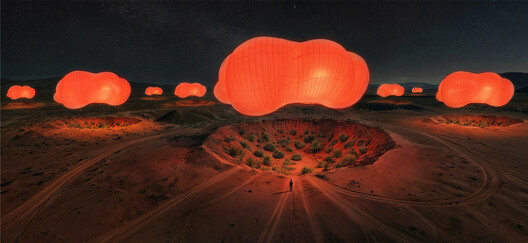
Buildner has announced the results of its competition, the Last Nuclear Bomb Memorial No.6. This competition is held each year to support the universal ban on nuclear weapons. In 2017, on the 75th anniversary of the 1945 bombings of Nagasaki and Hiroshima, which claimed the lives of over 100,000 people, the United Nations adopted the Treaty on the Prohibition of Nuclear Weapons.
In recognition of this treaty, Buildner invites conceptual designs for a memorial to be located on any known decommissioned nuclear weapon testing site. The conceptual memorial is intended to reflect the history and ongoing threat of nuclear weapons, aiming to promote public awareness of nuclear disarmament.
The challenge is intended to bring attention to the history and dangers of nuclear weapons. Participants are tasked with designing a space that commemorates nuclear warfare victims and conveys the need for a nuclear-free future. As a 'silent' competition, submissions are not allowed to include any text, titles, or annotations.
Buildner's next silent competition, the Museum of Emotions #8 has been launched with a registration closing date on 18 June 2026.
The brief
This competition invites designers to conceive a memorial that meaningfully engages the public with the critical issue of nuclear disarmament. Memorials play a crucial role in capturing history and facilitating collective reflection, shaping how future generations understand and respond to global challenges. The proposed memorial will specifically address the legacy of nuclear warfare, emphasizing the urgency of diplomatic solutions and international solidarity in preventing nuclear conflict.
Design proposals are encouraged to consider the following core principles:
- Vision of Peace: Proposals should embody the aspiration for a world free of nuclear threats, incorporating symbolic or abstract representations that inspire unity and harmony.
- Reflection and Remembrance: Designs must foster a thoughtful and enduring dialogue, offering visitors a contemplative environment where they can reflect upon the consequences of nuclear weaponry.
- Educational Impact: The memorial should provide visitors with accessible insights into the historical realities and ongoing dangers of nuclear arms, actively promoting public knowledge and awareness.
- Emotional Engagement: Successful memorials will create a powerful emotional connection, provoking personal and collective introspection on peace, responsibility, and the human cost of nuclear conflict.
- Sustainable Stewardship: Designs must embrace environmental sustainability, reinforcing the memorial's overarching message of responsible stewardship and enduring peace.
Buildner's other ongoing competitions include: the MICROHOME 2026, with a 100,000 € prize fund seeking innovations for small scale housing; the Mujassam Watan Urban Sculpture Challenge aimed at finding innovative sculptures reflecting Saudi Arabia's heritage, modern achievements, and future ambitions; and The Next House: USA, which invites innovative ideas for a new American suburban prototype: a home that is compact yet generous, adaptable yet grounded, replicable yet sensitive to place.
Projects:
First Prize Winner
Project title: The Suspended Seconds
Authors: Hamzeh Ahmad Hasan Al-thweib, from Jordan
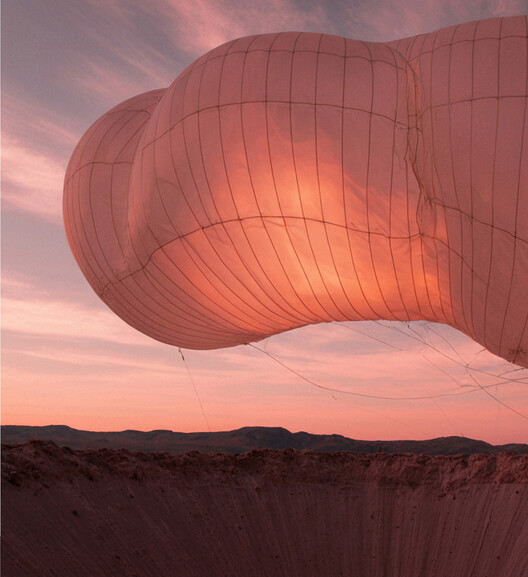
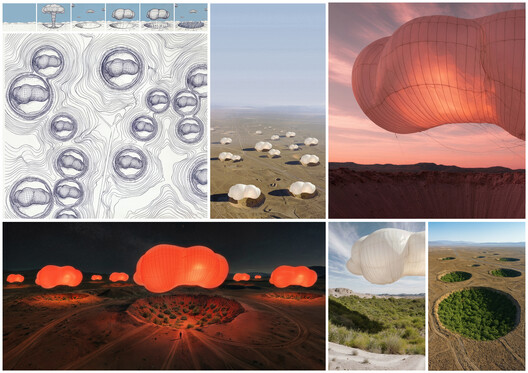
The Suspended Seconds responds to the brief with a deliberate inversion of the mushroom cloud, transforming one of history's most violent spatial symbols into a quiet, atmospheric presence embedded within the landscape. The project deploys a series of inflated, cloud-like volumes that hover above circular ground depressions, referencing both the form of the nuclear blast and the scars it leaves on territory. Rather than monumentalizing destruction, the installation diffuses it, using translucency, softness, and light to create a space of pause and reflection. By day, the forms appear pale and weightless against the horizon, while at night they glow gently, activating the site without spectacle. The landscape beneath evolves into zones of regrowth, with vegetation reclaiming the ground below each hovering cloud. The intervention operates simultaneously at territorial and human scales, legible from afar yet intimate when experienced on the ground. Architecture is reduced to a minimal gesture, allowing memory, absence, and slow ecological recovery to become the primary carriers of meaning.
Second Prize Winner
Project title: Below The Unseen
Authors: Andreea-Mihaela Nicolae, Tabark H Felaih, Mara Ioana Constantin, Alexandra-Stefana Fartais, of Aecom EC Romania, Romania
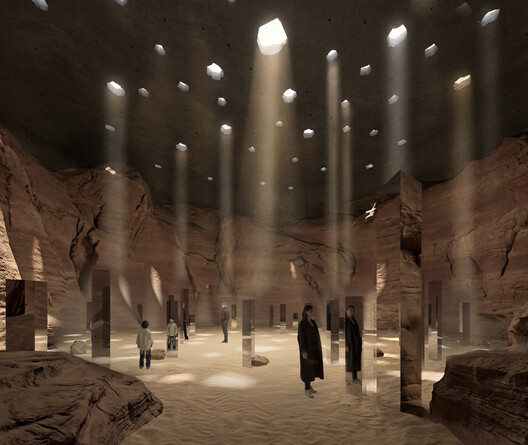
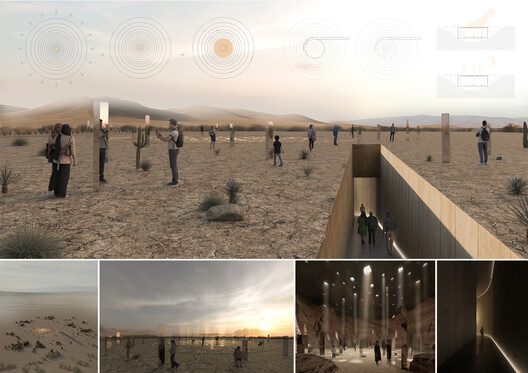
This project proposes a sunken memorial space embedded within the desert landscape, contrasting the vast openness of the terrain with a subterranean chamber of reflection. At surface level, mirrored pillars are arranged in a radial composition, capturing light and fragmenting views to evoke the disorientation of a site marked by trauma. Visitors descend into the earth via a narrow cut in the ground, entering a contemplative void perforated by shafts of daylight. These apertures serve as both markers above and conduits of light below, transforming the surface into a perceptual membrane through which the past is quietly acknowledged. Rather than replicating the violence of nuclear detonation, the architecture reframes the landscape into a sensory archive, revealed gradually through material restraint, movement, and light.
3rd Prize Winner
Project title: The Silence Beneath
Authors: Frederic Gapinski, from New Zealand
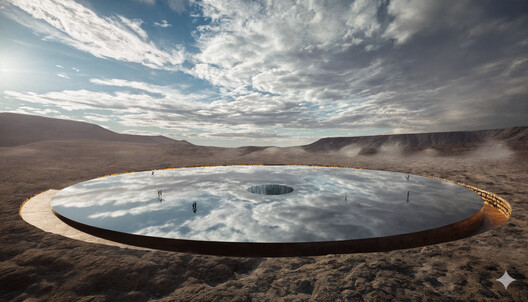
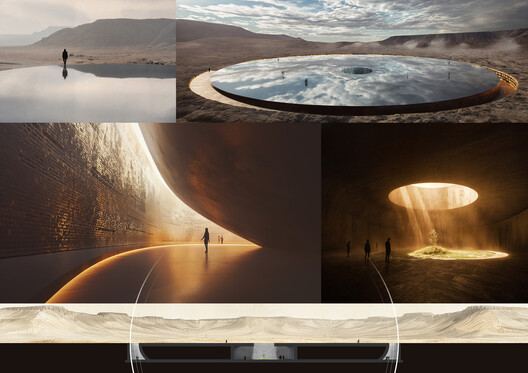
This project presents a crater-like ring in the desert, where a vast mirrored disc rests gently upon the landscape, encircling a central oculus that reveals a subterranean chamber below. The experience begins with a reflection (of sky, of self, of environment) before drawing visitors inward through a gentle descent beneath the reflective surface. Below, a solitary tree bathed in daylight becomes the focal point: a symbol of fragility, resilience, and rebirth. The project balances monumentality and minimalism, using light, geometry, and material contrast to evoke both the devastation of past violence and the quiet persistence of life. It is at once an eye upon the Earth and a wound within it, simultaneously observing and healing.
Buildner Student Award
Project title: The Remains, the Sound and the Wound
Authors: Tất Sĩ Minh Lê, Tra My Do Nguyen, Minh Phú Nguyễn, of Ho Chi Minh City Architecture University, Vietnam
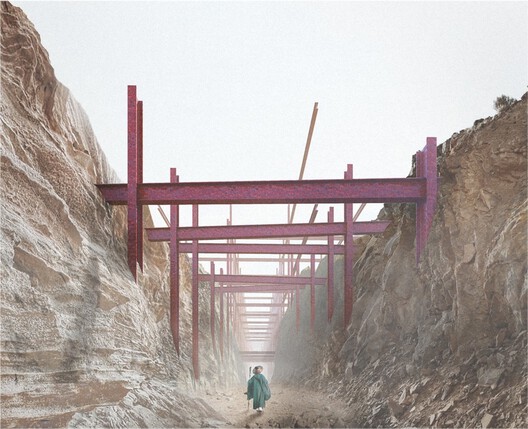
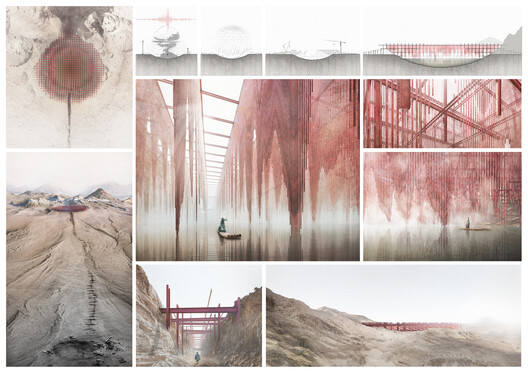
This project introduces a haunting linear incision across the desert terrain, culminating in a vast field of red structural members suspended above a flooded crater. The architecture acts as both wound and prosthesis: a gridded scaffold that hovers delicately over a landscape marked by violence. From afar, the installation resembles a cauterized scar; from within, the dense vertical elements form a visceral and immersive spatial experience, evoking blood, roots, or even flames. Water plays a central role—both as mirror and barrier—introducing reflection, distortion, and a sense of uncertainty. Visitors navigate the space by raft, moving through the suspended elements with reverence. This is not a space to observe from above, but to inhabit slowly and bodily, where scale is overwhelming and time seems suspended.
Honorable Mentions
Project title: Salt & Stone
Author: Abraham Chintianto, Indonesia
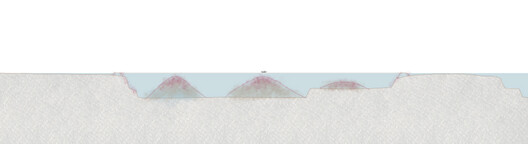
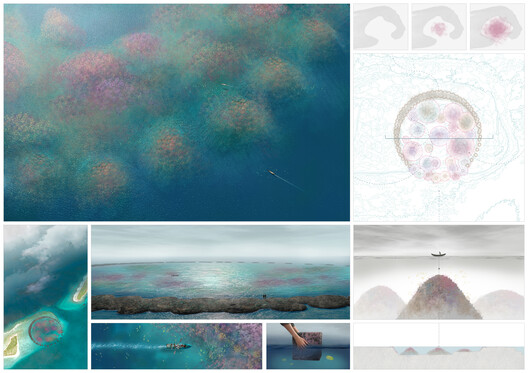
Salt & Stone reimagines the site of nuclear devastation as a submerged field of delicate, cloud-like formations that drift just beneath the water's surface. Drawing from the destructive image of the atomic blast, the project transforms it into a dispersed, living landscape where color, light, and movement replace violence with quiet regeneration. Circular clusters emerge as soft underwater blooms, visible from above as shifting patterns and experienced at the surface as subtle traces of life and memory. Visitors engage the site from a distance or by boat, observing how the forms dissolve and reappear with changing light and tide. Rather than marking absence through monumentality, the proposal diffuses memory across a fluid environment, allowing time, nature, and perception to gently reshape the narrative of destruction into one of healing and continuity.
Project title: Beyond the Flowers
Author: Valentina Fesenko, Budapest University of Technology and Economics, Hungary
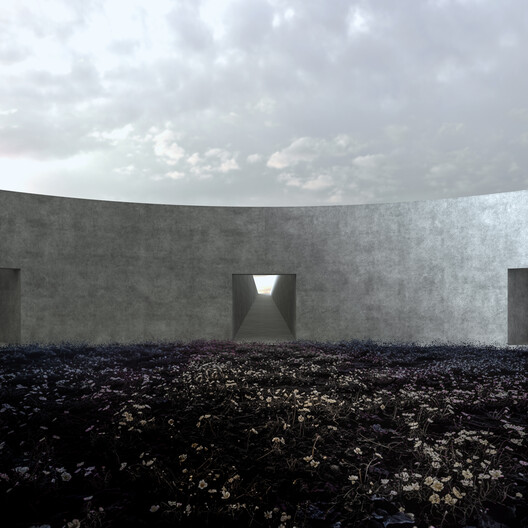
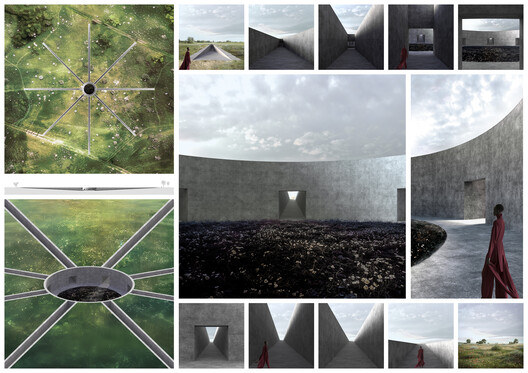
Beyond the Flowers presents a quiet yet powerful memorial landscape organized around a central void, from which a series of linear paths radiate outward across an open field. From above, the geometry recalls the imprint of an explosion, but on the ground it unfolds as a sequence of restrained, introspective spaces. Visitors enter through narrow, descending corridors that gradually remove the surrounding context, leading toward a circular chamber where darkness, silence, and a field of fragile vegetation create a space for reflection. The contrast between the ordered exterior and the immersive interior reinforces a journey from exposure to introspection. Rather than representing destruction directly, the project frames memory through absence, spatial compression, and the delicate persistence of life, allowing visitors to confront loss while sensing the quiet possibility of renewal.
Project title: Fragments of Memory
Author: Carlos Manuel Da Silva Bessa Pinto and Ana Leonor Peixoto Nogueira, Bessa Pinto Arquitetos, Portugal
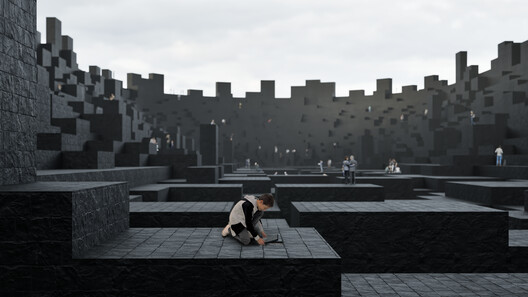
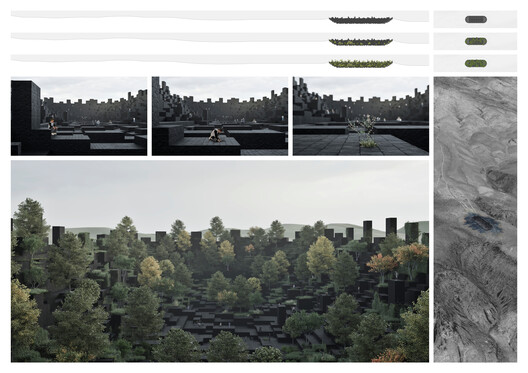
Fragments of Memory constructs a contemplative landscape of fragmented forms that emerge from the ground as a field of dark, monolithic volumes. Organized as a dispersed terrain of blocks and voids, the project evokes the rupture and disintegration associated with nuclear events, while creating a spatial framework for reflection and movement. Visitors navigate across a shifting topography of platforms and passages, where moments of stillness are punctuated by subtle interventions of vegetation that gradually reclaim the site. Over time, the rigid geometry softens as nature infiltrates the composition, transforming absence into growth. The project balances permanence and change, using fragmentation as both a formal language and a narrative device to express memory, loss, and the slow process of healing.
Project title: Shadow of a City
Author: Aleksa Milojevic, United States
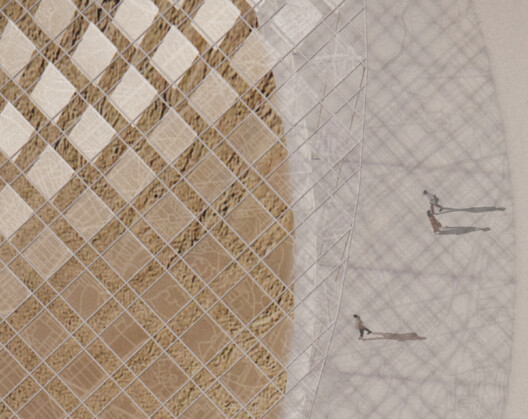
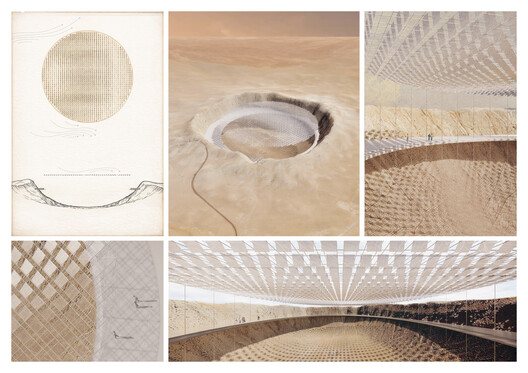
Shadow of a City transforms a vast crater into a suspended field of light and shadow, where a delicate overhead grid hovers above the scarred landscape. The intervention frames the void without filling it, allowing the memory of destruction to remain present while introducing a new atmospheric layer that shifts with time and sun. Visitors circulate along a perimeter path, suspended between ground and sky, experiencing the crater as both absence and stage. The grid above casts a constantly changing pattern across the terrain, evoking the imprint of a vanished city and the lingering traces of human presence. Rather than reconstructing what was lost, the project projects its shadow—using light, repetition, and void to create a contemplative space where memory is held in suspension.
Project title: After the Last Wind
Author: Fang Guo, United States
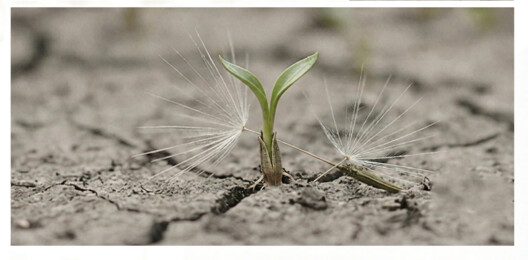
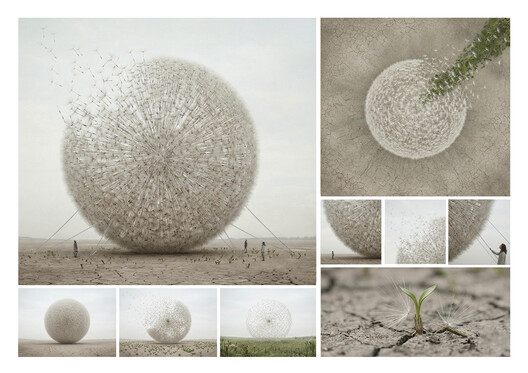
After the Last Wind transforms the destructive force of the nuclear blast into a fragile, transient monument inspired by the form of a dandelion seed head. A large spherical structure composed of delicate, filament-like elements stands lightly upon the landscape, gradually dispersing over time through wind and interaction. As the structure releases its components, seeds scatter across the site, initiating cycles of growth and regeneration that slowly reclaim the scarred ground. The project shifts the narrative from instant destruction to slow renewal, using ephemerality and motion as primary design drivers. Rather than fixing memory in a permanent object, it allows remembrance to unfold through time, dispersal, and the quiet persistence of life.
Project title: In Cycles
Author: Oleksii Zolochevskyi and Oleksandra Savchuk, Ukraine
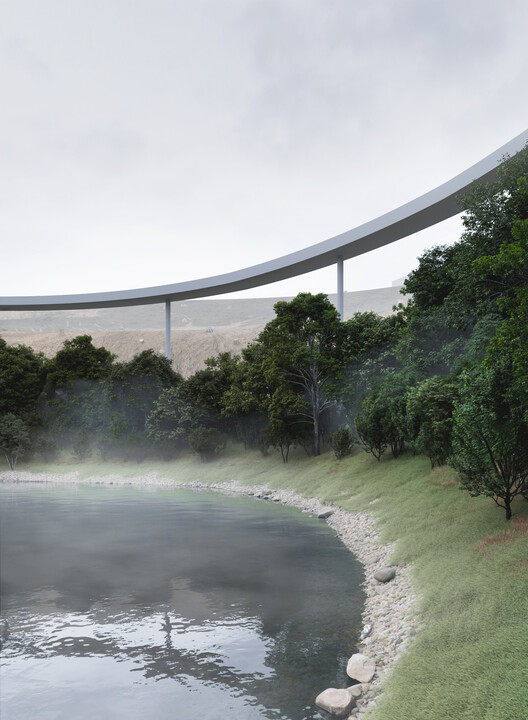
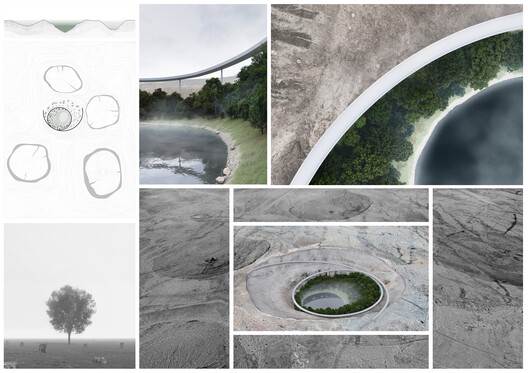
In Cycles reinterprets the nuclear crater as a landscape of gradual ecological renewal, structured around a circular intervention that frames a protected inner environment. A continuous ring traces the edge of the scar, guiding visitors along a quiet path while enclosing a regenerating forest and water body at its center. The project emphasizes time as a primary design element, allowing natural processes to reclaim and transform the damaged terrain. As visitors move along the elevated perimeter, they observe the contrast between barren surroundings and the slowly evolving life within. Rather than imposing a fixed monument, the design creates a living system where cycles of decay and growth become the memorial itself, expressing resilience through the patient return of nature.


