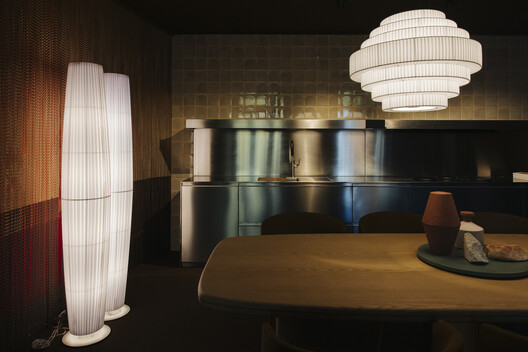
Interpreting the contemporary habitat is a priority for architects and designers worldwide. Amid shifting trends, stylistic blends, and the revival of different techniques, contemporary interior design brings together materials, textures, and colors to transform the user experience. Within the domestic realm, a series of realities, tensions, and activities unfold, with design serving as a strong foundation and support system to meet the needs of its inhabitants. During Milan Design Week 2026, ICEX and Elle Decor Italia presented the fourth edition of Appartamento Spagnolo—a spatial framework created to showcase contemporary Spanish interior design within a historic context.
While contemporary practice does not draw from a single source of inspiration in the same way as modernism or postmodernism, it reveals clear trends, such as the use of sustainable materials, the integration of new technologies, and the reimagining of architectural elements. From the work of Philippe Starck to Patricia Urquiola, professionals today draw on personal aspirations and cross-disciplinary influences throughout the creative process, proving there is no single way to conceive or carry out a project. Reflecting on a creator's social responsibility, Philippe Starck stated in an interview with ArchDaily that "creativity is the best result for human intelligence," suggesting that design's ultimate responsibility is to improve life for the many.
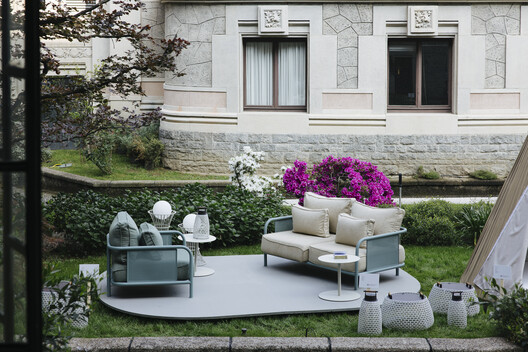
This philosophy is reflected in the exhibition design by Milan-based Studiopepe, which transformed the Palazzo Castiglioni into a temporary domestic sequence. Organized by Interiors from Spain and curated by Elle Decor Italia, each exhibition area was assigned a specific domestic function, occupying several rooms of the palace, including Sala Pavoni, Sala Sommaruga, Sala Liberty, the central circulation areas, the winter garden, and the courtyard. Based on a continuous spatial configuration composed of six main atmospheres, the design strategy focused on subdividing spaces through lightweight, reversible elements.
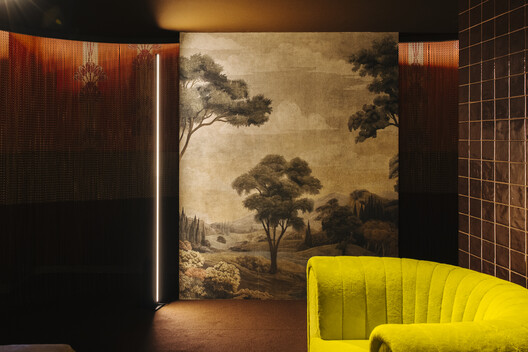
Studiopepe founders Arianna Lelli Mami and Chiara Di Pinto conceived the project as a "house within a house," asserting a contemporary identity against the palace's ornate backdrop. Once inside, the layout is organized as a series of independent volumetric units defined by curved, organic geometries. This approach establishes a dual spatial system: the rigid architectural framework of the past hosting the fluid, temporary volumes of the present.
Each atmosphere corresponded to a domestic program, including living, dining, kitchen, bedrooms, and bathrooms, as well as transitional and intermediary areas. The layout followed a non-linear circulation path that connected all spaces through gradual transitions rather than fixed corridors.
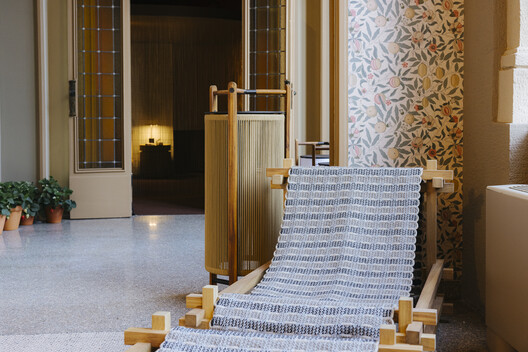
Acting as the primary dividing elements, semi-transparent metal mesh curtains were installed to define boundaries without enclosing the spaces. These permeable partitions allowed for visual continuity between rooms while simultaneously guiding access and circulation. In the winter garden, the intervention remains light, preserving existing architectural elements while introducing modular furniture as non-permanent additions. This area functioned as a transition between the historic building and the temporary installation.
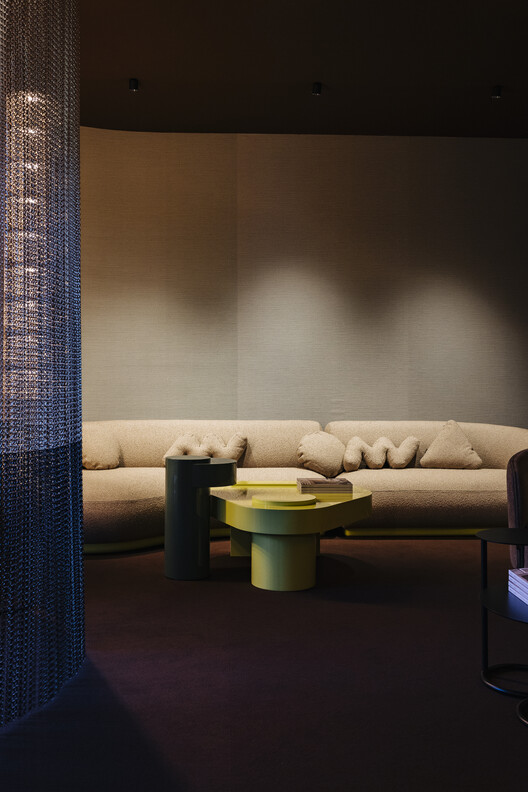
To ensure spatial continuity, the material palette follows a controlled color system across all rooms. Base tones of dark brown and chocolate provide a grounded foundation, accented by subtle contrast of pastel green and acid yellow. Meanwhile, lighting was integrated into the architectural design to enhance depth and layering. Ambient and task lighting systems were used to emphasize transitions between spaces and highlight changes in materials across surfaces, textiles, and ceramic applications.
The installation features contributions from an extensive collective of Spanish brands: Agora, Alexandra, Ape Group, Arkoslight, Arturo Álvarez, Bover, Cevica, Coordonné, Cosentino, Crevin, Decocer, Gandia Blasco, Hisbalit, Isimar, Kriskadecor, Maora Ceramic, Martínez Cardona, Mobalco, Mobboli, Roca, Sancal, and SKLD Studio. Rather than being treated as isolated objects, each piece is integrated into the spatial configuration, functioning as part of a cohesive living system.
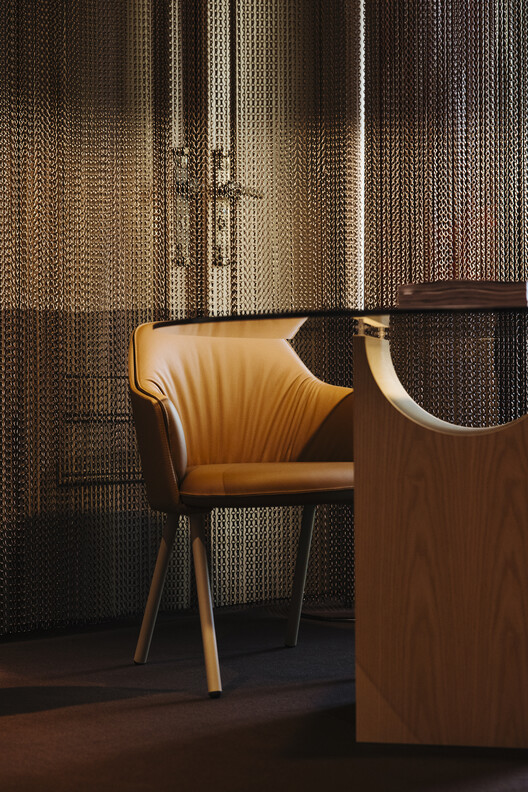
Appartamento Spagnolo demonstrates a system of "reversible architecture" by combining architecture, interior design, and product exhibition into one unified space based on subdivision, permeability, and material integration. Lightweight structures, modular components, and demountable partitions are used throughout the project. Guided by the principle of discovery, the project interprets the contemporary habitat by creating intimate atmospheres with a distinct character of their own.


